



Alaska Park Science: USGS and National Park Service Partners in Research
The latest issue of Alaska Park Science features articles on collaborative research between USGS and NPS scientists in park units across Alaska, building a body of science that informs a variety of disciplines as well as park management.
USGS Guest Editors
Sarah M. Laske is a Research Fish Biologist at the USGS Alaska Science Center. She studies aquatic communities, pursuing questions about how the environment affects biodiversity and food webs. She has studied aquatic ecosystems in the Arctic and subarctic since 2011, studying at the University of Alaska Fairbanks, earning her Ph.D. in 2017. Her science is collaborative to provide information to support decision making.
Jeffrey D. Muehlbauer is the Unit Leader of the USGS Alaska Cooperative Fish and Wildlife Research Unit and an Assistant Professor of Fisheries at the University of Alaska Fairbanks. He is a river ecologist who studies how stream, river, and lake habitat conditions affect food webs and fisheries. He mentors graduate students and designs research to meet the needs of land management partners statewide, including studies on water quality, mining, and restoration within Alaska’s national parks
Christian E. Zimmerman is the Director of the USGS Alaska Science Center. He has contributed to various research topics including the population structure of salmonids and the migratory histories of Chinook salmon. His research has been pivotal in understanding the impacts of climate change on Arctic ecosystems.
Articles Featured in Alaska Park Science
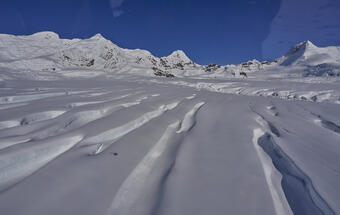
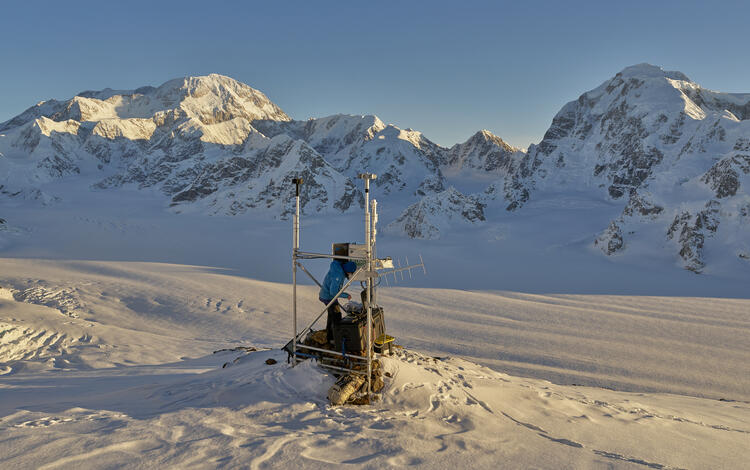
Brewing Change in the (Glacier) Percolation Zone
Authors: Louis Sass, Christopher McNeil, Emily Baker, and Zanden A. Frederick, Alaska Science Center, U.S. Geological Survey; Michael Loso, Wrangell-St. Elias National Park and Preserve, National Park Service
Alaska’s glaciers are losing mass at the fastest rate of any region globally, significantly affecting both the volume and distribution of water across the landscape. While most studies measure mass changes in the ablation and wet snow zones of glaciers, our work also studies the higher-elevation percolation zone to understand how changing processes will influence larger glaciers.
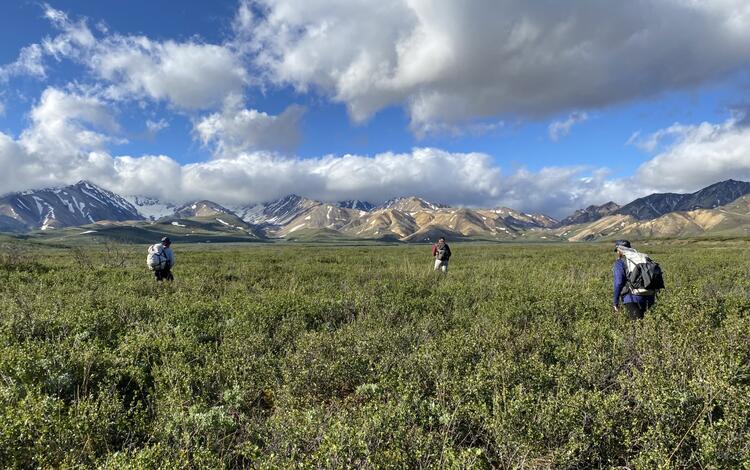
Monitoring for the Future of Central Alaska Streams
Authors: Caleb J. Robbins, Baylor University and University of Alaska Fairbanks; Trey Simmons, Central Alaska Network, National Park Service; Thomas F. House, University of Alaska Fairbanks; Jeffrey D. Muehlbauer, Alaska Cooperative Fish and Wildlife Research Unit, University of Alaska Fairbanks and U.S. Geological Survey
Streams are good indicators of change and the health of watersheds. By monitoring stream chemical composition and the kinds of life they support, we can learn about how they are being stressed (by activities such as mining or climate change) or recovering from a stress (after restoration efforts). But Central Alaska watersheds and the natural stream conditions they produce are diverse. From long-term monitoring, and repeat measurements, we can start to understand the related baselines and fine-tune our understanding of changes.
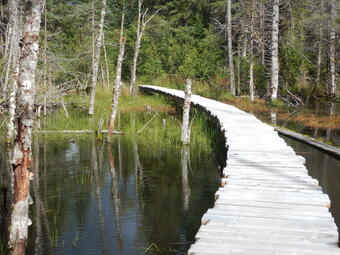
Understanding Flooding and Channel Dynamics Along the Taiya River: Providing Context for Resource Management
Author: Janet H. Curran, Alaska Science Center, U.S. Geological Survey
Flooding and channel change in the Taiya River Basin in recent decades have directly affected park infrastructure and cultural resources. The complexities of flooding and channel change are compounded by the changing sediment and flow regime from a changing climate and shrinking glaciers, which will continue to drive dynamic riverine change. Streamflow data and geomorphic interpretation helped us place these events in context to inform decision making that takes dynamic natural processes into account.
Using Long-term Monitoring Data to Understand Lake Water Quality Trends in Southwest Alaska National Parks
Authors: Matthew R. Dunkle, Institute of Arctic Biology, University of Alaska Fairbanks; Krista K. Bartz, Southwest Alaska Network, National Park Service; Paul W. C. Gabriel, Alaska Department of Environmental Conservation; Jeffrey D. Muehlbauer, Alaska Cooperative Fish and Wildlife Research Unit, U.S. Geological Survey
Lakes are vital ecosystems in southwest Alaska, supporting Pacific salmon, wildlife, and people. The diverse landscapes of Southwest Alaska include volcanic uplands, glacier-fed valleys, and tundra, all of which combine to influence temperature, water quality, and critical uses of regional lakes. Through long-term sampling of lakes from the surface to deep waters, we track how the environment governs lake water quality.
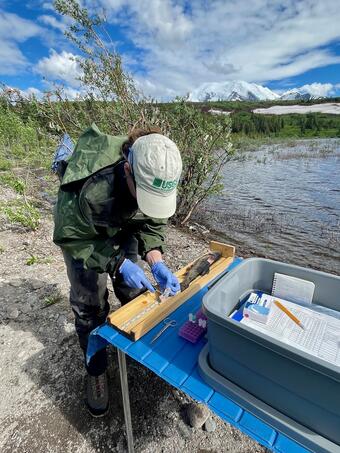
Investigating the Role of Lake Environments and Food Chains on the Transfer of Mercury to Lake Trout
Authors: Sarah Laske, Alaska Science Center, U.S. Geological Survey; Krista Bartz, Southwest Alaska Network, National Park Service; Dan Young, Lake Clark National Park and Preserve, National Park Service
Mercury contamination can pose threats to fish, wildlife, and people. Methylmercury, found in fish, can be particularly detrimental, especially to children. This study explores the sources and concentrations of mercury and proposes how people can become aware and limit their exposure.
The Tracing Mercury Through Lake Food Webs project was featured in KTNA’s Six Minute Science program.
Hyperabundance of a Native Species: Pink Salmon in Sitka National Historical Park
Authors: Brian McGreal, Quantitative Ecology and Resource Management, University of Washington; Scott Gende, Alaska Region, National Park Service; Mark Scheuerell, School of Aquatic and Fishery Sciences, University of Washington and Washington Cooperative Fish and Wildlife Research Unit, U.S. Geological Survey; Thomas Quinn, School of Aquatic and Fishery Sciences, University of Washington
Hyperabundance of native species within their natural range can pose a difficult management challenge. This study examines the case of pink salmon in Sitka National Historical Park’s Indian River. Though native to the river, numbers of pink salmon returning to spawn in late summer have grown exponentially in recent decades, putting other fish species that are reliant on the river at risk. This article explores the drivers and context of this hyperabundance.
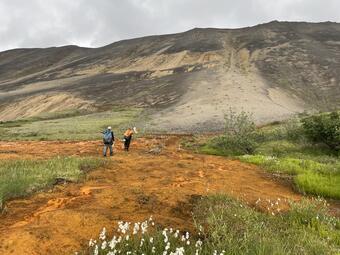
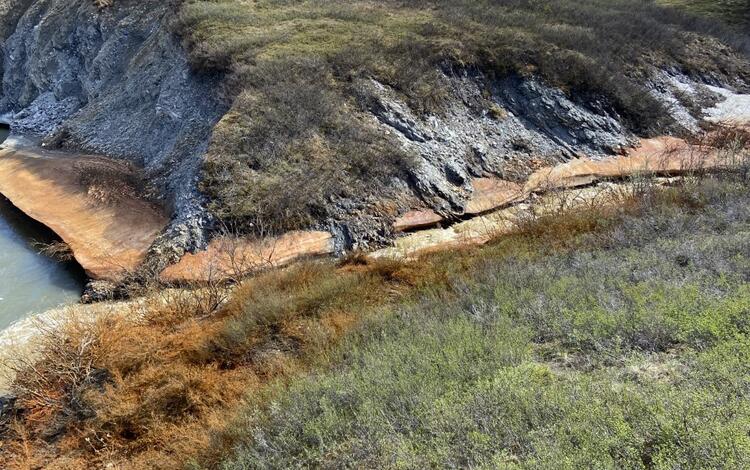
Exploring How Dolly Varden in Arctic Streams Respond to Changes from Permafrost Thaw
Authors: Michael P. Carey and Joshua C. Koch, Alaska Science Center, U.S. Geological Survey; Jonathan A. O’Donnell and Kenneth Hill, Arctic Network, National Park Service; Brett A. Poulin, Department of Environmental Toxicology, University of California, Davis
The influence of permafrost thaw on aquatic ecosystems is complex. Carbon, nutrients, and metals in stream discharge result in changing stream color, chemistry, and temperature. These different processes create a mosaic of spatially and temporally dynamic disturbances across the landscape with complex effects on the ecology.
Intertidal Community Responses to Perturbations Along Alaska Park Coastlines
Authors: Sarah B. Traiger, Brenda Ballachey, and Daniel Esler, Alaska Science Center, U.S. Geological Survey; Heather A. Coletti, Southwest Alaska Network, National Park Service
Nearshore ecosystems are highly productive zones with strong connections to both terrestrial and open ocean ecosystems. The rocky intertidal is a highly dynamic ecosystem and changes over a variety of spatial and temporal scales depending on the factors contributing to the change. Here we summarize how nearshore communities and species responded to several perturbations to intertidal communities within Alaska’s coastal national parks.
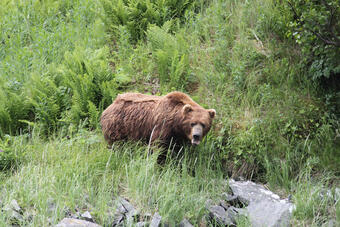
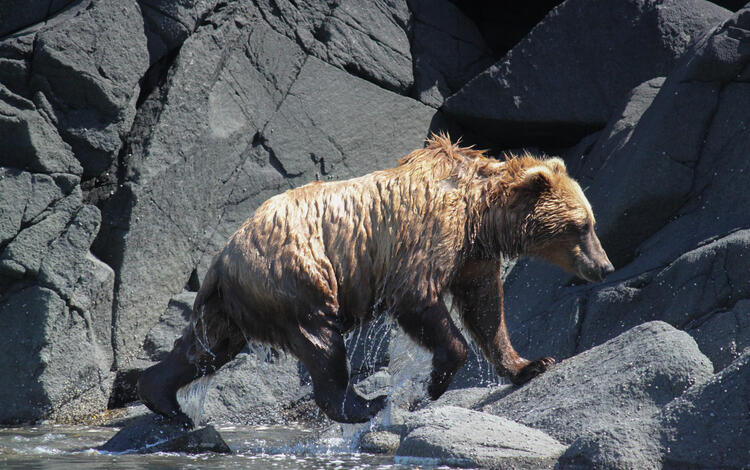
Connecting the Dots: Using Multiple Datasets to Monitor the Brown Bear Population in Katmai National Park and Preserve
Authors: Leslie C. Skora, Katmai National Park and Preserve, National Park Service; Tammy L. Wilson, Massachusetts Cooperative Fish and Wildlife Research Unit, U.S. Geological Survey
Monitoring wide-ranging wildlife populations is challenging. Surveys are time consuming, expensive, and observation conditions need to be just right. But confidently assessing the number of animals, and if their numbers are increasing or decreasing is important for park management and ecological understanding. This article describes survey methods and how they can be combined for the most accurate estimates.
Incorporating Local and Indigenous Knowledge into Subsistence Management: A Katmai Caribou Case Study
Author: Dillon Patterson, Sealaska Heritage Institute (formerly National Park Service)
This article is an example of how the ethnographic documentation of local and Indigenous knowledge can help parks make more informed decisions. Small, resident caribou populations are important to subsistence communities. These populations are already under environmental stress, and people who depend on them have insights that can help