Population dynamics
Department of Interior partner agencies require information on Pacific walrus survival, reproduction, population abundance, and population trend to inform management decisions and address statutory responsibilities.
US and Russian partners conducted aerial surveys in 1975, 1976, 1980, 1985, and 1990 to estimate population abundance. In 2006, USGS collaborated with US Fish and Wildlife Service (USFWS) and Russian partners to estimate population abundance from an offshore aerial survey that accounted for the proportion of walruses that were in-water and therefore unavailable to be counted, and was the first to rigorously account for uncertainty in the population abundance estimate.
Because these offshore survey efforts resulted in large uncertainty in the estimated population size, development began on alternative abundance estimation methods. The USFWS has led an effort, with USGS support, to estimate Pacific walrus population abundance using genetic mark-recapture methods. USGS efforts developing methods to determine sex and age of walruses from remotely collected biopsies support this effort.
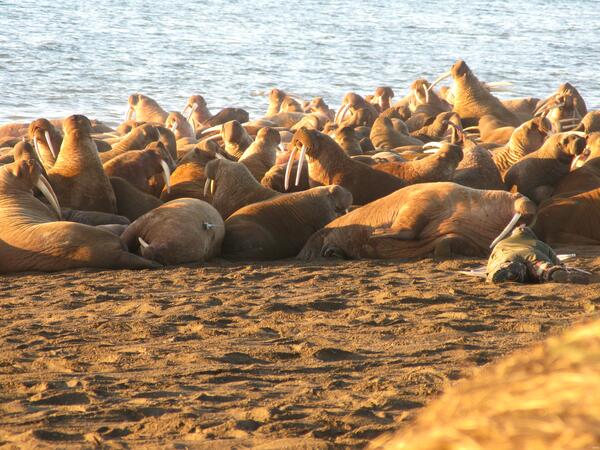
USGS developed methods to estimate regional population size at a large coastal haulout and has refined these methods through use of unoccupied aerial systems (UAS or survey drones) through support of the USGS National Uncrewed Systems Office to estimate the regional walrus abundance in the U.S. Chukchi Sea autumn waters during 2018 and 2019.
Age structure surveys provide information on population demographics required by USFWS statutory responsibilities under the Marine Mammal Protection Act (MMPA). In the 1950’s, F.H. Fay pioneered methods for collecting walrus sex and age structure data by observing facial and tusk characteristics. These methods were applied to collect age structure data on offshore surveys from 1981-1999 with Department of the Interior support. The State of Alaska’s Department of Fish and Game evaluated these methods and found them to provide invaluable information on population demographics.
USGS developed integrated population models that estimated Pacific walrus survival, reproduction, and population trend. These models used all available age structure and population survey data to estimate population parameters required by the MMPA. These models found the age structure data to strongly influence estimated population trends, prompting USGS and FWS with support from the Alaska Department of Fish and Game to collect additional age structure data during 2013 - 2017.
USGS is pursuing further age structure data collection beginning in 2023. Development of integrated population models has allowed USGS and collaborators to evaluate threats posed to the Pacific walrus population from climate related changes in the Arctic. For example, an increase in deaths of young walruses resulting from disturbances at large coastal haulouts can affect population trend.