



Connecting Conservation Practices to Local Stream Health in the Chesapeake Bay Watershed
Conservation practices, including those called management practices or best management practices, are implemented throughout the Chesapeake Bay watershed to target environmental effects of both agricultural and urban development, including nutrient and sediment delivery to the Bay. This study provides an interdisciplinary understanding of how local streams respond to these conservation practices.
⇒ Key issue: To what extent do conservation practices positively affect the ecological health of local streams in nontidal watersheds?
Critical knowledge to be delivered to stakeholders includes—
- the effects of conservation practices on local water quality conditions,
- the degree to which these same conservation practices also benefit local stream ecosystems, and
- a deeper understanding of local stream ecosystems to guide the selection of management efforts that enhance both water quality and overall ecosystem health
A Holistic Approach to Investigating the Influence of Conservation Practices
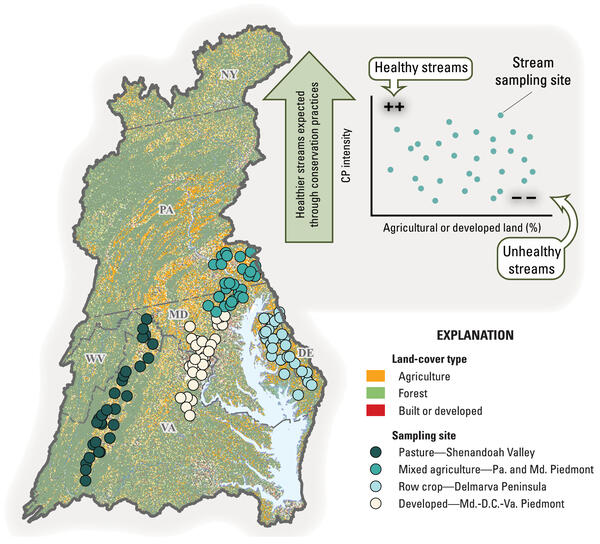
Management actions in the Chesapeake Bay watershed are focused primarily in areas contributing high nutrient and sediment loads and other forms of ecosystem degradation. This study targeted the following important Chesapeake Bay watershed landscapes for year-long assessments: pasture in the Shenandoah Valley, row crops in the Delmarva Peninsula, mixed agriculture in the Pennsylvania and Maryland Piedmont, and the developed Maryland-District of Columbia-Virginia corridor (fig. 1).
In each of these landscapes, 30 streams were selected that represent gradients of land use and the intensity of conservation practice implementation in the upstream watershed. The expectation is that these practices lessen the impacts of land use intensity, and stream health responds accordingly.
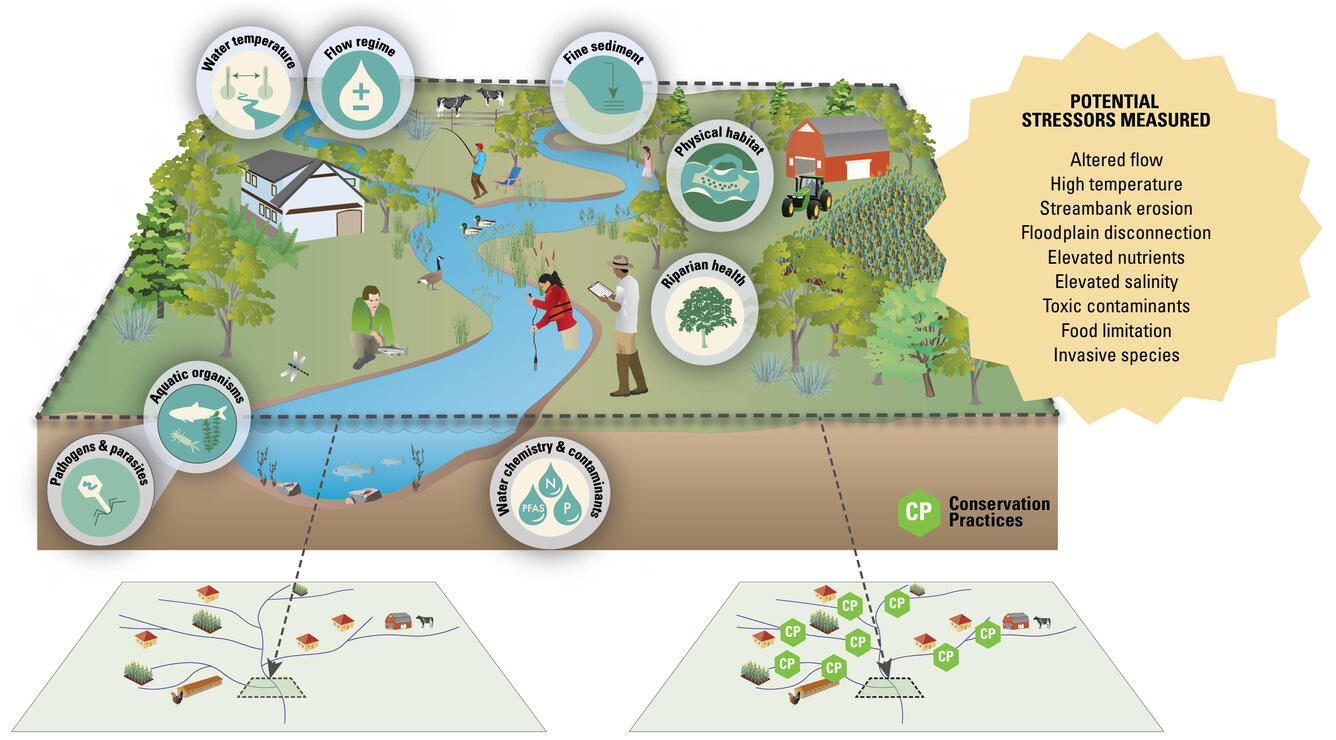
A holistic ecosystem approach was used, measuring the upstream drivers (including land use and other key ecosystem characteristics such as underlying geology) to contextualize the effect of conservation practices on different domains of stream ecosystem health (fig. 2). Stream measurements included water quality and contaminants, fish, macroinvertebrates, hydrology, and stream habitat (including in-channel geomorphology and riparian habitat). This research can evaluate whether rates of conservation practice implementation influence stream ecosystem health holistically, the effects of land use, and provide new understanding of which practices are most effective.
Primary Contacts
Greg Noe, gnoe@usgs.gov
Research Ecologist
Florence Bascom Geoscience Center
Tom Doody, tdoody@usgs.gov
Physical Scientist and Laboratory Manager
Florence Bascom Geoscience Center
Molly Huber, mhuber@usgs.gov
Physical Scientist and Laboratory Manager
Florence Bascom Geoscience Center
Science and Communication and Synthesis Teams
The stream team principal investigators for this study are Greg Noe (lead), Paul Angermeier, Olivia Devereux, Sally Entrekin, Rosemary Fanelli, Jeramy Jasmann, Kelly Maloney, Tristan Mohs, Rebecca O'Brien, Kelly Smalling, Charlie Stillwell, and Ty Wagner.
Acknowledgments
This study would not have been possible without the generous support of private, nonprofit, and public landowners, who granted scientists access so that they could study the streams and riparian areas. We are sincerely grateful for their generosity. Numerous stakeholders charged with implementing conservation practices helped us connect with these landowners and better understand local stream issues and their information needs to better manage their watersheds. Finally, we thank the many scientists who dedicated their expertise to this study. U.S. Geological Survey (USGS) Chesapeake Bay Activities supports this work and is a partnership between scientists from the USGS and Virginia Tech.

Connecting Conservation Practices to Local Stream Health in the Chesapeake Bay Watershed
Conservation practices, including those called management practices or best management practices, are implemented throughout the Chesapeake Bay watershed to target environmental effects of both agricultural and urban development, including nutrient and sediment delivery to the Bay. This study provides an interdisciplinary understanding of how local streams respond to these conservation practices.
⇒ Key issue: To what extent do conservation practices positively affect the ecological health of local streams in nontidal watersheds?
Critical knowledge to be delivered to stakeholders includes—
- the effects of conservation practices on local water quality conditions,
- the degree to which these same conservation practices also benefit local stream ecosystems, and
- a deeper understanding of local stream ecosystems to guide the selection of management efforts that enhance both water quality and overall ecosystem health
A Holistic Approach to Investigating the Influence of Conservation Practices
Management actions in the Chesapeake Bay watershed are focused primarily in areas contributing high nutrient and sediment loads and other forms of ecosystem degradation. This study targeted the following important Chesapeake Bay watershed landscapes for year-long assessments: pasture in the Shenandoah Valley, row crops in the Delmarva Peninsula, mixed agriculture in the Pennsylvania and Maryland Piedmont, and the developed Maryland-District of Columbia-Virginia corridor (fig. 1).
In each of these landscapes, 30 streams were selected that represent gradients of land use and the intensity of conservation practice implementation in the upstream watershed. The expectation is that these practices lessen the impacts of land use intensity, and stream health responds accordingly.
A holistic ecosystem approach was used, measuring the upstream drivers (including land use and other key ecosystem characteristics such as underlying geology) to contextualize the effect of conservation practices on different domains of stream ecosystem health (fig. 2). Stream measurements included water quality and contaminants, fish, macroinvertebrates, hydrology, and stream habitat (including in-channel geomorphology and riparian habitat). This research can evaluate whether rates of conservation practice implementation influence stream ecosystem health holistically, the effects of land use, and provide new understanding of which practices are most effective.
Primary Contacts
Greg Noe, gnoe@usgs.gov
Research Ecologist
Florence Bascom Geoscience Center
Tom Doody, tdoody@usgs.gov
Physical Scientist and Laboratory Manager
Florence Bascom Geoscience Center
Molly Huber, mhuber@usgs.gov
Physical Scientist and Laboratory Manager
Florence Bascom Geoscience Center
Science and Communication and Synthesis Teams
The stream team principal investigators for this study are Greg Noe (lead), Paul Angermeier, Olivia Devereux, Sally Entrekin, Rosemary Fanelli, Jeramy Jasmann, Kelly Maloney, Tristan Mohs, Rebecca O'Brien, Kelly Smalling, Charlie Stillwell, and Ty Wagner.
Acknowledgments
This study would not have been possible without the generous support of private, nonprofit, and public landowners, who granted scientists access so that they could study the streams and riparian areas. We are sincerely grateful for their generosity. Numerous stakeholders charged with implementing conservation practices helped us connect with these landowners and better understand local stream issues and their information needs to better manage their watersheds. Finally, we thank the many scientists who dedicated their expertise to this study. U.S. Geological Survey (USGS) Chesapeake Bay Activities supports this work and is a partnership between scientists from the USGS and Virginia Tech.