



Identifying Spatial and Temporal Trends in Avian Influenza Prevalence in Wild Waterfowl Across the United States
USGS researchers are at the forefront of building and maintaining datasets that represent the spatial and temporal patterns in avian influenza virus prevalence in wild birds, which is critical information used to estimate transmission risk to domestic poultry.
What is the issue?
Wild ducks and geese play a significant role in the ecology of avian influenza, acting as both reservoirs (hosts that carry the virus without showing symptoms) and vectors (organisms that transmit the virus to other species). Although it is known that the prevalence of avian influenza in waterfowl peaks during late summer through autumn, the specific patterns of temporal and spatial variation across different bird species have not been thoroughly characterized.
What is at stake?
Understanding the prevalence of avian influenza in wild waterfowl across time and space provides critical data for efforts to model the risk of transmission to domestic poultry and possible impacts to vulnerable wild bird species.
What is our approach?
USGS researchers combined two large avian influenza sampling databases for North America and applied spatiotemporal models to explore patterns in prevalence throughout the annual cycle and across the continental United States for 30 waterfowl species.
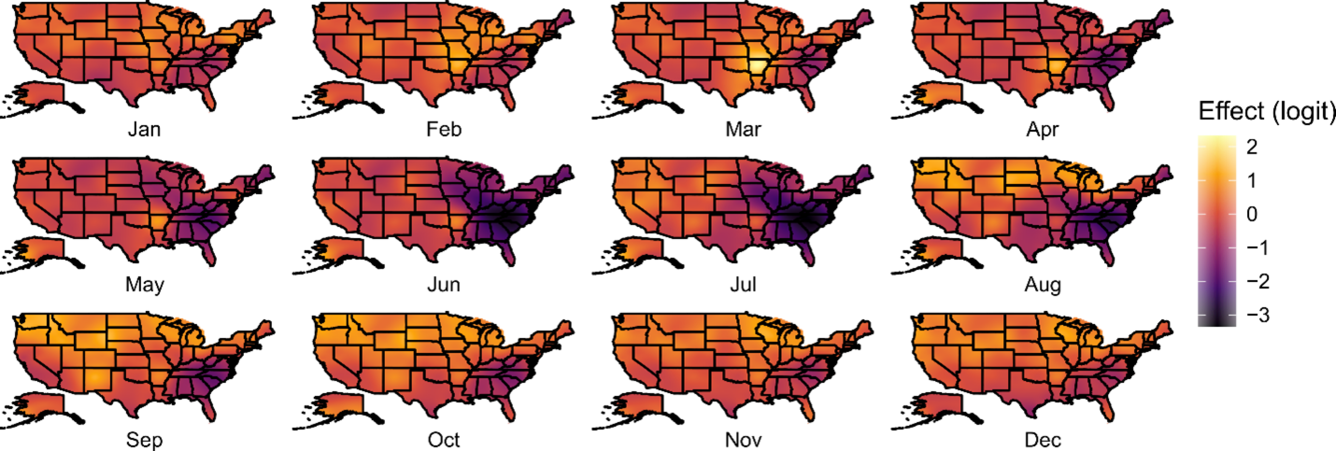
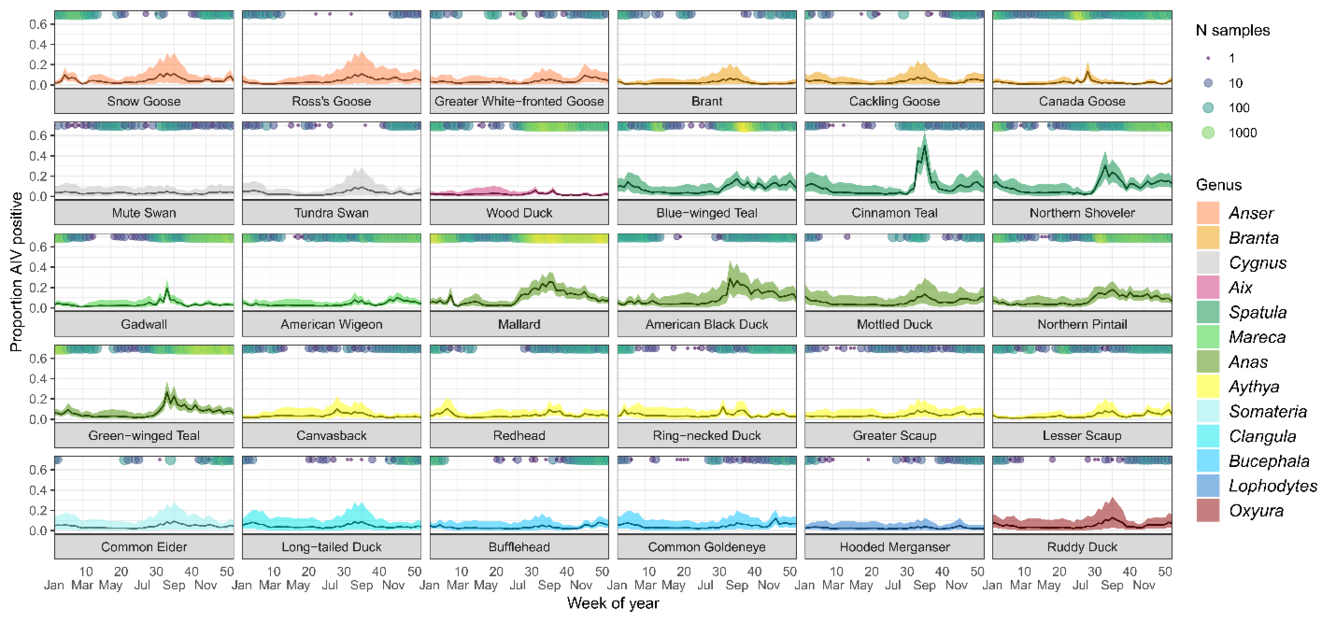
Peaks in prevalence in late summer through autumn were pronounced for dabbling ducks in the genera Anas and Spatula, but not Mareca. Spatially, areas of high prevalence appeared to be related to regional duck density, with highest predicted prevalence found across the upper Midwest during early fall, though further study is needed. We also documented elevated prevalence in late winter and early spring, particularly in the Mississippi Alluvial Valley. Our results suggest that spatiotemporal variation in prevalence outside autumn staging areas may also represent a dynamic parameter to be considered in further research on avian influenza virus ecology and associated risks.
While our initial models provide great insight and have allowed development of timely risk models, they were informed by data collected prior to the introduction of clade 2.3.4.4b viruses into North America in 2021. Given the subsequent changes in viral ecology, USGS is working to update these models to reflect current scenarios.
What are the benefits?
Avian influenza viruses can pose serious risks to agricultural production, human health, and wildlife. USGS research on the prevalence of these viruses in wild waterfowl informs surveillance programs, risk models, and potential impacts to domestic birds and humans. This information is also useful in helping to inform management practices that aim to mitigate avian influenza outbreaks in the United States.
<< Back to Avian Influenza Research at EESC
USGS researchers are at the forefront of building and maintaining datasets that represent the spatial and temporal patterns in avian influenza virus prevalence in wild birds, which is critical information used to estimate transmission risk to domestic poultry.
What is the issue?
Wild ducks and geese play a significant role in the ecology of avian influenza, acting as both reservoirs (hosts that carry the virus without showing symptoms) and vectors (organisms that transmit the virus to other species). Although it is known that the prevalence of avian influenza in waterfowl peaks during late summer through autumn, the specific patterns of temporal and spatial variation across different bird species have not been thoroughly characterized.
What is at stake?
Understanding the prevalence of avian influenza in wild waterfowl across time and space provides critical data for efforts to model the risk of transmission to domestic poultry and possible impacts to vulnerable wild bird species.
What is our approach?
USGS researchers combined two large avian influenza sampling databases for North America and applied spatiotemporal models to explore patterns in prevalence throughout the annual cycle and across the continental United States for 30 waterfowl species.
Peaks in prevalence in late summer through autumn were pronounced for dabbling ducks in the genera Anas and Spatula, but not Mareca. Spatially, areas of high prevalence appeared to be related to regional duck density, with highest predicted prevalence found across the upper Midwest during early fall, though further study is needed. We also documented elevated prevalence in late winter and early spring, particularly in the Mississippi Alluvial Valley. Our results suggest that spatiotemporal variation in prevalence outside autumn staging areas may also represent a dynamic parameter to be considered in further research on avian influenza virus ecology and associated risks.
While our initial models provide great insight and have allowed development of timely risk models, they were informed by data collected prior to the introduction of clade 2.3.4.4b viruses into North America in 2021. Given the subsequent changes in viral ecology, USGS is working to update these models to reflect current scenarios.
What are the benefits?
Avian influenza viruses can pose serious risks to agricultural production, human health, and wildlife. USGS research on the prevalence of these viruses in wild waterfowl informs surveillance programs, risk models, and potential impacts to domestic birds and humans. This information is also useful in helping to inform management practices that aim to mitigate avian influenza outbreaks in the United States.
<< Back to Avian Influenza Research at EESC