



A new framework for guiding management decisions for amphibians in an uncertain future
Amphibians face an uncertain future in the Southern Rocky Mountains. Disease, such as the deadly amphibian chytrid fungus, habitat loss, and drought are all considerable threats to amphibians in the region. A recently developed decision framework aims to assist resource managers in reducing these threats to amphibians.
FORT researchers, in collaboration with Conservation Science Partners, Inc., developed a decision support framework for managing amphibians in an uncertain future. They used boreal toads, a relatively data rich species, as a case study to develop an occupancy model that incorporates multiple threats, including disease and changes in hydrology. The model relies on novel metrics that describe changes in drying patterns of >150 historical boreal toad breeding sites in the Southern Rocky Mountain Region (SRMR). The changes in drying patterns of breeding sites were derived via an analysis of >30 years of Landsat imagery. The model outputs form the basis of a web-based decision support tool that allows managers to visually and quantitatively assess tradeoffs between disease, habitat suitability, and fire risk.
The associated web tool provides information on the probabilities of occupancy, colonization, and extinction under current and future environmental conditions for both boreal toads and the amphibian chytrid fungus at multiple spatial scales (individual breeding pond, toad management units within the SRMR, and across the SRMR as whole). It also includes spatial information on current fire risk, and changes in hydrological patterns at the watershed level over the last thirty years.
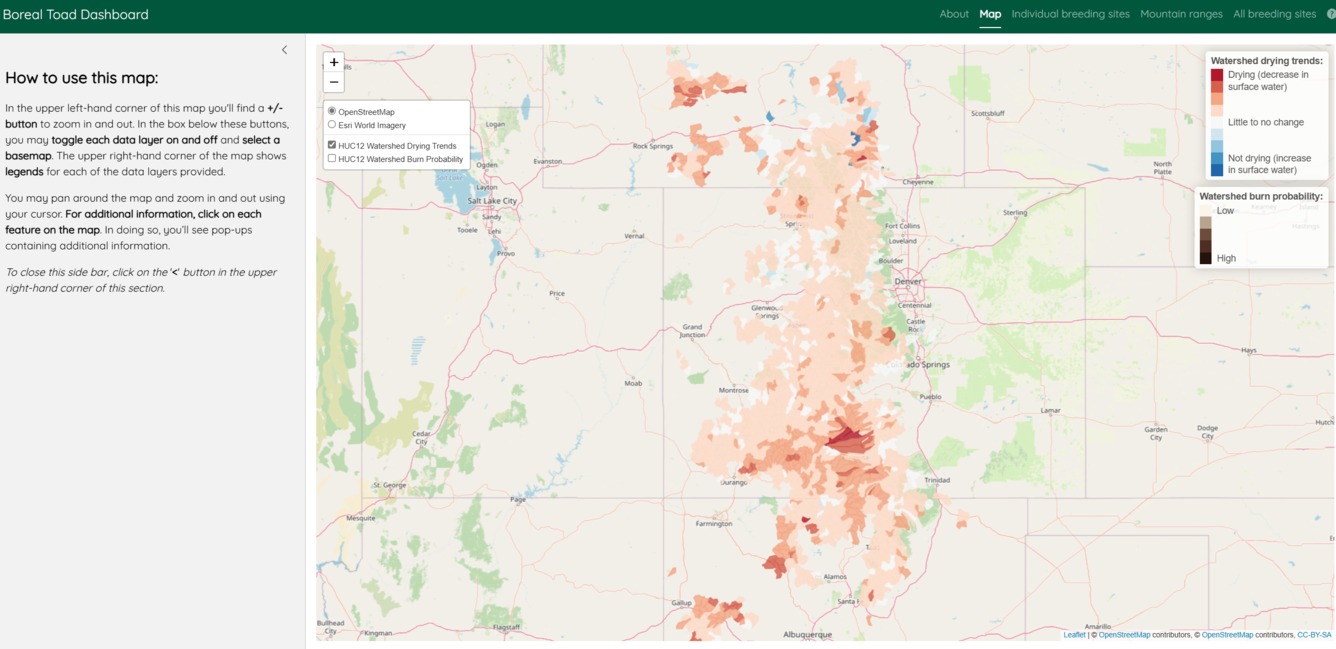
The tool was co-created with the Boreal Toad Conservation Team to help inform decisions regarding habitat management/restoration and reintroduction strategies for populations of boreal toads in the SRMR. USGS researchers also demonstrated the utility of their hydrologic modeling framework to be applied to other amphibians of management concern in the region with sparse data: the wood frog and Great Basin spadefoot toad.
For more information, check out the comprehensive report and the interactive, web-based decision support tool that allows users to engage with the model outputs. The corresponding code and model outputs are also available via a software release and data release, respectively.
Related

A Framework for Guiding Management Decisions for Amphibians in an Uncertain Future
Related