



Dinner denied: cold weather stops invasive python mid-digestion
Burmese pythons have invaded Southern Florida, and USGS researchers are monitoring individuals to understand their feeding behavior and potential for spread to new geographic locations. In a new publication, invasive species scientists describe a one-of-a-kind observation that supports this research: a female python vomiting a deer after a sudden drop in temperature.
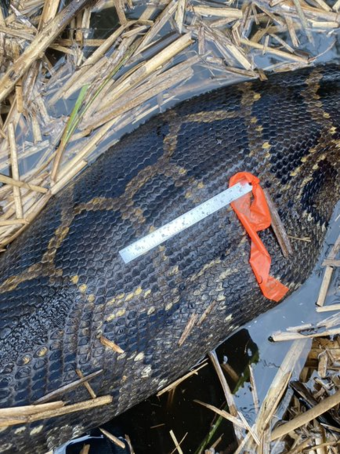
One day, a large python has a deer-sized bulge in its stomach. The next day, that bulge is gone and a partially digested deer lies nearby. As a scientist studying python feeding behavior, your job is to solve this mystery – what made this python lose its lunch?
Burmese pythons are large, constricting snakes, native to Southeastern Asia where they live in a variety of habitats, including swamps, grasslands, rivers, and rainforests. In the 1970s, they were introduced to Southern Florida and rapidly established as an invasive species throughout the Greater Everglades. Since their establishment in Florida, researchers have recorded large declines in mammal populations, including white-tailed deer.
To better understand their feeding behavior and potential effects on ecosystems, USGS researchers and their collaborators have been tracking individual pythons, monitoring what they eat, and how long it takes individuals to digest food. To do this, they track individuals, and measure when snakes feed through observation of new boluses – large, visible lumps in snakes after prey consumption. They measure the size of a bolus to estimate the size of prey, and check back periodically to monitor the timing of digestion.

In November 2024, researchers observed a 16-foot-long python with a large bolus. This individual had previously ingested white-tailed deer on two different occasions with each deer taking about 7 days to be completely digested. Over the course of 10 days, researchers monitored the snake and the bolus had not gotten smaller, as expected if digestion was occurring normally. However, suddenly the bolus completely disappeared from one day to the next. Researchers were shocked to see – and then smell – a partially digested deer in the swamp near the python. Scientists concluded the python had vomited up the deer that morning after examining both the deer carcass and the snake. But why?
Previous studies have found that pythons digest food faster when temperatures are higher, and that pythons will vomit or regurgitate food when temperatures are too high or too low. Knowing this, researchers compared temperatures between the previous feeding events and the vomiting event. During the successful digestions, the temperatures were at an average of 24°C (75°F). However, temperatures were under 16°C (61°F) – the threshold below which pythons cease digestion – for five of the ten days (and at least 10 hours a day) between the first observation of the bolus and the vomiting event. Thus, researchers hypothesize that the vomiting may have been induced by cold temperatures, which stopped the ability of the python to digest the deer.

This is the first observation of a Burmese python naturally vomiting in the wild without human disturbance. While only a single instance, observations like this can generate new hypotheses for scientists to study.
For example, researchers will continue monitoring this individual to see if this vomiting event influences future feeding behavior, health, or reproduction. Observations like this can also help researchers predict invasive species success in new environments. If pythons are unable to digest food in cooler weather, they might be less likely to establish new populations in geographic regions with colder temperatures.
In total, this observation adds to a broader understanding of interactions between the environment and python feeding behavior, and can help researchers develop new studies to inform management of this invasive species.
Related

Invasive Burmese python research in the Greater Everglades
Related