



FORT Science in Action 2026, Part 6: Economics and social science to support wildfire risk management
Wildfires are increasing in frequency and intensity across the Western United States, posing significant risk to public safety and security. FORT scientists aid decision makers in determining which wildfire risk assessment and reduction actions are most needed and valued by the public.
Identifying postfire chains of consequences and interventions


The 2021 Dixie Fire in northern California was one of the most destructive wildfires in California history. A new study describes the process and outcomes of a workshop to identify the chains of effects caused by the fire and postfire conditions on people, buildings, land, and the environment. Led by Fort Collins Science Center, economists and social scientists across USGS hosted the two-day workshop in 2024 where participants identified key concerns emerging from postfire conditions, including effects of the fire that went beyond immediate damage. Workshop participants also discussed actionable strategies to enhance resilience in fire-prone regions, providing suggestions for what could be done before and after future wildfires to reduce risk and potential negative effects. Findings revealed a complex network of interacting consequences, many of which transcended disciplinary boundaries, affected multiple sectors of society, and persisted over time.
Public values of forest restoration for wildfire risk reduction
Large investments in forest restoration for reduced wildfire risks have prompted organizations to ask how the public is benefiting from such investments. Some economic values are relatively straightforward to estimate, like the money saved from not having to repair damaged infrastructure. Other effects of reduced wildfire risk – like improved air or water quality – may not have a clear market dollar value, so economists use other techniques like surveys to determine what value the public places on such benefits.
An economic survey of New Mexico residents living in and outside of the Upper Rio Grande watershed indicates residents were willing to pay for forest restoration that improved air quality, reduced private property damage, and created local jobs. People living within the watershed benefited most from, and were most likely to pay for, forest restoration that supported local job creation and reduced wildfire risk on private property. People living in New Mexico but outside the watershed benefited most from, and were most likely to pay for, restoration that supported local jobs, protected healthy forests and water sources, and reduced wildfire smoke’s harm to air quality.
Improving wildfire risk assessments
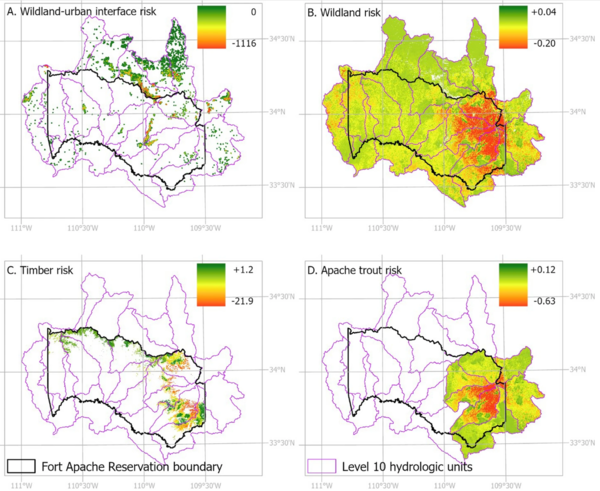
In related work, USGS FORT economists are collaborating with other USGS science centers to improve the practice of assessing wildfire risks. Two additional studies from 2026 highlight important considerations for conducting or understanding the results of wildfire risk assessments.
- One study examined how existing wildfire risk assessments represent the threat that wildfire poses to important resources and assets. This study found some consistent patterns across different assessments but also that supporting information is often not well documented.
- In another study, researchers collaborated with the White Mountain Apache Tribe in Arizona to incorporate Tribal values into a widely used wildfire risk assessment framework. This study demonstrated the conventional framework’s flexibility and ability to accommodate a broad set of values, while also highlighting the sensitivity of results to analysts’ decisions.
More FORT Science in Action
This September, FORT is highlighting how our science projects support sound decision-making. Each day, we will highlight a new project and its applications. To see more, follow the tabs below.
FORT Science in Action, Part 5
FORT Science in Action, Part 7
Related

Identifying Chains of Consequences and Interventions for Post-fire Hazards and Impacts to Resources and Ecosystems

Economics of Wildland Fire
Related
Identifying Chains of Consequences and Interventions for Post-fire Hazards and Impacts to Resources and Ecosystems