
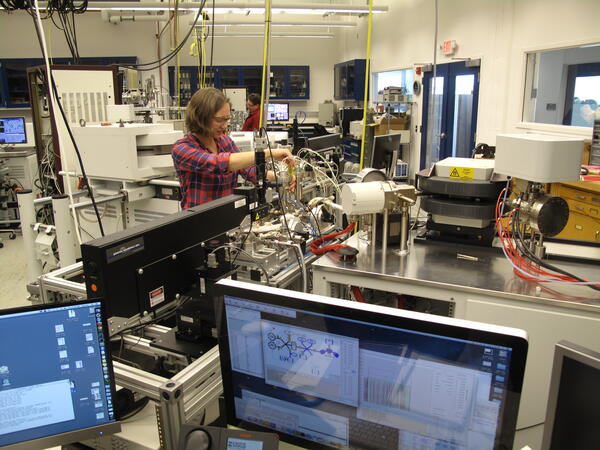
This project supports the USGS argon geochronology laboratory in Denver. The USGS 40Ar/39Ar geochronology laboratory is a state-of-the-art research facility for determining absolute ages of minerals and rocks. The 40Ar/39Ar laboratory contributes critical geochronology to individual USGS research projects and to partners in academia and other Federal agencies. This laboratory develops methodology for small and difficult sample analysis often at the limits of existing mass spectrometer technology.
Science Issue and Relevance
The 40Ar/39Ar Method: 40Ar/39Ar geochronology is an experimentally robust and versatile method for constraining the age and thermal history of rocks. Such information is extremely valuable for understanding a variety of geological processes including the formation of ore deposits, mountain building and history of volcanic events, paleo-seismic events, and paleo-climate. The 40Ar/39Ar isotopic dating method has evolved into the most commonly applied geochronological method, and can be applied to many geological problems that require precise and accurate time and temperature control.
Methodology to Address Issue
This project provides partial support for the USGS argon geochronology laboratory in Denver. The USGS 40Ar/39Ar geochronology laboratory is a state-of-the-art research facility for determining absolute ages of minerals and rocks. The 40Ar/39Ar laboratory contributes critical geochronology to individual USGS research projects and to partners in academia and other Federal agencies. This facility houses necessary equipment for sample preparation and analysis, including high-sensitivity noble gas mass spectrometers and ultraviolet (UV) and infrared (IR) lasers. The versatility of the 40Ar/39Ar method permits determining the timing of processes and events such as igneous intrusions and extrusions, ore mineralization and hydrothermal fluid circulation, metamorphic cooling and exhumation, mineral formation and recrystallization, and shallow crustal faulting. Scientists are dependent on the geochronologist for data and interpretations to determine these parameters. This laboratory develops methodology for small and difficult sample analysis often at the limits of existing mass spectrometer technology.
Below are other science projects associated with this project.
Below are data releases associated with this project. Visit USGS Geochron - a database of geochronologic and thermochronologic dates and data.
Below are publications associated with this project.
Instrumentation development for In Situ 40Ar/39Ar planetary geochronology Instrumentation development for In Situ 40Ar/39Ar planetary geochronology
Geochemical characteristics of igneous rocks associated with epithermal mineral deposits—A review Geochemical characteristics of igneous rocks associated with epithermal mineral deposits—A review
Episodic formation of the world-class Waihi epithermal Au-Ag vein system, Hauraki Goldfield, New Zealand Episodic formation of the world-class Waihi epithermal Au-Ag vein system, Hauraki Goldfield, New Zealand
Preservation of ancient impact ages on the R chondrite parent body: 40Ar/39Ar age of hornblende-bearing R chondrite LAP 04840 Preservation of ancient impact ages on the R chondrite parent body: 40Ar/39Ar age of hornblende-bearing R chondrite LAP 04840
Changing disturbance regimes, ecological memory, and forest resilience Changing disturbance regimes, ecological memory, and forest resilience
Tracking the timing of subduction and exhumation using 40Ar/39Ar phengite ages in blueschist- and eclogite-facies rocks (Sivrihisar, Turkey) Tracking the timing of subduction and exhumation using 40Ar/39Ar phengite ages in blueschist- and eclogite-facies rocks (Sivrihisar, Turkey)
U-Pb, Re-Os, and Ar/Ar geochronology of rare earth element (REE)-rich breccia pipes and associated host rocks from the Mesoproterozoic Pea Ridge Fe-REE-Au deposit, St. Francois Mountains, Missouri U-Pb, Re-Os, and Ar/Ar geochronology of rare earth element (REE)-rich breccia pipes and associated host rocks from the Mesoproterozoic Pea Ridge Fe-REE-Au deposit, St. Francois Mountains, Missouri
Mid-Cretaceous oblique rifting of West Antarctica: Emplacement and rapid cooling of the Fosdick Mountains migmatite-cored gneiss dome Mid-Cretaceous oblique rifting of West Antarctica: Emplacement and rapid cooling of the Fosdick Mountains migmatite-cored gneiss dome
Himalayan gneiss dome formation in the middle crust and exhumation by normal faulting: New geochronology of Gianbul dome, northwestern India Himalayan gneiss dome formation in the middle crust and exhumation by normal faulting: New geochronology of Gianbul dome, northwestern India
The emergence of volcanic oceanic islands on a slow-moving plate: The example of Madeira Island, NE Atlantic The emergence of volcanic oceanic islands on a slow-moving plate: The example of Madeira Island, NE Atlantic
Application of U-Th-Pb phosphate geochronology to young orogenic gold deposits: New age constraints on the formation of the Grass Valley gold district, Sierra Foothills province, California Application of U-Th-Pb phosphate geochronology to young orogenic gold deposits: New age constraints on the formation of the Grass Valley gold district, Sierra Foothills province, California
Pressure disequilibria induced by rapid valve closure in noble gas extraction lines Pressure disequilibria induced by rapid valve closure in noble gas extraction lines
In addition to the USGS National Cooperative Geologic Mapping Program and the Geosciences and Environmental Change Science Center, below are partners associated with this project.
This project supports the USGS argon geochronology laboratory in Denver. The USGS 40Ar/39Ar geochronology laboratory is a state-of-the-art research facility for determining absolute ages of minerals and rocks. The 40Ar/39Ar laboratory contributes critical geochronology to individual USGS research projects and to partners in academia and other Federal agencies. This laboratory develops methodology for small and difficult sample analysis often at the limits of existing mass spectrometer technology.
Science Issue and Relevance
The 40Ar/39Ar Method: 40Ar/39Ar geochronology is an experimentally robust and versatile method for constraining the age and thermal history of rocks. Such information is extremely valuable for understanding a variety of geological processes including the formation of ore deposits, mountain building and history of volcanic events, paleo-seismic events, and paleo-climate. The 40Ar/39Ar isotopic dating method has evolved into the most commonly applied geochronological method, and can be applied to many geological problems that require precise and accurate time and temperature control.
Methodology to Address Issue
This project provides partial support for the USGS argon geochronology laboratory in Denver. The USGS 40Ar/39Ar geochronology laboratory is a state-of-the-art research facility for determining absolute ages of minerals and rocks. The 40Ar/39Ar laboratory contributes critical geochronology to individual USGS research projects and to partners in academia and other Federal agencies. This facility houses necessary equipment for sample preparation and analysis, including high-sensitivity noble gas mass spectrometers and ultraviolet (UV) and infrared (IR) lasers. The versatility of the 40Ar/39Ar method permits determining the timing of processes and events such as igneous intrusions and extrusions, ore mineralization and hydrothermal fluid circulation, metamorphic cooling and exhumation, mineral formation and recrystallization, and shallow crustal faulting. Scientists are dependent on the geochronologist for data and interpretations to determine these parameters. This laboratory develops methodology for small and difficult sample analysis often at the limits of existing mass spectrometer technology.
Below are other science projects associated with this project.
Below are data releases associated with this project. Visit USGS Geochron - a database of geochronologic and thermochronologic dates and data.
Below are publications associated with this project.
Instrumentation development for In Situ 40Ar/39Ar planetary geochronology Instrumentation development for In Situ 40Ar/39Ar planetary geochronology
Geochemical characteristics of igneous rocks associated with epithermal mineral deposits—A review Geochemical characteristics of igneous rocks associated with epithermal mineral deposits—A review
Episodic formation of the world-class Waihi epithermal Au-Ag vein system, Hauraki Goldfield, New Zealand Episodic formation of the world-class Waihi epithermal Au-Ag vein system, Hauraki Goldfield, New Zealand
Preservation of ancient impact ages on the R chondrite parent body: 40Ar/39Ar age of hornblende-bearing R chondrite LAP 04840 Preservation of ancient impact ages on the R chondrite parent body: 40Ar/39Ar age of hornblende-bearing R chondrite LAP 04840
Changing disturbance regimes, ecological memory, and forest resilience Changing disturbance regimes, ecological memory, and forest resilience
Tracking the timing of subduction and exhumation using 40Ar/39Ar phengite ages in blueschist- and eclogite-facies rocks (Sivrihisar, Turkey) Tracking the timing of subduction and exhumation using 40Ar/39Ar phengite ages in blueschist- and eclogite-facies rocks (Sivrihisar, Turkey)
U-Pb, Re-Os, and Ar/Ar geochronology of rare earth element (REE)-rich breccia pipes and associated host rocks from the Mesoproterozoic Pea Ridge Fe-REE-Au deposit, St. Francois Mountains, Missouri U-Pb, Re-Os, and Ar/Ar geochronology of rare earth element (REE)-rich breccia pipes and associated host rocks from the Mesoproterozoic Pea Ridge Fe-REE-Au deposit, St. Francois Mountains, Missouri
Mid-Cretaceous oblique rifting of West Antarctica: Emplacement and rapid cooling of the Fosdick Mountains migmatite-cored gneiss dome Mid-Cretaceous oblique rifting of West Antarctica: Emplacement and rapid cooling of the Fosdick Mountains migmatite-cored gneiss dome
Himalayan gneiss dome formation in the middle crust and exhumation by normal faulting: New geochronology of Gianbul dome, northwestern India Himalayan gneiss dome formation in the middle crust and exhumation by normal faulting: New geochronology of Gianbul dome, northwestern India
The emergence of volcanic oceanic islands on a slow-moving plate: The example of Madeira Island, NE Atlantic The emergence of volcanic oceanic islands on a slow-moving plate: The example of Madeira Island, NE Atlantic
Application of U-Th-Pb phosphate geochronology to young orogenic gold deposits: New age constraints on the formation of the Grass Valley gold district, Sierra Foothills province, California Application of U-Th-Pb phosphate geochronology to young orogenic gold deposits: New age constraints on the formation of the Grass Valley gold district, Sierra Foothills province, California
Pressure disequilibria induced by rapid valve closure in noble gas extraction lines Pressure disequilibria induced by rapid valve closure in noble gas extraction lines
In addition to the USGS National Cooperative Geologic Mapping Program and the Geosciences and Environmental Change Science Center, below are partners associated with this project.