
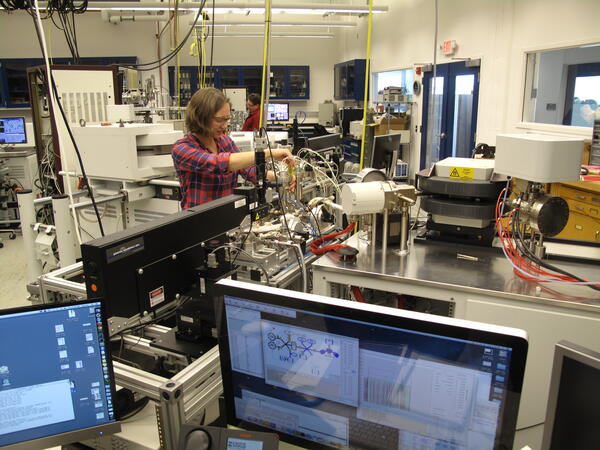
This project supports the USGS argon geochronology laboratory in Denver. The USGS 40Ar/39Ar geochronology laboratory is a state-of-the-art research facility for determining absolute ages of minerals and rocks. The 40Ar/39Ar laboratory contributes critical geochronology to individual USGS research projects and to partners in academia and other Federal agencies. This laboratory develops methodology for small and difficult sample analysis often at the limits of existing mass spectrometer technology.
Science Issue and Relevance
The 40Ar/39Ar Method: 40Ar/39Ar geochronology is an experimentally robust and versatile method for constraining the age and thermal history of rocks. Such information is extremely valuable for understanding a variety of geological processes including the formation of ore deposits, mountain building and history of volcanic events, paleo-seismic events, and paleo-climate. The 40Ar/39Ar isotopic dating method has evolved into the most commonly applied geochronological method, and can be applied to many geological problems that require precise and accurate time and temperature control.
Methodology to Address Issue
This project provides partial support for the USGS argon geochronology laboratory in Denver. The USGS 40Ar/39Ar geochronology laboratory is a state-of-the-art research facility for determining absolute ages of minerals and rocks. The 40Ar/39Ar laboratory contributes critical geochronology to individual USGS research projects and to partners in academia and other Federal agencies. This facility houses necessary equipment for sample preparation and analysis, including high-sensitivity noble gas mass spectrometers and ultraviolet (UV) and infrared (IR) lasers. The versatility of the 40Ar/39Ar method permits determining the timing of processes and events such as igneous intrusions and extrusions, ore mineralization and hydrothermal fluid circulation, metamorphic cooling and exhumation, mineral formation and recrystallization, and shallow crustal faulting. Scientists are dependent on the geochronologist for data and interpretations to determine these parameters. This laboratory develops methodology for small and difficult sample analysis often at the limits of existing mass spectrometer technology.
Below are other science projects associated with this project.
Below are data releases associated with this project. Visit USGS Geochron - a database of geochronologic and thermochronologic dates and data.
Below are publications associated with this project.
Interpretation of low‐temperature thermochronometer ages from tilted normal fault blocks Interpretation of low‐temperature thermochronometer ages from tilted normal fault blocks
Controls on submarine channel-modifying processes identified through morphometric scaling relationships Controls on submarine channel-modifying processes identified through morphometric scaling relationships
Rapid late Miocene surface uplift of the Central Anatolian Plateau margin Rapid late Miocene surface uplift of the Central Anatolian Plateau margin
Reverse weathering in marine sediments and the geochemical cycle of potassium in seawater: Insights from the K isotopic composition (41K/39K) of deep-sea pore-fluids Reverse weathering in marine sediments and the geochemical cycle of potassium in seawater: Insights from the K isotopic composition (41K/39K) of deep-sea pore-fluids
40Ar/39Ar geochronology and petrogenesis of the Table Mountain Shoshonite, Golden, Colorado, U.S.A. 40Ar/39Ar geochronology and petrogenesis of the Table Mountain Shoshonite, Golden, Colorado, U.S.A.
Climate stability in Central Anatolia during the Messinian Salinity Crisis Climate stability in Central Anatolia during the Messinian Salinity Crisis
Thermochronometry across the Austroalpine-Pennine boundary, Central Alps, Switzerland: Orogen-perpendicular normal fault slip on a major ‘overthrust’ and its implications for orogenesis Thermochronometry across the Austroalpine-Pennine boundary, Central Alps, Switzerland: Orogen-perpendicular normal fault slip on a major ‘overthrust’ and its implications for orogenesis
Elemental, isotopic, and geochronological variability in Mogollon-Datil volcanic province archaeological obsidian, southwestern USA: Solving issues of intersource discrimination Elemental, isotopic, and geochronological variability in Mogollon-Datil volcanic province archaeological obsidian, southwestern USA: Solving issues of intersource discrimination
High-precision 41K/39K measurements by MC-ICP-MS indicate terrestrial variability of δ41K High-precision 41K/39K measurements by MC-ICP-MS indicate terrestrial variability of δ41K
Characteristics and 40Ar/39Ar geochronology of the Erdenet Cu-Mo deposit, Mongolia Characteristics and 40Ar/39Ar geochronology of the Erdenet Cu-Mo deposit, Mongolia
Sediment unmixing using detrital geochronology Sediment unmixing using detrital geochronology
Emergence and evolution of Santa Maria Island (Azores)—The conundrum of uplifted islands revisited Emergence and evolution of Santa Maria Island (Azores)—The conundrum of uplifted islands revisited
In addition to the USGS National Cooperative Geologic Mapping Program and the Geosciences and Environmental Change Science Center, below are partners associated with this project.
This project supports the USGS argon geochronology laboratory in Denver. The USGS 40Ar/39Ar geochronology laboratory is a state-of-the-art research facility for determining absolute ages of minerals and rocks. The 40Ar/39Ar laboratory contributes critical geochronology to individual USGS research projects and to partners in academia and other Federal agencies. This laboratory develops methodology for small and difficult sample analysis often at the limits of existing mass spectrometer technology.
Science Issue and Relevance
The 40Ar/39Ar Method: 40Ar/39Ar geochronology is an experimentally robust and versatile method for constraining the age and thermal history of rocks. Such information is extremely valuable for understanding a variety of geological processes including the formation of ore deposits, mountain building and history of volcanic events, paleo-seismic events, and paleo-climate. The 40Ar/39Ar isotopic dating method has evolved into the most commonly applied geochronological method, and can be applied to many geological problems that require precise and accurate time and temperature control.
Methodology to Address Issue
This project provides partial support for the USGS argon geochronology laboratory in Denver. The USGS 40Ar/39Ar geochronology laboratory is a state-of-the-art research facility for determining absolute ages of minerals and rocks. The 40Ar/39Ar laboratory contributes critical geochronology to individual USGS research projects and to partners in academia and other Federal agencies. This facility houses necessary equipment for sample preparation and analysis, including high-sensitivity noble gas mass spectrometers and ultraviolet (UV) and infrared (IR) lasers. The versatility of the 40Ar/39Ar method permits determining the timing of processes and events such as igneous intrusions and extrusions, ore mineralization and hydrothermal fluid circulation, metamorphic cooling and exhumation, mineral formation and recrystallization, and shallow crustal faulting. Scientists are dependent on the geochronologist for data and interpretations to determine these parameters. This laboratory develops methodology for small and difficult sample analysis often at the limits of existing mass spectrometer technology.
Below are other science projects associated with this project.
Below are data releases associated with this project. Visit USGS Geochron - a database of geochronologic and thermochronologic dates and data.
Below are publications associated with this project.
Interpretation of low‐temperature thermochronometer ages from tilted normal fault blocks Interpretation of low‐temperature thermochronometer ages from tilted normal fault blocks
Controls on submarine channel-modifying processes identified through morphometric scaling relationships Controls on submarine channel-modifying processes identified through morphometric scaling relationships
Rapid late Miocene surface uplift of the Central Anatolian Plateau margin Rapid late Miocene surface uplift of the Central Anatolian Plateau margin
Reverse weathering in marine sediments and the geochemical cycle of potassium in seawater: Insights from the K isotopic composition (41K/39K) of deep-sea pore-fluids Reverse weathering in marine sediments and the geochemical cycle of potassium in seawater: Insights from the K isotopic composition (41K/39K) of deep-sea pore-fluids
40Ar/39Ar geochronology and petrogenesis of the Table Mountain Shoshonite, Golden, Colorado, U.S.A. 40Ar/39Ar geochronology and petrogenesis of the Table Mountain Shoshonite, Golden, Colorado, U.S.A.
Climate stability in Central Anatolia during the Messinian Salinity Crisis Climate stability in Central Anatolia during the Messinian Salinity Crisis
Thermochronometry across the Austroalpine-Pennine boundary, Central Alps, Switzerland: Orogen-perpendicular normal fault slip on a major ‘overthrust’ and its implications for orogenesis Thermochronometry across the Austroalpine-Pennine boundary, Central Alps, Switzerland: Orogen-perpendicular normal fault slip on a major ‘overthrust’ and its implications for orogenesis
Elemental, isotopic, and geochronological variability in Mogollon-Datil volcanic province archaeological obsidian, southwestern USA: Solving issues of intersource discrimination Elemental, isotopic, and geochronological variability in Mogollon-Datil volcanic province archaeological obsidian, southwestern USA: Solving issues of intersource discrimination
High-precision 41K/39K measurements by MC-ICP-MS indicate terrestrial variability of δ41K High-precision 41K/39K measurements by MC-ICP-MS indicate terrestrial variability of δ41K
Characteristics and 40Ar/39Ar geochronology of the Erdenet Cu-Mo deposit, Mongolia Characteristics and 40Ar/39Ar geochronology of the Erdenet Cu-Mo deposit, Mongolia
Sediment unmixing using detrital geochronology Sediment unmixing using detrital geochronology
Emergence and evolution of Santa Maria Island (Azores)—The conundrum of uplifted islands revisited Emergence and evolution of Santa Maria Island (Azores)—The conundrum of uplifted islands revisited
In addition to the USGS National Cooperative Geologic Mapping Program and the Geosciences and Environmental Change Science Center, below are partners associated with this project.