



An electrofishing catamaran rests on the berm surrounding Maankiki Marsh - Center Unit, the most recent wetland unit at the Shiawassee National Wildlife Refuge near Saginaw, Michigan, to be reconnected to the local waterway. Photo credit: Sasha Bozimowski, USGS.
Images
Images captured by GLSC scientists while working in and around the Great Lakes.
Filter Total Items: 495

Electrofishing Maankiki Marsh
An electrofishing catamaran rests on the berm surrounding Maankiki Marsh - Center Unit, the most recent wetland unit at the Shiawassee National Wildlife Refuge near Saginaw, Michigan, to be reconnected to the local waterway. Photo credit: Sasha Bozimowski, USGS.

Emergent Vegetation in a Wetland
Landscape view of two researchers walking through the emergent vegetation zone of a Great Lakes coastal wetland. Photo Credit: Alexandra (Sasha) Bozimowski, USGS.
Landscape view of two researchers walking through the emergent vegetation zone of a Great Lakes coastal wetland. Photo Credit: Alexandra (Sasha) Bozimowski, USGS.

Trails of LED-tagged sea lampreys in the dark
Light trails of LED-tagged sea lampreys, part of a study of sea lamprey sex pheromone antagonists, altered pheromone cocktails that can disrupt spawning behavior.
Light trails of LED-tagged sea lampreys, part of a study of sea lamprey sex pheromone antagonists, altered pheromone cocktails that can disrupt spawning behavior.

Sea lamprey LED-light trail
A light trail of an LED-tagged sea lamprey, part of a study of sea lamprey sex pheromone antagonists, altered pheromone cocktails that can disrupt spawning behavior.
A light trail of an LED-tagged sea lamprey, part of a study of sea lamprey sex pheromone antagonists, altered pheromone cocktails that can disrupt spawning behavior.

Sea lampreys spawning
Sea lampreys spawning in a stream during a study that tested how sea lamprey sex pheromone antagonists influenced spawning behavior.
Sea lampreys spawning in a stream during a study that tested how sea lamprey sex pheromone antagonists influenced spawning behavior.

Spawning sea lamprey
Spawning sea lampreys tagged for a study of sea lamprey sex pheromone antagonists.
Spawning sea lampreys tagged for a study of sea lamprey sex pheromone antagonists.
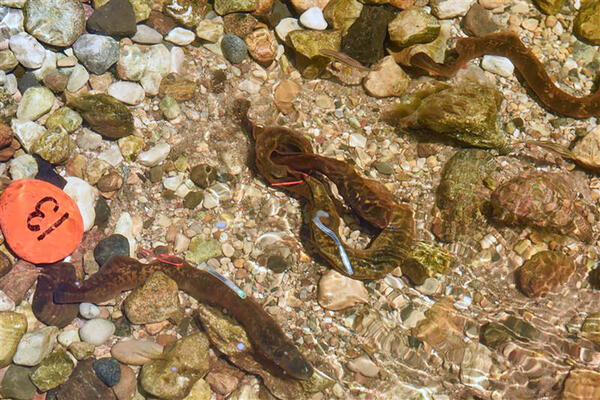
Spawning Sea Lamprey
In addition to investigating chemosensory cues such as pheromones and alarm cues, researchers are also testing antagonists—compounds that specifically block a sea lamprey’s ability to detect pheromones—as a means to disrupt mating. Shown here is an experiment with an antagonist in a natural stream.
In addition to investigating chemosensory cues such as pheromones and alarm cues, researchers are also testing antagonists—compounds that specifically block a sea lamprey’s ability to detect pheromones—as a means to disrupt mating. Shown here is an experiment with an antagonist in a natural stream.

Sea lampreys attached to lake trout
Sea lampreys attached to lake trout in a tank at Hammond Bay Biological Station.
Sea lampreys attached to lake trout in a tank at Hammond Bay Biological Station.

Sea lamprey tagged with LED light
A sea lamprey tagged with a red LED light as part of a study of sex pheromone antagonists, altered sex pheromone compounds that can interfere with sea lamprey spawning.
A sea lamprey tagged with a red LED light as part of a study of sex pheromone antagonists, altered sex pheromone compounds that can interfere with sea lamprey spawning.

Employee Photo Challenge Collage
A collage of images taken by UGS-GLSC employees during the 2020 field season.
A collage of images taken by UGS-GLSC employees during the 2020 field season.
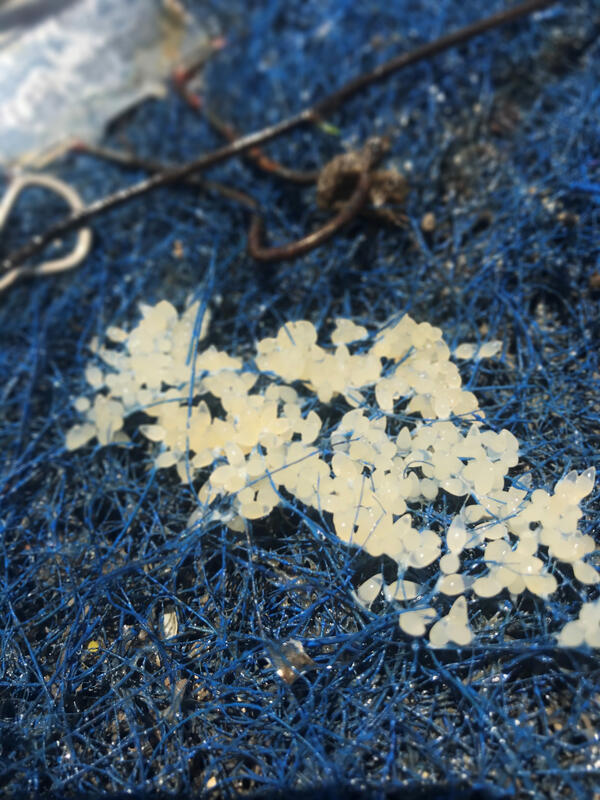
Entangled Eggs
A cluster of invasive round goby eggs on an egg-capturing mat that was recovered in the St. Clair-Detroit River System. Photo credit: Ellie Olds, USGS.
A cluster of invasive round goby eggs on an egg-capturing mat that was recovered in the St. Clair-Detroit River System. Photo credit: Ellie Olds, USGS.
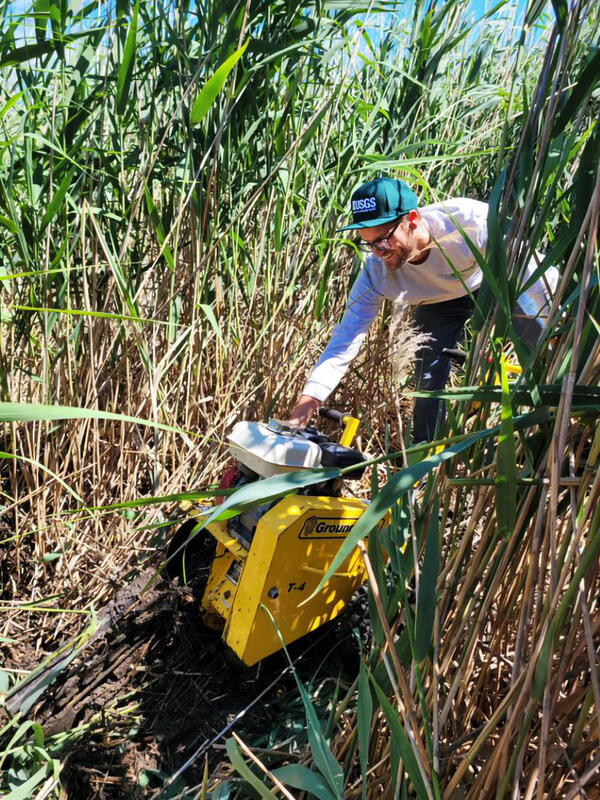
Cutting Dense Phragmites Rhizomes at Quanicassee State Wildlife Area
Cutting Dense Phragmites Rhizomes at Quanicassee State Wildlife AreaWes Bickford (USGS GLSC) uses a trencher to cut through dense Phragmites rhizomes at Quanicassee State Wildlife Area. Credit: Danielle Snow, USGS.
Cutting Dense Phragmites Rhizomes at Quanicassee State Wildlife Area
Cutting Dense Phragmites Rhizomes at Quanicassee State Wildlife AreaWes Bickford (USGS GLSC) uses a trencher to cut through dense Phragmites rhizomes at Quanicassee State Wildlife Area. Credit: Danielle Snow, USGS.
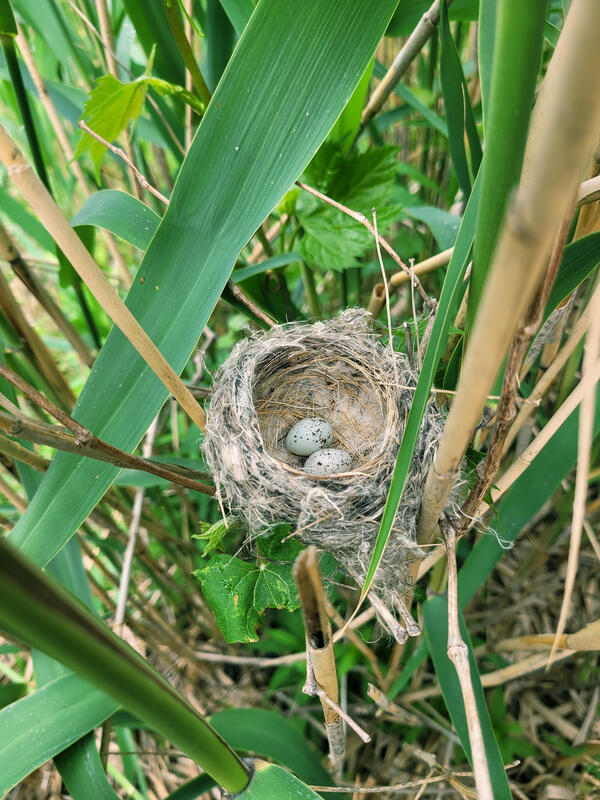
Waiting to Hatch
A bird's nest in a stand of Phragmites at Quanicassee State Wildlife Area in Bay City, Michigan. Photo credit: Danielle Snow, USGS.
A bird's nest in a stand of Phragmites at Quanicassee State Wildlife Area in Bay City, Michigan. Photo credit: Danielle Snow, USGS.

Brand New Day
R/V Sturgeon heading out for a day of sampling during a spring gillnet survey on Lake Michigan with the Charlevoix lighthouse to the left and anglers to the right. Photo credit: Patty Dieter, USGS.
R/V Sturgeon heading out for a day of sampling during a spring gillnet survey on Lake Michigan with the Charlevoix lighthouse to the left and anglers to the right. Photo credit: Patty Dieter, USGS.

Phragmites seedlings for Control Experiments
Phragmites australis seedlings in the GLSC (Ann Arbor, Michigan) greenhouse, planted over the course of two days in late May 2021. These seedlings will be used to test cutting strategies in management techniques.
Phragmites australis seedlings in the GLSC (Ann Arbor, Michigan) greenhouse, planted over the course of two days in late May 2021. These seedlings will be used to test cutting strategies in management techniques.

Lily of the Valley
Area in Charlevoix, Michigan covered with Lily of the Valley, discovered after a day of work aboard the R/V Sturgeon during a spring gillnet survey on Lake Michigan. Photo credit: Patty Dieter, USGS.
Area in Charlevoix, Michigan covered with Lily of the Valley, discovered after a day of work aboard the R/V Sturgeon during a spring gillnet survey on Lake Michigan. Photo credit: Patty Dieter, USGS.
Searching for Electrofishing Sites
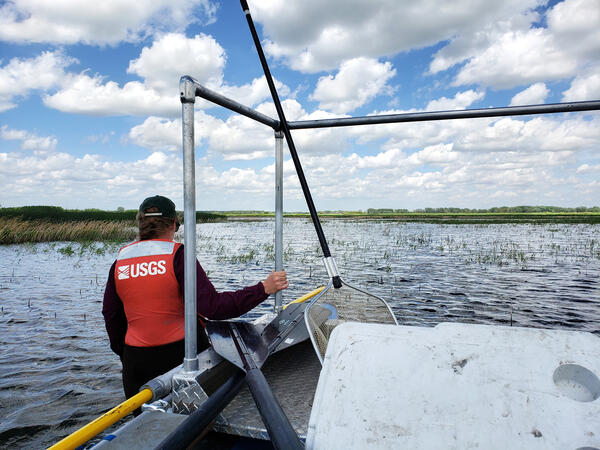
Pulling an electrofishing catamaran through the Maankiki Marsh - Center Unit in search of the next sample site at the Shiawassee National Wildlife Refuge in Saginaw, Michigan. Photo credit: Taaja Tucker, USGS.
Pulling an electrofishing catamaran through the Maankiki Marsh - Center Unit in search of the next sample site at the Shiawassee National Wildlife Refuge in Saginaw, Michigan. Photo credit: Taaja Tucker, USGS.

Opening Day
For the first time since its restoration, the Maankiki Marsh - Center Unit in the Shiawassee National Wildlife Refuge near Saginaw, Michigan, was hydrologically reconnected to the local stream and its fish community assessed by the USGS Great Lakes Science Center and U.S. Fish and Wildlife Service. Photo credit: Sasha Bozimowski, USGS.
For the first time since its restoration, the Maankiki Marsh - Center Unit in the Shiawassee National Wildlife Refuge near Saginaw, Michigan, was hydrologically reconnected to the local stream and its fish community assessed by the USGS Great Lakes Science Center and U.S. Fish and Wildlife Service. Photo credit: Sasha Bozimowski, USGS.

GLSC Diver Collects Cladophora Samples in Lake Michigan
GLSC Diver Collects Cladophora Samples in Lake MichiganEmily Wimmer (GLSC, Ann Arbor, Michigan) collects Cladophora growing at 6m depth in Lake Michigan.
GLSC Diver Collects Cladophora Samples in Lake Michigan
GLSC Diver Collects Cladophora Samples in Lake MichiganEmily Wimmer (GLSC, Ann Arbor, Michigan) collects Cladophora growing at 6m depth in Lake Michigan.

Measuring Water Quality at Maankiki Marsh Complex Distribution Basin
Measuring Water Quality at Maankiki Marsh Complex Distribution BasinTaaja Tucker (USGS GLSC) and USFWS partner Eliza Lugten using a multiparameter sonde to take water quality readings at the Maankiki Marsh Complex Distribution Basin where a DIDSON sonar unit is mounted to capture fish passage into the newly hydrologically reconnected wetland units. Credit: Sasha Bozimowski, USGS,
Measuring Water Quality at Maankiki Marsh Complex Distribution Basin
Measuring Water Quality at Maankiki Marsh Complex Distribution BasinTaaja Tucker (USGS GLSC) and USFWS partner Eliza Lugten using a multiparameter sonde to take water quality readings at the Maankiki Marsh Complex Distribution Basin where a DIDSON sonar unit is mounted to capture fish passage into the newly hydrologically reconnected wetland units. Credit: Sasha Bozimowski, USGS,
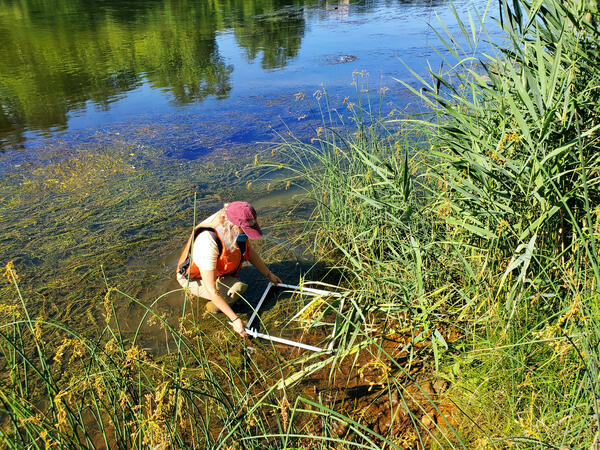
A Student Services Contractor for the U.S. Geological Survey monitors Phragmites growing in the Rouge River in Ypsilanti, MI.
A Student Services Contractor for the U.S. Geological Survey monitors Phragmites growing in the Rouge River in Ypsilanti, MI.A Student Services Contractor for the U.S. Geological Survey monitors Phragmites growing in the Rouge River in Ypsilanti, MI.
A Student Services Contractor for the U.S. Geological Survey monitors Phragmites growing in the Rouge River in Ypsilanti, MI.
A Student Services Contractor for the U.S. Geological Survey monitors Phragmites growing in the Rouge River in Ypsilanti, MI.A Student Services Contractor for the U.S. Geological Survey monitors Phragmites growing in the Rouge River in Ypsilanti, MI.