U.S. flag

An official website of the United States government

Publications

The Center publishes analyses critical to national security on domestic and international mineral supply chains.

Filter Total Items: 606

Mineral Commodity Summaries 2007 Mineral Commodity Summaries 2007

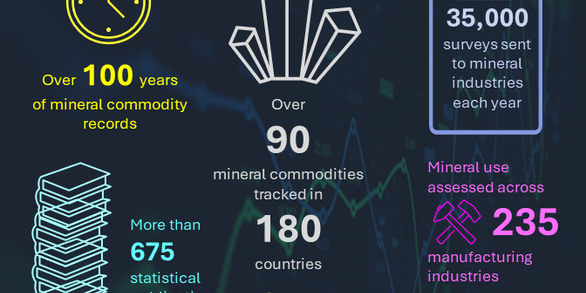
Published on an annual basis, this report is the earliest Government publication to furnish estimates covering nonfuel mineral industry data. Data sheets contain information on the domestic industry structure, Government programs, tariffs, and 5-year salient statistics for over 90 individual minerals and materials.
Authors
Water Resources Division U.S. Geological Survey

Mineral resource of the month: kyanite Mineral resource of the month: kyanite

Kyanite and related minerals are used in making refractories, which are materials that can withstand high-temperature environments, generally in excess of 1,100 degrees Celsius. Refractories form an inner lining to furnaces, kilns and other containers with which molten metals and glass come into contact. Fifty to 70 percent of global refractory consumption is related to the steel...
Authors
Michael J. Potter

Mineral resource of the month: phosphate rock Mineral resource of the month: phosphate rock

Phosphate rock minerals provide the only significant global resources of phosphorus, which is an essential element for plant and animal nutrition. Phosphate rock is used primarily as a principal component of nitrogen-phosphorus-potassium fertilizers, but also to produce elemental phosphorus and animal feed.
Authors
Stephen M. Jasinski

Magnesium compounds Magnesium compounds

Seawater and natural brines accounted for about 52 percent of U.S. magnesium compounds production in 2006. Dead-burned magnesia was produced by Martin Marietta Magnesia Specialties from well brines in Michigan. Caustic-calcined magnesia was recovered from sea-water by Premier Chemicals in Florida; from well brines in Michigan by Martin Marietta and Rohm and Haas; and from magnesite in...
Authors
D.A. Kramer

Mineral resource of the month: wollastonite Mineral resource of the month: wollastonite

When asked about wollastonite, most people respond “wollasta-what?” That’s because the wollastonite industry in the United States is relatively small and not highly publicized. Furthermore, the general public does not have any direct contact with wollastonite despite its use in many consumer products, ranging from car brakes to paint.
Authors
Robert Virta, Brad Van Gosen

Mineral resource of the month: talc Mineral resource of the month: talc

When most people think of talc, they probably think of talcum and baby powder. However, these uses of talc are quite minor compared to its wide variety of applications in manufacturing. The leading use of talc is in the production of ceramics, where it acts as a source of magnesium oxide, serves as a flux to reduce firing temperatures and improves thermal shock characteristics of the...
Authors
Robert Virta, Brad Van Gosen

Ball clay Ball clay

The article offers information on ball clay. Among the companies that mine ball clay in the U.S. are H.C. Spinks Clay, Kentucky-Tennessee Clay and Old Hickory Clay. In 2006, an estimated 1.2 million tons of the mineral was sold or used domestically and exported. Forty-percent of the total sales is accounted for ceramic floor and wall tile followed by sanitaryware and miscellaneous...
Authors
R.L. Virta

Fluorspar Fluorspar

Apart from some fluorspar by-product, there was no U.S. production of fluorspar in 2006. Imports were 553 kt, nearly 14 percent less than in 2005, and China was by far the largest supplier. China's changing export policy and high ocean freight rates indicate that delivered prices for fluorspar may increase in 2007 and countries such as Mexico, Mongolia, and South Africa are gaining...
Authors
M. Miller

Mineral resource of the month: niobium (columbium) Mineral resource of the month: niobium (columbium)

It’s not just diamonds associated with conflict in Africa. Coltan, short for columbite-tantalite (a blend of niobium — also called columbium — and tantalum minerals), is linked with the recent conflicts in the Congo that involved several African countries. The metallic ore, which is processed to separate out niobium and the very valuable tantalum (see Geotimes, August 2004), is believed...
Authors
John F. Papp

Exploration review Exploration review

This summary of international mineral exploration activities for 2006 draws upon available information from literature, industry and U.S. Geological Survey (USGS) specialists. The summary provides data on exploration budgets by region and mineral commodity, identifies significant mineral discoveries and areas of mineral exploration, discusses government programs affecting the mineral...
Authors
D.R. Wilburn

Gemstones Gemstones

Part of the 2006 industrial minerals review. During 2006, total U.S. gemstone trade with all countries and territories exceeded $28.3 billion. Estimates indicate that U.S. gemstone markets accounted for over 35 percent of world gemstone demand in 2006. Natural gemstone production from U.S. deposits during 2006 was worth an estimated $13.3 million, a slight decrease from 2005, and...
Authors
D.W. Olson

Mineral resource of the month: steel Mineral resource of the month: steel

About 96 million metric tons of steel was produced in the United States last year — more than any other metal. And the $3.46 billion of iron and steel scrap exported was also the highest of any metal scrap export, helping to reduce the U.S. trade deficit.
Authors
Michael D. Fenton
Was this page helpful?