An official website of the United States government
Here's how you know
Official websites use .gov
A .gov website belongs to an official government organization in the United States.
Secure .gov websites use HTTPS
A lock () or https:// means you’ve safely connected to the .gov website. Share sensitive information only on official, secure websites.
Each chapter of the 2020 edition of the U.S. Geological Survey (USGS) Mineral Commodity Summaries (MCS) includes information on events, trends, and issues for each mineral commodity as well as discussions and tabular presentations on domestic industry structure, Government programs, tariffs, 5-year salient statistics, and world production and resources. The MCS is the earliest...
Mineral resources, and their mining and enrichment operations, are not equally distributed across Earth. The concentration of mineral supply in certain regions, owing to the geology or geography of the mineral resource, raises the level of risk related to supply disruption. Where mineral production coincides with areas prone to natural hazards, supply may be especially at risk. However...
Authors
Emily K. Schnebele, Kishor S. Jaiswal, Nico Luco, Nedal T. Nassar
The United States’ supply of critical minerals has been a concern and a source of potential strategic vulnerabilities for U.S. economic and national security interests for decades (for example, see Strategic and Critical Minerals Stockpiling Act, 1939). More recently, with the rapid increase in the types of materials being used in advanced technologies (Fortier et al. 2018a), and...
Authors
Steven M. Fortier, Jane M. Hammarstrom, Sarah J. Ryker, Warren C. Day, Robert R. Seal,
In addition to increasing interest in the supply risk of minerals produced in China, there is also concern that China’s efforts to mitigate mineral supply risk—through foreign direct investment—may limit mineral availability for other countries in the short-term (due to production capacity constraints). However, little is publicly known about the quantity of global mineral production...
Garnet is the general name given to a group of complex silicate minerals, all with isometric crystal structure and similar properties and chemical composition. The most common garnet minerals are classified into three groups: the aluminum-garnet group, the chromium-garnet group and the iron-garnet group. Worldwide, garnet resources are large and occur in a wide variety of rocks...
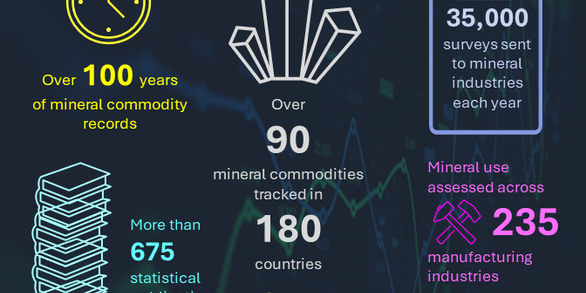
Published on an annual basis, this report is the earliest Government publication to furnish estimates covering nonfuel mineral industry data and is available at https://minerals.usgs.gov/minerals/pubs/mcs/. Data sheets contain information on the domestic industry structure, Government programs, tariffs, and 5-year salient statistics for more than 90 individual minerals and materials.
Although chromium is a metal, it does not occur naturally in metallic form. Chromium can be found in many minerals, but the only economically significant chromium-bearing mineral is chromite. Chromite has been mined from four different deposit types: stratiform chromite, podiform chromite, placer chromite, and laterite deposits. Most of the world's resources, however, are located in...
The United States’ supply of critical minerals has been a concern and a source of potential strategic vulnerabilities for U.S. economic and national security interests for decades (for example, see Strategic and Critical Minerals Stockpiling Act, 1939). More recently, with the rapid increase in the types of materials being used in advanced technologies (Fortier et al. 2018a), and...
Authors
Steven M. Fortier, Jane M. Hammarstrom, Sarah J. Ryker, Warren C. Day, Robert R. Seal