An official website of the United States government
Here's how you know
Official websites use .gov
A .gov website belongs to an official government organization in the United States.
Secure .gov websites use HTTPS
A lock () or https:// means you’ve safely connected to the .gov website. Share sensitive information only on official, secure websites.
Tin was one of the first metals discovered by humans and, like most metals, tin is rarely used by itself. Most tin is used as a protective coating or as an alloy with other metals in a diverse range of commercial and defense applications.
In 1807, Sir Humphrey Davy discovered a metal during the electrolysis of potassium hydroxide; he named the metal potassium because it came from potash recovered from wood ashes. The four types of potash are the water-soluble compounds potassium chloride, potassium sulfate, potassium-magnesium sulfate and potassium nitrate. The early uses of potash were in glass and soap manufacturing, as...
The worldwide budget for nonferrous, nonfuel mineral exploration was expected to increase by 58 percent in 2004 from the 2003 budget, according to Metals Economics Group (MEG) of Halifax, Nova Scotia. The increase comes two years after a five-year period of declining spending for mineral exploration (1998 to 2002). Figures suggest a subsequent 27 percent increase in budgeted expenditures...
Rhenium, an exotic, heat-resistant metal, has grown in importance since its discovery nearly 80 years ago. First isolated by a team of German chemists studying a platinum ore, the mineral was named for the Rhine River. From then until the 1960s, only 2 metric tons of rhenium were produced worldwide. In 2004, worldwide production was 40 metric tons.
Aluminum is the second most abundant metallic element in Earth’s crust after silicon. Even so, it is a comparatively new industrial metal that has been produced in commercial quantities for little more than 100 years. Aluminum is lightweight, ductile, malleable and corrosion resistant, and is a good conductor of heat and electricity. Weighing about one-third as much as steel or copper...
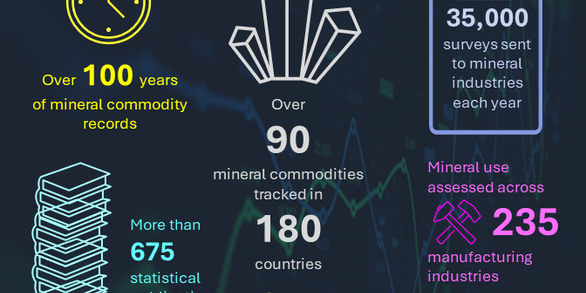
Published on an annual basis, this report is the earliest Government publication to furnish estimates covering nonfuel mineral industry data. Data sheets contain information on the domestic industry structure, Government programs, tariffs, and 5-year salient statistics for over 90 individual minerals and materials.
Manganese is one of the most important ferrous metals and one of the few for which the United States is totally dependent on imports. It is a black, brittle element predominantly used in metallurgical applications as an alloying addition, particularly in steel and cast iron production, which together provide the largest market for manganese (about 83 percent). It is also used as an alloy...
Magnesium, often confused with last month’s mineral of the month manganese, is valued primarily because of its light weight and high strength-to-weight ratio. Magnesium is the eighth most abundant element and constitutes about 2 percent of the Earth’s crust. It is the third most plentiful element dissolved in seawater, with a concentration averaging 0.13 percent. Magnesium is found in...
Cadmium, which was once used almost exclusively for pigments, now has many diverse applications. Cadmium’s low melting point, excellent electrical conductivity and resistance to corrosion make it valuable for many products including batteries, electroplated coatings, stabilizers for plastics, solar cells and nonferrous alloys. Today’s cadmium is primarily used in rechargeable batteries...
What does boron have to do with baseball, apple pie, motherhood and Chevrolet? Boron minerals and chemicals are used in the tanning of leather baseballs and gloves; in micro-fertilizer to grow apples and in the glass and enamels of bakewares to cook apple pie; in boron detergents for soaking baby clothes and diapers; and in fiberglass parts for the Chevrolet Corvette.
Clays represent one of the largest mineral commodities in the world in terms of mineral and rock production and use. Many people, however, do not recognize that clays are used in an amazingly wide variety of applications. Use continues to increase worldwide as populations and their associated needs increase. Robert Virta, clay and shale commodity specialist for the U.S. Geological Survey...
From paint to airplanes, titanium is important in a number of applications. Commercial production comes from titanium-bearing ilmenite, rutile and leucoxene (altered ilmenite). These minerals are used to produce titanium dioxide pigment, as well as an assortment of metal and chemical products.