An official website of the United States government
Here's how you know
Official websites use .gov
A .gov website belongs to an official government organization in the United States.
Secure .gov websites use HTTPS
A lock () or https:// means you’ve safely connected to the .gov website. Share sensitive information only on official, secure websites.
The earliest known use of gypsum as a building material was in Anatolia (in what is now Turkey) around 6000 B.C. It has been found on the interiors of the great pyramids in Egypt, which were erected in about 3700 B.C. Now an average new American home contains more than 7 metric tons of gypsum in the form of more than 6,000 square feet of wallboard.
The United States is a major producer and consumer of refined lead, representing almost one quarter of total world production and consumption. Two mines in Alaska and six in Missouri accounted for 97 percent of domestic lead production in 2002. The United States also imports enough refined lead to satisfy almost 20 percent of domestic consumption. Other major producers or consumers of...
Part of the 2003 industrial minerals review. Supply and demand data for industrial diamond are provided. Topics discussed are consumption, prices, imports and exports, government stockpiles, and the outlook for 2004.
Seven companies mined fire clay in four states during 2003. From 1984 to 1992, production declined to 383 kt (422,000 st) from a high of 1.04 Mt (1.14 million st) as markets for clay-based refractories declined. Since 1992, production levels have been erratic, ranging from 383 kt (422,000 st) in 1992 and 2001 to 583 kt (642,000 st) in 1995. Production in 2003, based on preliminary data...
Tantalum is a metal that is critical to the United States because of its defense-related applications in aircraft, missiles and radio communications. It is ductile, easily fabricated, highly resistant to corrosion by acids, a good conductor of heat and electricity, and has a high melting point. Tantalum’s first commercial usage was as filament material in incandescent electric lamps in...
Molybdenum is a metallic element that is most frequently used in alloy and stainless steels, which together represent the single largest market for molybdenum. Molybdenum has also proven invaluable in carbon steel, cast iron and superalloys. Its alloying versatility is unmatched because its addition enhances material performance under high-stress conditions in expanded temperature ranges...
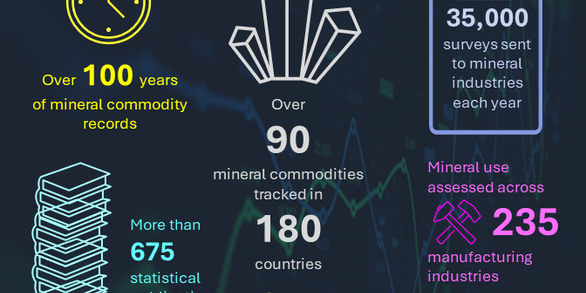
Published on an annual basis, this report is the earliest Government publication to furnish estimates covering nonfuel mineral industry data. Data sheets contain information on the domestic industry structure, Government programs, tariffs, and 5-year salient statistics for over 90 individual minerals and materials.
Ammonia is the principal source of fixed nitrogen. It was produced by 17 companies at 34 plants in the United States during 2003. Fifty-three percent of U.S. ammonia production capacity was centered in Louisiana, Oklahoma and Texas because of their large reserves of natural gas, the dominant domestic feedstock.
Dead-burned and caustic-calcined magnesias were recovered from seawater by Premier Chemicals in Florida; from well brines in Michigan by Dow Chemical, Martin Marietta Magnesia Specialties, and Rohm & Haas; and from magnesite in Nevada by Premier Chemicals. Reilly Industries and Great Salt Lake Minerals recovered magnesium chloride brines from the Great Salt Lake in Utah.
Part of the 2003 industrial minerals review. Supply and demand data for kaolin are provided. Topics discussed are consumption and prices, industry news, foreign trade, and the outlook for 2004.
Indium was discovered in Germany in 1863. Although it is a lustrous silver-white color, the finders named the new material for the “indigo” spectral lines the mineral created on the spectrograph. Indium ranks 61st in abundance in Earth’s crust and is about three times more abundant than silver or mercury.
Part of the 2003 industrial minerals review. Supply and demand data for gemstones are provided. Industry developments and the outlook for 2004 are discussed.