U.S. flag

An official website of the United States government

Publications

The Center publishes analyses critical to national security on domestic and international mineral supply chains.

Filter Total Items: 763

Mineral resource of the month: niobium (columbium) Mineral resource of the month: niobium (columbium)

It’s not just diamonds associated with conflict in Africa. Coltan, short for columbite-tantalite (a blend of niobium — also called columbium — and tantalum minerals), is linked with the recent conflicts in the Congo that involved several African countries. The metallic ore, which is processed to separate out niobium and the very valuable tantalum (see Geotimes, August 2004), is believed...
Authors
John F. Papp

Mineral resource of the month: kyanite Mineral resource of the month: kyanite

Kyanite and related minerals are used in making refractories, which are materials that can withstand high-temperature environments, generally in excess of 1,100 degrees Celsius. Refractories form an inner lining to furnaces, kilns and other containers with which molten metals and glass come into contact. Fifty to 70 percent of global refractory consumption is related to the steel...
Authors
Michael J. Potter

Construction aggregates Construction aggregates

Construction aggregates, primarily stone, sand and gravel, are recovered from widespread naturally occurring mineral deposits and processed for use primarily in the construction industry. They are mined, crushed, sorted by size and sold loose or combined with portland cement or asphaltic cement to make concrete products to build roads, houses, buildings, and other structures. Much...
Authors
T.I. Nelson, W.P. Bolen

Mineral resource of the month: thallium Mineral resource of the month: thallium

Thallium is known as a poison, its use initially suspected in the recent death of a Russian spy, but it has a variety of more important applications in everything from medical imaging to wireless communications.
Authors
Xiaoyu Bi

Ball clay Ball clay

The article offers information on ball clay. Among the companies that mine ball clay in the U.S. are H.C. Spinks Clay, Kentucky-Tennessee Clay and Old Hickory Clay. In 2006, an estimated 1.2 million tons of the mineral was sold or used domestically and exported. Forty-percent of the total sales is accounted for ceramic floor and wall tile followed by sanitaryware and miscellaneous...
Authors
R.L. Virta

Mineral Commodity Summaries 2007 Mineral Commodity Summaries 2007

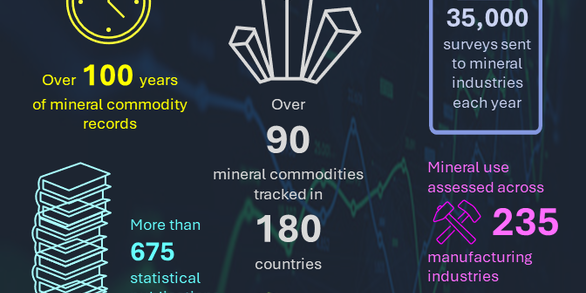
Published on an annual basis, this report is the earliest Government publication to furnish estimates covering nonfuel mineral industry data. Data sheets contain information on the domestic industry structure, Government programs, tariffs, and 5-year salient statistics for over 90 individual minerals and materials.
Authors
Water Resources Division U.S. Geological Survey

Mineral resource of the month: soda ash Mineral resource of the month: soda ash

Soda ash, also known as sodium carbonate, is an alkali chemical that can be refined from the mineral trona and from sodium carbonate-bearing brines. Several chemical processes exist for manufacturing synthetic soda ash.
Authors
Dennis S. Kostic

Mineral resource of the month: nickel Mineral resource of the month: nickel

Together with chromium, nickel makes steel more resistant to corrosion. Stainless steel thus accounts for more than 65 percent of primary nickel consumption in the world. One of the more common grades of stainless steel is Type 304, which contains 18 to 20 percent chromium and 10.5 to 12 percent nickel. Owing to their high corrosion resistance, nickel-bearing stainless steels are widely...
Authors
Peter H. Kuck

Mineral resource of the month: beryllium Mineral resource of the month: beryllium

Beryllium metal is lighter than aluminum and stiffer than steel. These and other properties, including its strength, dimensional stability, thermal properties and reflectivity, make it useful for aerospace and defense applications, such as satellite and space-vehicle structural components. Beryllium’s nuclear properties, combined with its low density, make it useful as a neutron...
Authors
Kim B. Shedd

Fire clay Fire clay

In 2005, six companies mined fire clay in Missouri, Ohio and South Carolina. Production was estimate to be 300 kt with a value of $8.3 million. Missouri was the leading producer state followed by Ohio and South Carolina. For the third consecutive year, sales and use of fire clays have been relatively unchanged. For the next few years, sales of fire clay is forecasted to remain around 300...
Authors
R.L. Virta

Common clay and shale Common clay and shale

At present, 150 companies produce common clay and shale in 41 US states. According to the United States Geological Survey (USGS), domestic production in 2005 reached 24.8 Mt valued at $176 million. In decreasing order by tonnage, the leading producer states include North Carolina, Texas, Alabama, Georgia and Ohio. For the whole year, residential and commercial building construction...
Authors
R.L. Virta
Was this page helpful?