U.S. flag

An official website of the United States government

Publications

The Center publishes analyses critical to national security on domestic and international mineral supply chains.

Filter Total Items: 655

Mineral resource of the month: platinum-group metals Mineral resource of the month: platinum-group metals

The precious metals commonly referred to as platinum-group metals (PGM) include iridium, osmium, palladium, platinum, rhodium and ruthenium. PGM are among the rarest of elements, and their market values — particularly for palladium, platinum and rhodium — are the highest of all precious metals.
Authors
Henry Hilliard

Dimension stone Dimension stone

Dimension stone can be defined as natural rock material quarried to obtain blocks or slabs that meet specifications as to size (width, length and thickness) and shape for architectural or engineering purposes. Color, grain texture and pattern, and surface finish of the stone are also normal requirements. Other important selection criteria are durability (based on mineral composition...
Authors
T.P. Dolley

Fluorspar Fluorspar

The United States had a small quantity of fluorspar production from one mine in Utah during 2002. Most of the fluorspar consumed in the United States continued to come from imports or material purchased from the National Defense Stockpile (NDS). In addition, a small amount of synthetic fluorspar (CaF2) was produced from industrial waste streams.
Authors
M. Miller

Kaolin Kaolin

Part of the 2002 industrial minerals review. Statistics on kaolin production, consumption, prices, and imports are provided. Other developments in the industry and the outlook for 2003 are detailed.
Authors
R.L. Virta

Industrial garnet Industrial garnet

Statistics on industrial garnet supply, demand, prices, and trade are provided. The outlook for the industrial garnet market is also predicted.
Authors
D.W. Olson

Mineral resource of the month: perlite Mineral resource of the month: perlite

Perlite is found in most homes, workplaces and schools. Most of the white ceiling tiles in offices and classrooms are made primarily of perlite. The soil around potted plants also has small white grains of perlite. Other than in these lightweight construction products and horticultural soil mixes, perlite is used in food processing for filtration and in natural gas processing as a low...
Authors
Wallace Bolen

Mineral Commodity Summaries 2003 Mineral Commodity Summaries 2003

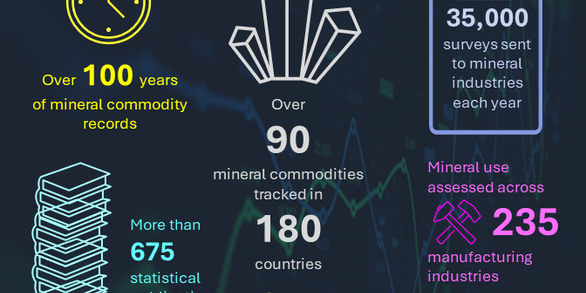
Published on an annual basis, this report is the earliest Government publication to furnish estimates covering nonfuel mineral industry data. Data sheets contain information on the domestic industry structure, Government programs, tariffs, and 5-year salient statistics for over 90 individual minerals and materials.
Authors
Water Resources Division U.S. Geological Survey

Common clay and shale Common clay and shale

Part of the 2002 industrial minerals review. The production, consumption, and price of shale and common clay in the U.S. during 2002 are discussed. The impact of EPA regulations on brick and structural clay product manufacturers is also outlined.
Authors
R.L. Virta

Strontium Strontium

Mexico and Spain are the leading producers of celestite, the most common strontium ore. Those countries produced nearly 80 percent of the estimated 360 kt (397,000 st) of celestite produced worldwide during 2002. China and Turkey are other significant celestite producers.
Authors
J.A. Ober

Mineral resource of the month: fluorspar Mineral resource of the month: fluorspar

Fluorspar, this month’s featured mineral resource commodity, has been widely used in steelmaking since the introduction of basic open-hearth furnace technology in the late 19th century. Its uses have grown and changed over the last 100 years, and now fluorspar’s most important markets are fluorochemicals, aluminum refining and steel. M. Michael Miller, Fluorspar Commodity Specialist for...
Authors
M. Michael Miller

Mineral resource of the month: germanium Mineral resource of the month: germanium

Germanium is a hard, brittle semimetal that first came into use over a half-century ago as a semiconductor material in radar units and in the first transistor ever made. Most germanium is recovered as a byproduct of zinc smelting, but it has also been recovered at some copper smelters and from the fly ash of coal-burning industrial power plants.
Authors
John D. Jorgenson

Mineral resource of the month: silicon Mineral resource of the month: silicon

In the industrialized world, silicon is as ubiquitous in the objects people use every day as it is in nature. The second most abundant element in Earth’s crust and more than 25 percent of the crust by weight, silicon is one of the most useful elements to humans.
Authors
Lisa A. Corathers
Was this page helpful?