An official website of the United States government
Here's how you know
Official websites use .gov
A .gov website belongs to an official government organization in the United States.
Secure .gov websites use HTTPS
A lock () or https:// means you’ve safely connected to the .gov website. Share sensitive information only on official, secure websites.
Molybdenum is a metallic element that is most frequently used in alloy and stainless steels, which together represent the single largest market for molybdenum. Molybdenum has also proven invaluable in carbon steel, cast iron and superalloys. Its alloying versatility is unmatched because its addition enhances material performance under high-stress conditions in expanded temperature ranges...
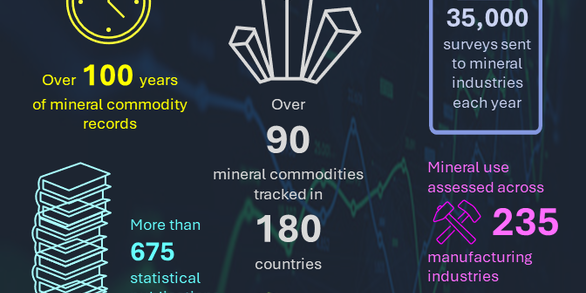
Published on an annual basis, this report is the earliest Government publication to furnish estimates covering nonfuel mineral industry data. Data sheets contain information on the domestic industry structure, Government programs, tariffs, and 5-year salient statistics for over 90 individual minerals and materials.
Germanium is a hard, brittle semimetal that first came into use over a half-century ago as a semiconductor material in radar units and in the first transistor ever made. Most germanium is recovered as a byproduct of zinc smelting, but it has also been recovered at some copper smelters and from the fly ash of coal-burning industrial power plants.
Exploration budgets fell for a fifth successive year during 2002. These decreases reflected unsettled mineral commodity prices and the continued reluctance to invest in mineral markets.
The ammonia industry partially recovered from the effects of high natural gas prices that had closed a significant portion of the industry in 2001. Ammonia production capacity in the United States in 2002 was about 17.1 Mt (18.8 million st). About 53 percent of this capacity was centered in Louisiana, Oklahoma and Texas where there are large reserves of natural gas.
Part of the 2002 industrial minerals review. Production, consumption, cost, and trade data for bentonite during 2002 are presented. Predictions on bentonite markets in 2003 are also provided.
Fluorspar, this month’s featured mineral resource commodity, has been widely used in steelmaking since the introduction of basic open-hearth furnace technology in the late 19th century. Its uses have grown and changed over the last 100 years, and now fluorspar’s most important markets are fluorochemicals, aluminum refining and steel. M. Michael Miller, Fluorspar Commodity Specialist for...
Perlite is found in most homes, workplaces and schools. Most of the white ceiling tiles in offices and classrooms are made primarily of perlite. The soil around potted plants also has small white grains of perlite. Other than in these lightweight construction products and horticultural soil mixes, perlite is used in food processing for filtration and in natural gas processing as a low...
Since domestic sulfur production peaked at nearly 11 million metric tons in 1974, the sulfur industry has undergone dramatic change. In 1974, mined sulfur produced using the Frasch hot water method provided 8 million tons of sulfur, representing 75 percent of total elemental sulfur production. (In the Frasch process, hot water is injected directly into the sulfur-containing mineral...
In the industrialized world, silicon is as ubiquitous in the objects people use every day as it is in nature. The second most abundant element in Earth’s crust and more than 25 percent of the crust by weight, silicon is one of the most useful elements to humans.