An official website of the United States government
Here's how you know
Official websites use .gov
A .gov website belongs to an official government organization in the United States.
Secure .gov websites use HTTPS
A lock () or https:// means you’ve safely connected to the .gov website. Share sensitive information only on official, secure websites.
The precious metals commonly referred to as platinum-group metals (PGM) include iridium, osmium, palladium, platinum, rhodium and ruthenium. PGM are among the rarest of elements, and their market values — particularly for palladium, platinum and rhodium — are the highest of all precious metals.
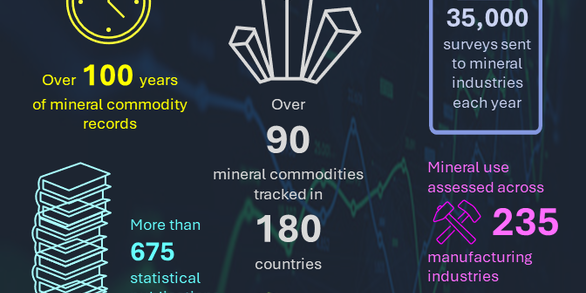
Published on an annual basis, this report is the earliest Government publication to furnish estimates covering nonfuel mineral industry data. Data sheets contain information on the domestic industry structure, Government programs, tariffs, and 5-year salient statistics for over 90 individual minerals and materials.
The estimated domestic production of pumice and pumicite in 2002 was 950 kt (1.04 million st), a 3.2 percent increase compared with the revised total of 2001, according to the U.S. Geological Survey (USGS). The amount of pumice and pumicite sold or used in the United States was revised for the years 1998 through 2001 in the USGS Mineral Commodity Summaries, 2003.
Peat is a natural organic material of botanical origin and commercial significance. Peatlands are situated predominately in shallow wetland areas of the Northern Hemisphere. Commercial deposits are formed from the gradual decomposition of plant matter under anaerobic conditions over about a 5,000-year period.
Seawater and natural brines accounted for about 60 percent of U.S. magnesium compounds production during 2002. Dead-burned and caustic-calcined magnesias were recovered from seawater by Premier Chemicals in Florida. They were also recovered from well brines in Michigan by Dow Chemical, Martin Marietta Magnesia Specialties and Rohm & Haas. And they were recovered from magnesite in Nevada...
Dimension stone can be defined as natural rock material quarried to obtain blocks or slabs that meet specifications as to size (width, length and thickness) and shape for architectural or engineering purposes. Color, grain texture and pattern, and surface finish of the stone are also normal requirements. Other important selection criteria are durability (based on mineral composition...
Part of the 2002 industrial minerals review. Statistics on gemstone production, processing, consumption, prices, and trade are provided. The outlook for gem diamonds and other precious gems is considered.
Statistics on the production, consumption, cost, trade, and government stockpile of natural and synthetic industrial diamond are provided. The outlook for the industrial diamond market is also considered.
The United States had a small quantity of fluorspar production from one mine in Utah during 2002. Most of the fluorspar consumed in the United States continued to come from imports or material purchased from the National Defense Stockpile (NDS). In addition, a small amount of synthetic fluorspar (CaF2) was produced from industrial waste streams.
Part of the 2002 industrial minerals review. Statistics on kaolin production, consumption, prices, and imports are provided. Other developments in the industry and the outlook for 2003 are detailed.
Part of the 2002 industrial minerals review. The production, consumption, and price of shale and common clay in the U.S. during 2002 are discussed. The impact of EPA regulations on brick and structural clay product manufacturers is also outlined.
Mexico and Spain are the leading producers of celestite, the most common strontium ore. Those countries produced nearly 80 percent of the estimated 360 kt (397,000 st) of celestite produced worldwide during 2002. China and Turkey are other significant celestite producers.