



Research in Response to Florida’s Emerging Stony Coral (scleractinia) Diseases
Stony coral tissue loss disease (SCTLD) is a rapidly progressive disease threat to corals that results in a bleached appearance due to loss of living tissue.
What is the issue?

The disease first emerged in Florida in 2014 and soon spread throughout the Florida Reef Tract and to the Caribbean, resulting in losses of up to 97% in some susceptible species. There is now concern that SCTLD could spread to the Pacific. The cause of SCTLD remains unknown, hampering efforts to manage and prevent the spread of this disease.
What is at stake?
Providing ecosystem, recreational, and commercial services with an estimated value of over \$3.4 billion per year in the US and \$11 trillion worldwide, coral reefs are a critical resource for industries such as tourism and commercial and recreational fisheries. In addition to supporting recreation and commerce, reefs provide protection against storm surges, flooding, and coastal erosion equaling an estimated \$1.8 billion per year in averted property damage. Despite their value, coral reefs and the services they provide are vulnerable to a myriad of environmental threats, including invasive species and disease.
What is our approach?
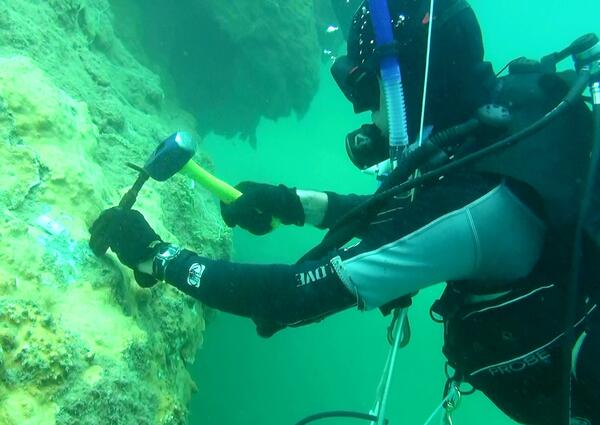
Historically, coral disease investigations have been approached from an ecological viewpoint in which efforts are concentrated on documenting the demographics of coral declines and their associated environment cofactors. In contrast, the USGS is focusing on understanding what is causing corals to die by applying diagnostic tools that are routinely used to determine cause of death in other wildlife. We suspect that with partnerships between ecologists and veterinarians, meaningful progress might be made to understand causes of coral death. With that understanding comes options to formulate targeted management questions. Specific activities include:
1) Examining coral tissues microscopically to describe changes at the cellular level (histopathology). Histopathology is a standard tool used to diagnose and develop case definitions for animal diseases. It is useful because it allows for localizing of lesions to particular anatomic locations, structures, and processes, thereby informing how disease works in animals. Histopathology can also aid in detection of causative agents of disease like bacteria, fungi, parasites and sometimes viruses.
2) Developing laboratory tools and biomarkers that will supplement histopathology and allow more refined understanding of how disease affects coral. This is necessary to gain an understanding of how corals respond to and recover from disease and their causes. As an example, we recently developed methods to examine individual coral cells microscopically which will complement tissue investigations by providing levels of detail not visible on routine histology.
3) Training biologists throughout the Pacific to document disease outbreaks in corals, collect samples for laboratory analysis, and connect field staff with laboratories that can analyze those samples. This will allow for more effective documentation of disease outbreaks and a greater understanding of exactly what kills corals.
What are the benefits?
- Linking ecology and veterinary medicine to address complex problems like SCTLD allows integration of two disciplines which have significant potential to increase our understanding of the causes of coral mortality and steps we can take to manage coral diseases.
- Applying histopathology and other laboratory techniques to coral disease presents an opportunity to deepen our understanding of these ecologically invaluable animals. Standardizing disease terminology and developing clear morphological definitions are key steps toward accurate diagnosis. This foundational work supports the creation of biomarkers and diagnostic tools, which are essential for guiding effective coral reef management and conservation efforts.
Stony coral tissue loss disease (SCTLD) is a rapidly progressive disease threat to corals that results in a bleached appearance due to loss of living tissue.
What is the issue?
The disease first emerged in Florida in 2014 and soon spread throughout the Florida Reef Tract and to the Caribbean, resulting in losses of up to 97% in some susceptible species. There is now concern that SCTLD could spread to the Pacific. The cause of SCTLD remains unknown, hampering efforts to manage and prevent the spread of this disease.
What is at stake?
Providing ecosystem, recreational, and commercial services with an estimated value of over \$3.4 billion per year in the US and \$11 trillion worldwide, coral reefs are a critical resource for industries such as tourism and commercial and recreational fisheries. In addition to supporting recreation and commerce, reefs provide protection against storm surges, flooding, and coastal erosion equaling an estimated \$1.8 billion per year in averted property damage. Despite their value, coral reefs and the services they provide are vulnerable to a myriad of environmental threats, including invasive species and disease.
What is our approach?
Historically, coral disease investigations have been approached from an ecological viewpoint in which efforts are concentrated on documenting the demographics of coral declines and their associated environment cofactors. In contrast, the USGS is focusing on understanding what is causing corals to die by applying diagnostic tools that are routinely used to determine cause of death in other wildlife. We suspect that with partnerships between ecologists and veterinarians, meaningful progress might be made to understand causes of coral death. With that understanding comes options to formulate targeted management questions. Specific activities include:
1) Examining coral tissues microscopically to describe changes at the cellular level (histopathology). Histopathology is a standard tool used to diagnose and develop case definitions for animal diseases. It is useful because it allows for localizing of lesions to particular anatomic locations, structures, and processes, thereby informing how disease works in animals. Histopathology can also aid in detection of causative agents of disease like bacteria, fungi, parasites and sometimes viruses.
2) Developing laboratory tools and biomarkers that will supplement histopathology and allow more refined understanding of how disease affects coral. This is necessary to gain an understanding of how corals respond to and recover from disease and their causes. As an example, we recently developed methods to examine individual coral cells microscopically which will complement tissue investigations by providing levels of detail not visible on routine histology.
3) Training biologists throughout the Pacific to document disease outbreaks in corals, collect samples for laboratory analysis, and connect field staff with laboratories that can analyze those samples. This will allow for more effective documentation of disease outbreaks and a greater understanding of exactly what kills corals.
What are the benefits?
- Linking ecology and veterinary medicine to address complex problems like SCTLD allows integration of two disciplines which have significant potential to increase our understanding of the causes of coral mortality and steps we can take to manage coral diseases.
- Applying histopathology and other laboratory techniques to coral disease presents an opportunity to deepen our understanding of these ecologically invaluable animals. Standardizing disease terminology and developing clear morphological definitions are key steps toward accurate diagnosis. This foundational work supports the creation of biomarkers and diagnostic tools, which are essential for guiding effective coral reef management and conservation efforts.