



A Model to Predict Sediment Bulk Density for the San Francisco Estuary
Sediment bulk density is a physical property of the sediment bed that tells scientists how compacted the particles are. It’s a key parameter for calculating sediment budgets, modeling sediment transport, and predicting bed erosion, and can be used to calculate carbon density when measured with carbon content to quantify sequestration rates.
These analyses are used in beneficial sediment reuse and marsh restoration projects in places like San Francisco Bay, where marshes buffer shorelines from storms but are in danger of drowning due to sea-level rise if sediment accumulation can’t keep up.
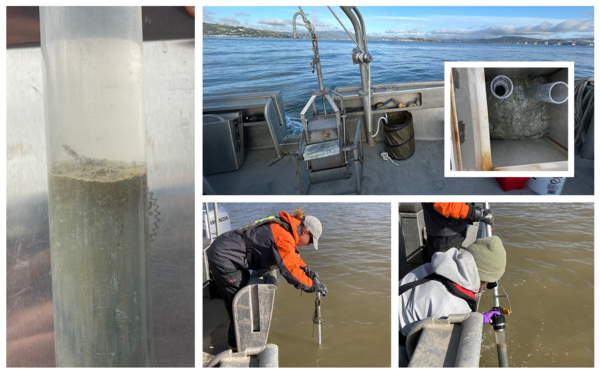
Accurately measuring sediment bulk density (referred to as ρdry) is difficult and time-consuming. The units of ρdry have not been consistently reported in the literature, leading to confusion, particularly in the calculation of sediment budgets that typically require integrating mass-based and volumetric components. To accurately calculate ρdry in a system as complex and dynamic as the San Francisco Bay and Sacramento–San Joaquin Delta, USGS scientists decided to create a site-specific model, described in a newly published study.
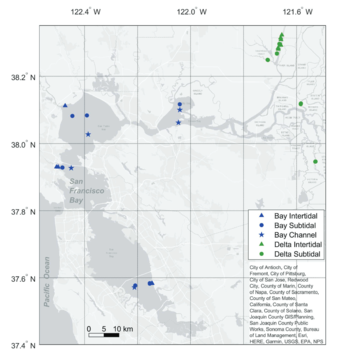
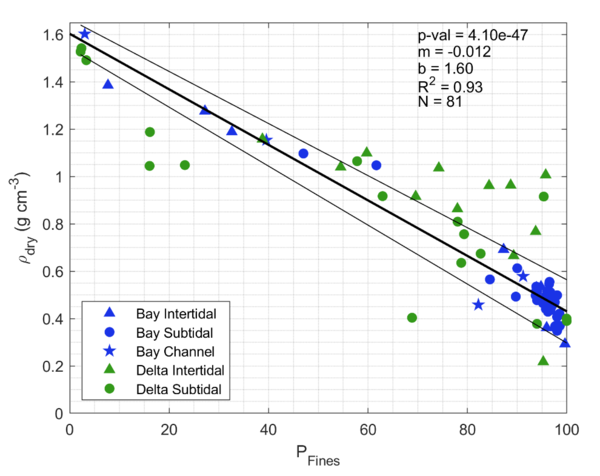
“Models showing relationships between ρdry and sediment composition have been developed for multiple regions and differ between systems—but none of them use sediment from San Francisco Bay,” said USGS Oceanographer Samantha McGill, lead author of the study. “Our model analyzes dozens of samples collected over the past decade throughout San Francisco Bay and the Sacramento–San Joaquin Delta to show that percent fines—the percentage of fine-grained particles in a sediment sample—predict bulk density with high accuracy.”
Outputs from this new bulk density model were compared to four models from the literature, which were developed using sediments from other regions. Results suggest that the local model provides more accurate bulk density predictions than those developed using sediments from a different region.
This local model could help improve both sediment transport models and sediment budgets by providing more accurate bulk density estimates. In addition, the data presented in this study increase the spatial resolution of measured bulk density for the San Francisco estuary for use in sediment-transport models and could potentially support planning of beneficial reuse projects.
Related

Sediment transport between estuarine habitats in San Francisco Bay
Related