



Sediment contaminants in Puget Sound: Implications for ecosystem health and remediation
For decades, chemicals from industry and development have lingered in the sediments of Puget Sound, threatening marine life and human health. Despite more than 30 years of remediation and monitoring, some contaminants remain stubbornly persistent in the Sound’s marine inhabitants and nearshore environment, raising questions about how best to restore this critical ecosystem.
A new study from USGS focuses on a suite of sediment contaminants in the Sound: polycyclic aromatic hydrocarbons (PAHs), polychlorinated biphenyls (PCBs), and chlorinated pesticides such as DDT. The researchers found that these chemicals originated from industrial oil and tar waste, landfill effluent, creosote-treated wood, and other shoreline activities. These contaminants are of special concern because they can accumulate in the tissues of fish and invertebrates, move up the food chain, and ultimately affect human health.
Researchers found that contaminated sites assessed in the study show strong “site fidelity”: contaminants largely remain close to their source instead of dispersing widely throughout the urban embayment. On one hand, this stability means that organisms living nearby continue to face chronic exposure to these contaminants. It also means that sediment capping and localized remediation—techniques that trap pollutants in place—may be an effective remediation strategy in this embayment.
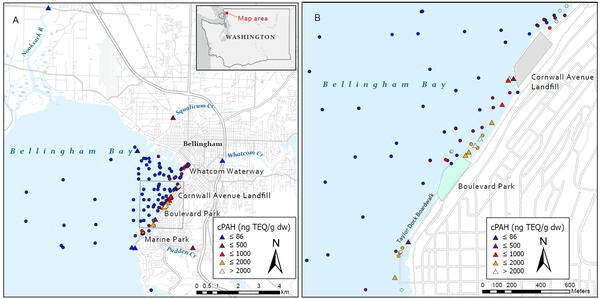
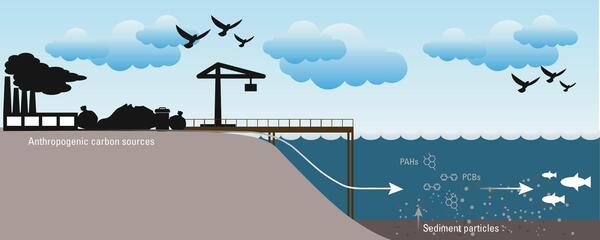
The study identified key insights into how contaminants in industrial sediments travel through the environment:
- PAHs can be transported via a wider range of sediment particle sizes than previously recognized, not just the smallest clays.
- The chemical mix differs between dissolved contaminants in water and those bound to particles, influencing toxicity risk and how marine organisms are exposed.
- Some persistent contaminants appear to be strongly bound to anthropogenic carbon, making them less bioavailable to organisms.
Puget Sound is far from alone in this challenge. Many U.S. estuaries—including Chesapeake Bay, San Francisco Bay, and the Great Lakes—face similar struggles to reduce toxic pollutants in nearshore habitats that are vital for fisheries and aquatic ecosystems.
The study notes that further research is needed to characterize complex chemical mixtures in these environments, particularly as affected by nearshore processes and conditions. Such efforts could help identify thresholds for safe contaminant levels, improve ecological risk assessment, and guide more effective cleanup strategies.
Read the study, Refining PAH and PCB bioavailability predictions in industrial sediments using source-fingerprinting, particle size, and bulk carbon, Puget Sound, Washington, in Marine Pollution Bulletin.
Related

Coastal Habitats in Puget Sound
Related