An official website of the United States government
Here's how you know
Official websites use .gov
A .gov website belongs to an official government organization in the United States.
Secure .gov websites use HTTPS
A lock () or https:// means you’ve safely connected to the .gov website. Share sensitive information only on official, secure websites.
Sediment washing into coral reefs from land has long been viewed as one of the biggest threats to reef health. But new research from USGS and collaborators indicates that what happens after sediment reaches the reef may be just as important as where it comes from.
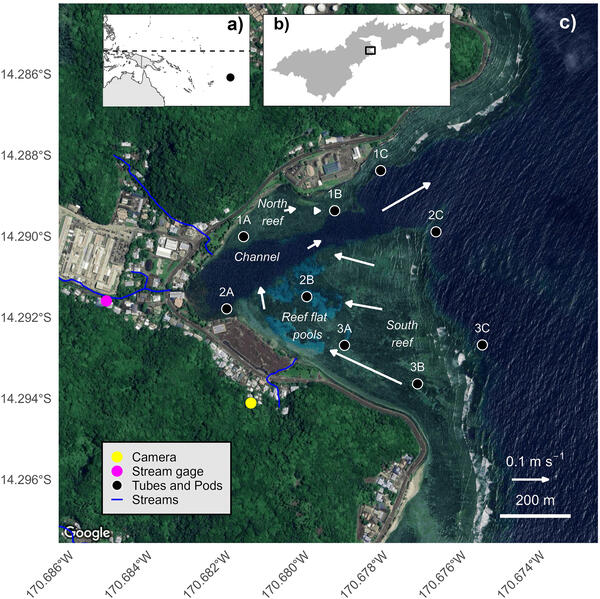
Maps of the study area and instrumentation in Faga'alu Bay. a) Location of American Samoa in the South Pacific region. b) Location of Faga'alu Bay on Tutuila Island, American Samoa. c) Faga'alu Bay, including locations of sediment pods and traps deployed at 9 locations.
A study focusing on the U.S. Coral Reef Task Force Watershed Partnership Initiative’s priority wateshed-reef system in Faga'alu Bay, American Samoa, found that wave energy, not watershed runoff, is the primary factor controlling when and where sediment accumulates across much of the bay’s coral reefs.
The findings provide new insights into how sediment affects coral ecosystems and could help resource managers better predict how, when, and where elevated stress on reefs may occur.
Tracking sediment transport in the bay
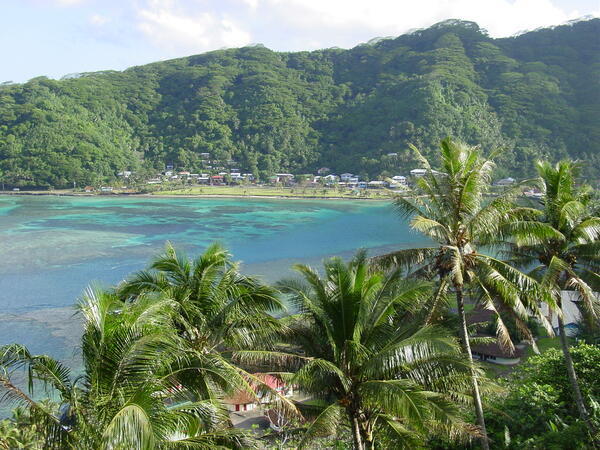
Located on the island of Tutuila, Faga'alu Bay is a coral reef-fringed embayment that has experienced sediment impacts from both natural processes (storms, floods) and human activities, including runoff from a nearby village and an aggregate quarry upstream of the village.
To better understand how sediment impacts to corals in the bay, researchers deployed sediment traps at multiple locations to measure both the amount and composition of material settling onto the reef over time. The team also analyzed wave conditions, water circulation, and sediment characteristics to determine which environmental factors most strongly influenced sediment accumulation.
The study found that sediment accumulated most rapidly in areas where water flow was slower; where water remained in the bay longer; and where loose sediment was already present on the seafloor. These sheltered areas acted as natural collection zones where suspended particles could settle more easily.
However, the most important factor controlling sediment accumulation through time proved to be wave energy.
Waves keep sediment in motion
While streams deposited terrigenous, or land-derived, sediment into the bay during storms, waves in the bay were found to continually stir material from the seafloor back into the water column. The researchers also found that wave energy strongly influenced both the total amount of sedimentation and the accumulation of carbonate material produced by reef organisms.
Using wave data from a regional ocean model, the team developed a simple mathematical relationship that accurately predicted sediment accumulation rates across most of the reef. This finding suggests that readily available wave forecasts could help estimate sediment conditions without requiring continuous field measurements.
One surprising finding was that sediment delivered from the watershed was generally a poor predictor of sediment accumulation across the reef. Across the study area, terrigenous sediment consistently tracked watershed inputs at only one monitoring site located near a stream mouth. Elsewhere in the bay, wave-driven resuspension largely controlled how much sediment accumulated, regardless of how much new material entered from land.
Implications for coral reef management
The results indicate that although sediment deposited from a stream during a storm can impact corals for a day or two, waves can resuspend and redeposit the flood sediment in certain parts of the bay dozens to hundreds of times a year, resulting in orders of magnitude greater sediment stress to the corals than just during the flood itself.
Repeated sediment resuspension can reduce water clarity, limit the sunlight available for photosynthesis, and increase stress on corals already coping with warming oceans and other environmental pressures.
By combining local sediment observations with global wave models, scientists may be able to develop practical tools for predicting sediment conditions, tracking long-term changes, and evaluating the effectiveness of watershed restoration projects in locations with limited resources.
Explore the fascinating undersea world of coral reefs. Learn how we map, monitor, and model coral reefs so we can better understand, protect, and preserve our Nation's reefs.
Explore the fascinating undersea world of coral reefs. Learn how we map, monitor, and model coral reefs so we can better understand, protect, and preserve our Nation's reefs.
Explore the fascinating undersea world of coral reefs. Learn how we map, monitor, and model coral reefs so we can better understand, protect, and preserve our Nation's reefs.
Explore the fascinating undersea world of coral reefs. Learn how we map, monitor, and model coral reefs so we can better understand, protect, and preserve our Nation's reefs.



 Sources/Usage: Some content may have restrictions. View Media Details