



Is there a genetic divide among humpback chub in Grand Canyon?
How does variation in habitat and behavior of Grand Canyon humpback chub lead to selective breeding?
Research has revealed differences in habitats, behavior, growth, and migration among humpback chub in the Grand Canyon, prompting questions about whether these groups represent distinct genetic subpopulations.
Background
Humpback chub are a native warm-water fish that are endemic to the Colorado River basin.
Historically, they ranged throughout warm-water sections of the Colorado, Green and Yampa rivers, but now remain in just a few populations due to river alterations and predations from nonnative fish.
The populations outside of Grand Canyon National Park are persisting, but population abundances are lower and geographic ranges smaller than they were historically.

Following the construction of Glen Canyon Dam in the 1960s, year-round cooling of the Colorado River in the Grand Canyon caused humpback chub habitat to shrink to just a few areas. Their overall population plummeted to only several thousand individuals.
The decline was so great that in 1967, humpback chub were listed as endangered throughout their range. Over the last decade they have somewhat rebounded, largely due to an increase in river water temperature, and in 2021 were downlisted to threatened.
The cold-water shift
When water temperatures in the Colorado River mainstem cooled, humpback chub populations declined because the conditions were too cold for successful spawning and growth.
The once-contiguous community became increasingly fragmented, with groups confined to isolated areas near warmwater springs and tributaries that acted as refugia—most notably the Little Colorado River in eastern Grand Canyon (River Mile 61.5).

There they continued to spawn and maintain a smaller but viable population at the confluence of the rivers, with some migrating into the mainstem of the Colorado River.
Humpback chub also survived in very small numbers in western Grand Canyon as a relict population of the original Colorado River assemblage, downstream of Havasu Creek (River Mile ~157).


The return of warmer waters
Lower water levels in Lake Powell reservoir mean that warmer surface water is released, and water temperatures have risen in the Colorado River downstream of Glen Canyon Dam.
This warming trend has led to more favorable conditions for humpback chub spawning and growth.
Over the last decade, the western Grand Canyon group has resurged, such that humpback chub are now commonly captured over a 200 km stretch of the mainstem river in western Grand Canyon.

Do distinct groups and behaviors indicate genetic divergence?
The two main humpback chub groups—one in eastern Grand Canyon near the Little Colorado River and the other in western Grand Canyon downstream of Havasu Creek, which is 95 miles downstream of the Little Colorado River—interbreed rarely or not at all, based on the very low numbers of individuals detected moving between these two regions.

Adding complexity, the eastern group itself exhibits distinct differences in breeding, migration, and growth patterns.
In eastern Grand Canyon, humpback chub in the Little Colorado River have split into two distinct life paths.

Some remain in the Little Colorado their entire lives, growing quickly but living shorter lives. Others are born there, then move into the mainstem Colorado River after about a year, returning to the Little Colorado to spawn as adults. These migratory fish grow more slowly but tend to live longer. (Read more here about those findings.)
Meanwhile, western humpback chub—from Havasu Creek downstream to Pearce Ferry—spend their entire lives in the mainstem.


Because of the differences between humpback chub groups and the distance between their habitats, researchers from USGS and partners at the National Park Service and US Fish and Wildlife Service set out to understand the genetic relationships between them.
They wanted to know whether eastern and western groups are genetically distinct, and whether genetic differences within the eastern group are linked to different life strategies.
Why is this important?
Genetic distinctiveness plays a key role in species conservation.
If individuals from different humpback chub locations rarely breed with one another, the groups may accumulate distinct behavioral, metabolic, or genetic characteristics and need to be treated as distinct subpopulation units in recovery planning.

Results of the study
To understand breeding dynamics, researchers analyzed samples from four representative sites in Grand Canyon and found no distinct genetic differences within the eastern group or between the eastern and western groups.

These results suggest that, despite persisting in isolated locations during the cold-water period and having different migratory strategies, humpback chub in Grand Canyon are genetically linked – either via current and/or historic interbreeding.
The differences in life cycles among eastern Grand Canyon humpback chub may be influenced by other factors, such as varying water temperatures or differences in food availability.
The findings also provide (some) evidence for a once-contiguous humpback chub population in Grand Canyon.

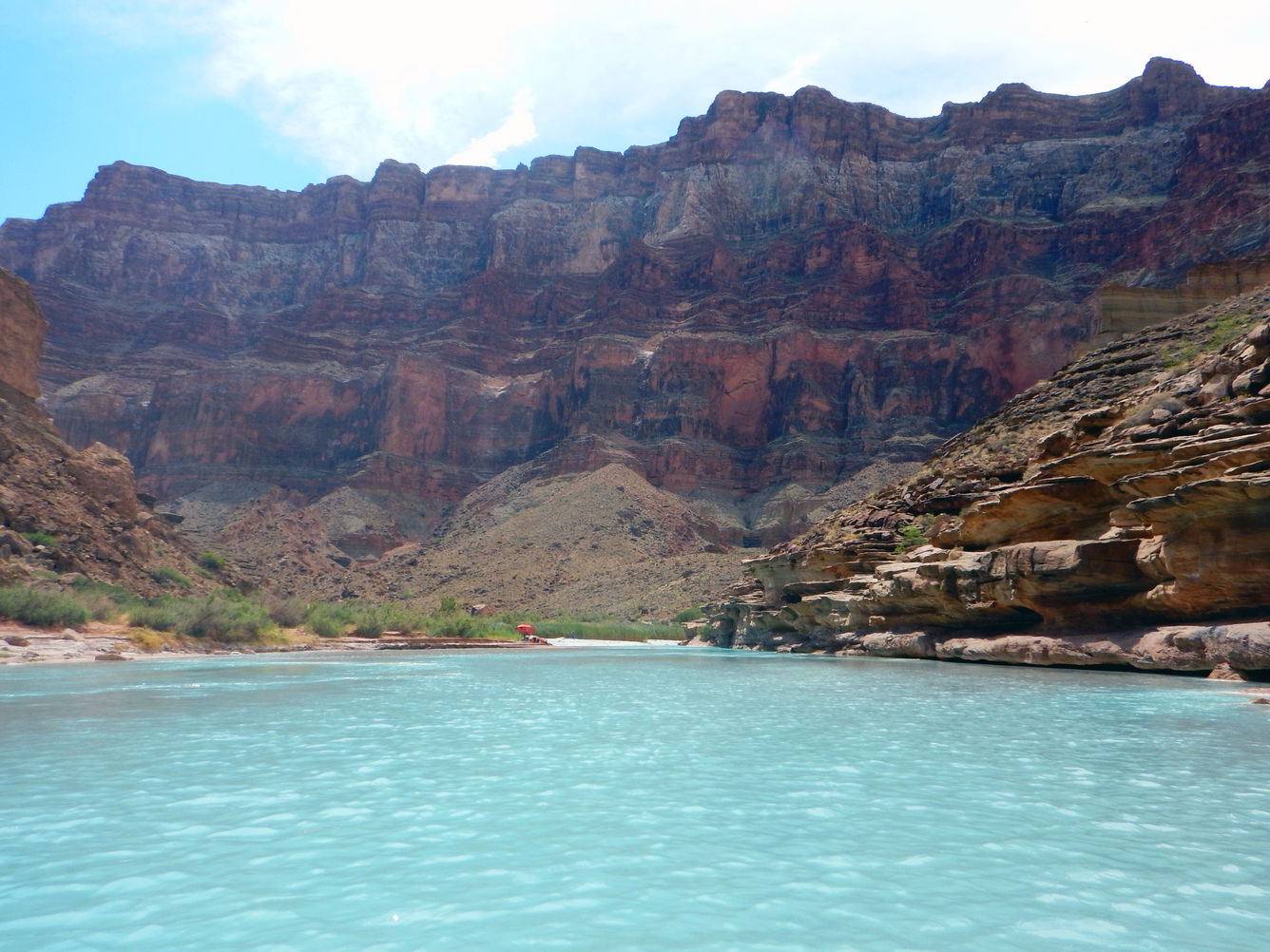
Warmer river waters are creating better conditions for humpback chub, supporting their population growth, which is a positive development for humpback chub recovery. Warmer water also benefits some highly predatory nonnative fishes, such as smallmouth bass (more information here), which increases risks to chub and other native fishes.
Given future uncertainty, these new genetic insights add an important piece to the puzzle and continue to provide a scientific foundation for managers that is adaptive and guided by data.
Related

Study Uncovers Migration Patterns of Native Fish in the Colorado River

Humpback Chub in the Colorado River, Grand Canyon
Related
Study Uncovers Migration Patterns of Native Fish in the Colorado River