An official website of the United States government
Here's how you know
Official websites use .gov
A .gov website belongs to an official government organization in the United States.
Secure .gov websites use HTTPS
A lock () or https:// means you’ve safely connected to the .gov website. Share sensitive information only on official, secure websites.
In 2019, the West Virginia legislature recognized the contamination risk to public source-water supplies posed by per- and polyfluoroalkyl substances (PFAS) and passed a resolution that required a statewide PFAS study. The purpose of this resulting study was to understand the occurrence and distribution of PFAS contamination throughout the state’s rivers, lakes, and groundwater aquifers.
This study was led by U.S. Geological Survey (USGS) scientists in cooperation with our partners at the West Virginia Department of Environmental Protection and the West Virginia Department of Health and Human Resources.
Occurrence of per- and polyfluoroalkyl substances and inorganic analytes in groundwater and surface water used as sources for public water supply in West Virginia
This latest report from the Virginia and West Virginia Water Sciences Center outlines our work testing for PFAS in West Virginia's drinking water supply.
USGS Data Release: Data Collected to Assess the Occurrence and Distribution of Per- and Polyfluoroalkyl Substances in West Virginia Public Source-Water Supplies, 2024
Want to access the latest data from this study? This USGS data release serves as the public release of the available data.
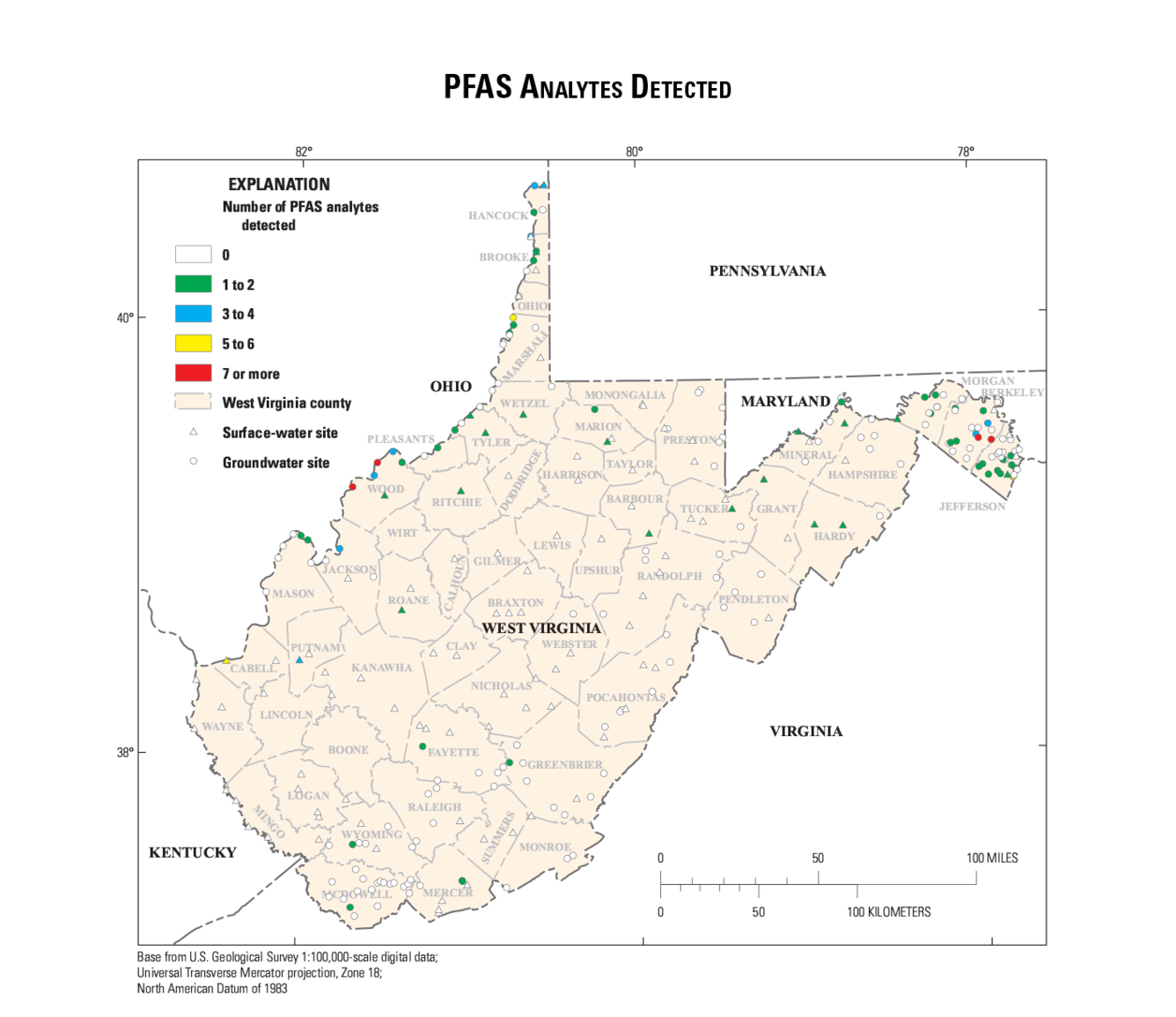
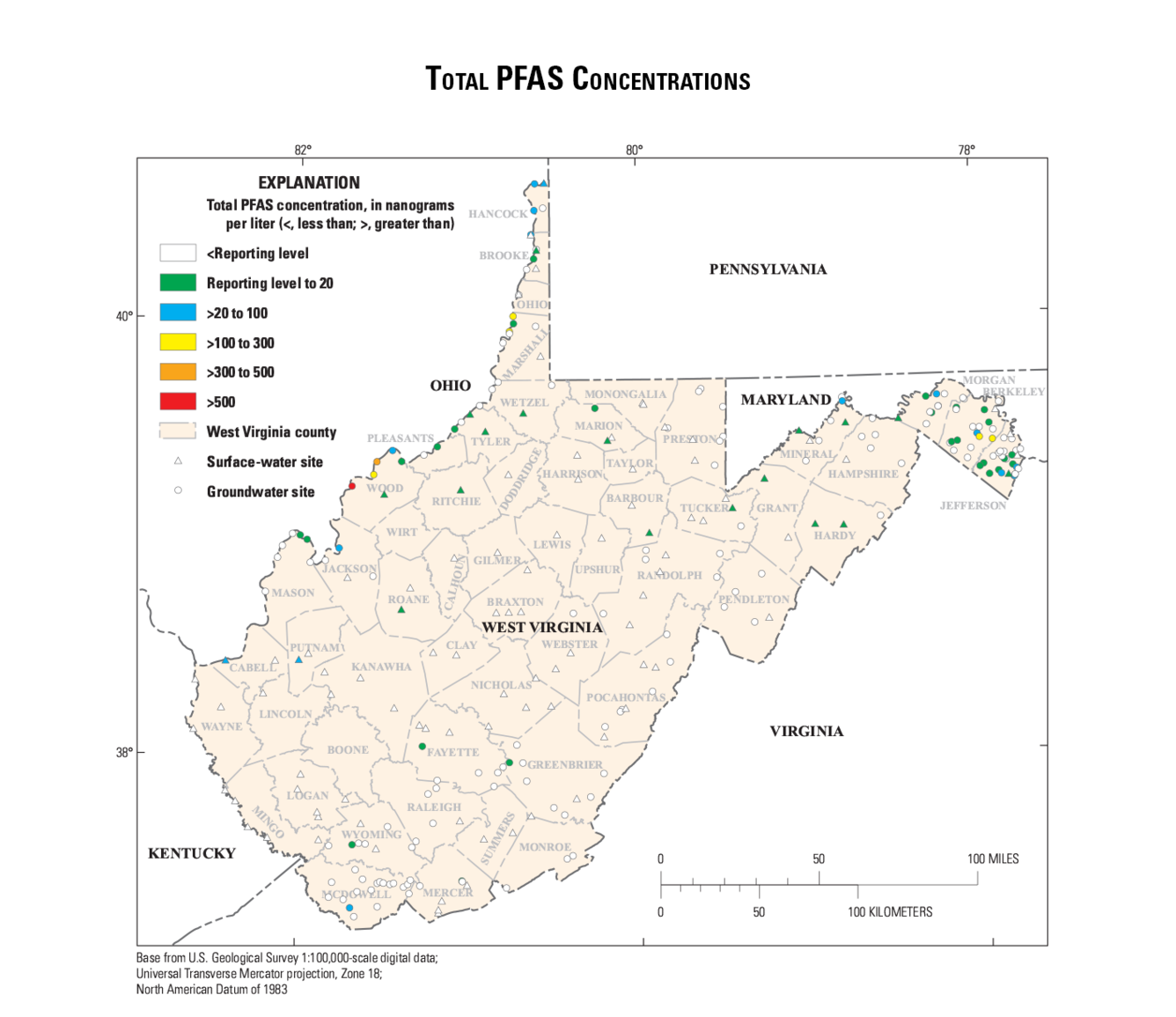
Out of 279 sites sampled, 212 sites (76% of sites sampled) had no PFAS detected above the reporting level. Sixty-seven sites (24% of sites sampled) had at least one PFAS detected, 47 of which were in groundwater sources and 20 in surface-water sources.
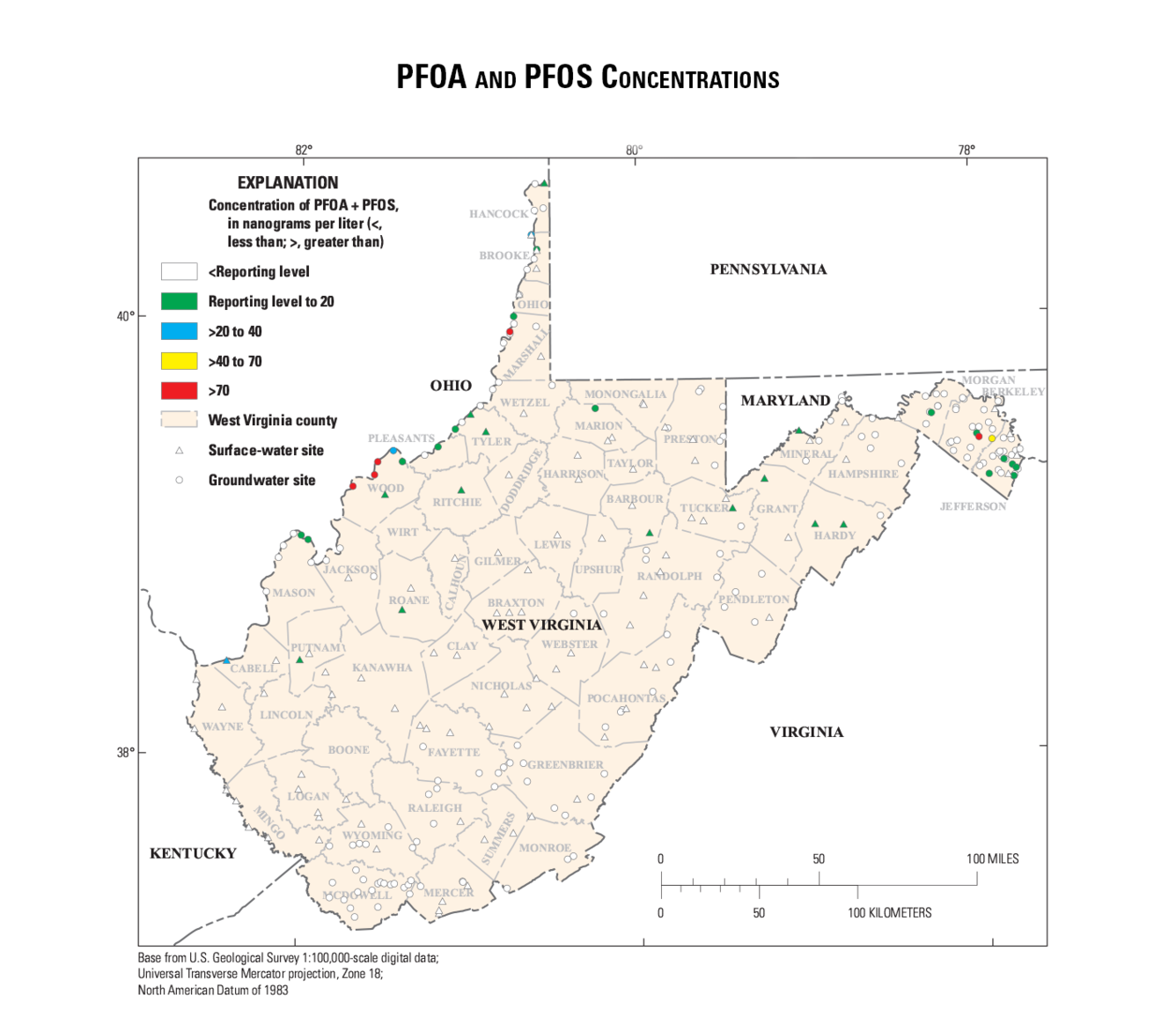
See the maps below for more details on the locations of PFAS sampling in West Virginia, including locations where elevated PFAS was measured.
Citation: McAdoo, M.A., Connock, G.T., and Messinger, T., 2022, Occurrence of per- and polyfluoroalkyl substances and inorganic analytes in groundwater and surface water used as sources for public water supply in West Virginia: U.S. Geological Survey Scientific Investigations Report 2022–5067, 37 p., https://doi.org/10.3133/sir20225067.
Sites with detections for perfluorooctanoic acid (PFOAS) and perfluorooctane sulfonate (PFOS) were highest in the western counties, with four samples exceeding the U.S. Environmental Protection Agency’s health advisory (HA) level of 70 nanograms per liter (ng/L) and three sites with concentrations between 20 and 40 ng/L. West Virginia’s eastern panhandle had one site that exceeded HA and one site with concentrations between 40 and 70 ng/L. These sites were located in highly susceptible karst and alluvial groundwater aquifers on the east and west sides of the state.
Overall, 37 sites had detections above the reporting level for PFOA, PFOS, or both. Eighteen of the 37 sites with detections for PFOA or PFOS were located in counties that border Ohio on the western side of the state in the Ohio River Valley and 13 sites with detections for PFOA or PFOS were located on the eastern side of the state in the eastern panhandle.
It is important to note that the results outlined here represent source water prior to treatment and are not necessarily representative of supplied drinking water.
Sampling
Public-water systems sampled for this study were identified by the West Virginia Department of Health and Human Resources and included systems classified as community water systems (drinking water system that regularly serves at least 25 residents and/or has at least 15 year-round service connections) and all daycares and schools that operate their own water systems.
USGS scientists collected 173 samples from groundwater sources and 106 samples from surface-water sources. In addition to testing for PFAS, this study also measured pH, specific conductance, water temperature, dissolved oxygen, turbidity, and alkalinity for all samples. PFAS was analyzed at all 279 sites, major ions and trace elements were analyzed at 272 sites, and nutrients were analyzed at 270 sites.
It is important to note that data collected for this study do not assess variability in results over time, which may be important at some sites based on local conditions. Further monitoring and study is needed to assess possible temporal variability.
Exposure to some per- and polyfluoroalkyl substances (PFAS) has been linked to harmful health effects in humans and animals. The Virginia and West Virginia Water Science Center works with local and regional partners to determine the drivers and distribution of PFAS contamination in groundwater, surface water, and drinking water supplies across Virginia and West Virginia.
PFAS Investigations at the Virginia and West Virginia Water Science Center
Exposure to some per- and polyfluoroalkyl substances (PFAS) has been linked to harmful health effects in humans and animals. The Virginia and West Virginia Water Science Center works with local and regional partners to determine the drivers and distribution of PFAS contamination in groundwater, surface water, and drinking water supplies across Virginia and West Virginia.
These data were collected to understand the occurrence of per- and polyfluoroalkyl substances (PFAS) in drinking water samples at selected public water systems in West Virginia identified to have detections for PFAS above laboratory reporting levels in previously collected raw-water samples (McAdoo and others, 2022). These data are stored in the USGS National Water Information System...
These data were collected to understand the occurrence of per- and polyfluoroalkyl substances in drinking water samples at public water systems identified to have perfluorooctanoic acid or perfluorooctane sulfonic acid above laboratory reporting levels in previously collected raw-water samples, and provide a review of the analytical results. The West Virginia Department of Health and...
Source water for West Virginia’s public water systems is pumped from groundwater aquifers or withdrawn from the state’s rivers and lakes. These systems provide drinking water to a majority of the state’s population and require constant monitoring for known and emerging contaminants. Groundwater contamination from Per- and Polyfluoroalkyl Substances (PFAS) has occurred in West Virginia...
Collecting raw-water samples from a public water supply pump house in West Virginia
Collecting raw-water samples from a public water supply system pump house. Water is drawn into a sampling chamber (left) to prevent external contamination of the water. A sonde connected to a handheld display (right) records ancillary parameters like pH, temperature, and dissolved oxygen.
Collecting raw-water samples from a public water supply system pump house. Water is drawn into a sampling chamber (left) to prevent external contamination of the water. A sonde connected to a handheld display (right) records ancillary parameters like pH, temperature, and dissolved oxygen.
Collecting raw-water samples from a public water supply pump house in West Virginia
Collecting raw-water samples from a public water supply system pump house. Raw water is the natural water (e.g., groundwater and surface water) that has not yet been treated for human consumption.
Collecting raw-water samples from a public water supply system pump house. Raw water is the natural water (e.g., groundwater and surface water) that has not yet been treated for human consumption.
Cleaning sampling equipment outside of a public water system in West Virginia
Equipment used for water-quality sampling needs thoroughly cleaned to remove lingering contaminants or sediment. In this photo, a peristaltic pump is used to flush three different solutions (liquid detergent, tap water, and deionized water) through the tubing used to collect raw-water samples from the public water supply systems.
Equipment used for water-quality sampling needs thoroughly cleaned to remove lingering contaminants or sediment. In this photo, a peristaltic pump is used to flush three different solutions (liquid detergent, tap water, and deionized water) through the tubing used to collect raw-water samples from the public water supply systems.
Collecting water samples at a public water system in Kanawha County, West Virginia
Hydrologic technicians with the Virginia and West Virginia Water Science Center collect water samples at a public water system in Kanawha County, West Virginia.
Hydrologic technicians with the Virginia and West Virginia Water Science Center collect water samples at a public water system in Kanawha County, West Virginia.
Sampling at a Public Water System in Fayette County, West Virginia
A Virginia and West Virginia Water Science Center hydrologic technician prepares for sampling at a public water system in Fayette County, West Virginia.
A Virginia and West Virginia Water Science Center hydrologic technician prepares for sampling at a public water system in Fayette County, West Virginia.
Recording field parameters at a public water system in Fayette County, West Virginia
A Virginia and West Virginia Water Science Center hydrologic technician records field parameters at a public water system in Fayette County, West Virginia. This sampling was conducted as part of a larger effort to assess the occurrence and distribution of per- and polyfluoroalkyl substances (PFAS) in the source waters of public water systems across West Vi
A Virginia and West Virginia Water Science Center hydrologic technician records field parameters at a public water system in Fayette County, West Virginia. This sampling was conducted as part of a larger effort to assess the occurrence and distribution of per- and polyfluoroalkyl substances (PFAS) in the source waters of public water systems across West Vi
Sampling at a public water system in Wyoming County, West Virginia
Virginia and West Virginia Water Science Center hydrologic technicians collect water samples for per- and polyfluoroalkyl substances (PFAS) and inorganic analytes at a public water system that uses an underground coal mine as a source in Wyoming County, West Virginia. This sampling was conducted as part of a larger effort to assess the occurrence and distributi
Virginia and West Virginia Water Science Center hydrologic technicians collect water samples for per- and polyfluoroalkyl substances (PFAS) and inorganic analytes at a public water system that uses an underground coal mine as a source in Wyoming County, West Virginia. This sampling was conducted as part of a larger effort to assess the occurrence and distributi
Preparing for sampling on the Ohio River near Point Pleasant, West Virginia
A Virginia and West Virginia Water Science Center hydrologic technician, Katherine Grindle, prepares for sampling on the Ohio River near Point Pleasant, West Virginia.
A Virginia and West Virginia Water Science Center hydrologic technician, Katherine Grindle, prepares for sampling on the Ohio River near Point Pleasant, West Virginia.
Sampling for PFAS in a West Virginia Public Water System
Virginia and West Virginia Water Science Center hydrologic technician Chelsea Delsak samples for per- and polyfluoroalkyl substances (PFAS) and inorganic analytes at a public water system in Greenbriar County, West Virginia.
Virginia and West Virginia Water Science Center hydrologic technician Chelsea Delsak samples for per- and polyfluoroalkyl substances (PFAS) and inorganic analytes at a public water system in Greenbriar County, West Virginia.
A USGS van outfitted for water quality sampling at an Ohio groundwater well
A U.S. Geological System van, outfitted on the inside with supplies for extensive water quality sampling, parked next to a groundwater well in Ohio. This sampling was conducted as part of a larger effort to assess the occurrence and distribution of per- and polyfluoroalkyl substances (PFAS) in the source waters of public water systems across West Virginia.
A U.S. Geological System van, outfitted on the inside with supplies for extensive water quality sampling, parked next to a groundwater well in Ohio. This sampling was conducted as part of a larger effort to assess the occurrence and distribution of per- and polyfluoroalkyl substances (PFAS) in the source waters of public water systems across West Virginia.
Mobile water quality lab at a groundwater well in Wood County, West Virginia
A U.S. Geological System van, outfitted on the inside with supplies for extensive water quality sampling, parked next to a groundwater well in Wood County, West Virginia.
A U.S. Geological System van, outfitted on the inside with supplies for extensive water quality sampling, parked next to a groundwater well in Wood County, West Virginia.
Per- and polyfluoroalkyl substances (PFAS) are widely observed anthropogenic compounds found in water supplies worldwide and increasingly linked with adverse health effects in humans. In 2019, the West Virginia Legislature recognized the contamination risk to public source-water supplies posed by PFAS and passed a resolution that required a statewide PFAS study. The purpose of the...
Authors
Mitchell A. McAdoo, Gregory T. Connock, Terence Messinger
This interactive map shares locations where per- and polyfluoroalkyl substances (PFAS) have been sampled by the Virginia and West Virginia Water Science Center in collaboration with partner agencies.
In 2019, the West Virginia legislature recognized the contamination risk to public source-water supplies posed by per- and polyfluoroalkyl substances (PFAS) and passed a resolution that required a statewide PFAS study. The purpose of this resulting study was to understand the occurrence and distribution of PFAS contamination throughout the state’s rivers, lakes, and groundwater aquifers.
This study was led by U.S. Geological Survey (USGS) scientists in cooperation with our partners at the West Virginia Department of Environmental Protection and the West Virginia Department of Health and Human Resources.
Occurrence of per- and polyfluoroalkyl substances and inorganic analytes in groundwater and surface water used as sources for public water supply in West Virginia
This latest report from the Virginia and West Virginia Water Sciences Center outlines our work testing for PFAS in West Virginia's drinking water supply.
USGS Data Release: Data Collected to Assess the Occurrence and Distribution of Per- and Polyfluoroalkyl Substances in West Virginia Public Source-Water Supplies, 2024
Want to access the latest data from this study? This USGS data release serves as the public release of the available data.
Out of 279 sites sampled, 212 sites (76% of sites sampled) had no PFAS detected above the reporting level. Sixty-seven sites (24% of sites sampled) had at least one PFAS detected, 47 of which were in groundwater sources and 20 in surface-water sources.
See the maps below for more details on the locations of PFAS sampling in West Virginia, including locations where elevated PFAS was measured.
Citation: McAdoo, M.A., Connock, G.T., and Messinger, T., 2022, Occurrence of per- and polyfluoroalkyl substances and inorganic analytes in groundwater and surface water used as sources for public water supply in West Virginia: U.S. Geological Survey Scientific Investigations Report 2022–5067, 37 p., https://doi.org/10.3133/sir20225067.
Sites with detections for perfluorooctanoic acid (PFOAS) and perfluorooctane sulfonate (PFOS) were highest in the western counties, with four samples exceeding the U.S. Environmental Protection Agency’s health advisory (HA) level of 70 nanograms per liter (ng/L) and three sites with concentrations between 20 and 40 ng/L. West Virginia’s eastern panhandle had one site that exceeded HA and one site with concentrations between 40 and 70 ng/L. These sites were located in highly susceptible karst and alluvial groundwater aquifers on the east and west sides of the state.
Overall, 37 sites had detections above the reporting level for PFOA, PFOS, or both. Eighteen of the 37 sites with detections for PFOA or PFOS were located in counties that border Ohio on the western side of the state in the Ohio River Valley and 13 sites with detections for PFOA or PFOS were located on the eastern side of the state in the eastern panhandle.
It is important to note that the results outlined here represent source water prior to treatment and are not necessarily representative of supplied drinking water.
Sampling
Public-water systems sampled for this study were identified by the West Virginia Department of Health and Human Resources and included systems classified as community water systems (drinking water system that regularly serves at least 25 residents and/or has at least 15 year-round service connections) and all daycares and schools that operate their own water systems.
USGS scientists collected 173 samples from groundwater sources and 106 samples from surface-water sources. In addition to testing for PFAS, this study also measured pH, specific conductance, water temperature, dissolved oxygen, turbidity, and alkalinity for all samples. PFAS was analyzed at all 279 sites, major ions and trace elements were analyzed at 272 sites, and nutrients were analyzed at 270 sites.
It is important to note that data collected for this study do not assess variability in results over time, which may be important at some sites based on local conditions. Further monitoring and study is needed to assess possible temporal variability.
Exposure to some per- and polyfluoroalkyl substances (PFAS) has been linked to harmful health effects in humans and animals. The Virginia and West Virginia Water Science Center works with local and regional partners to determine the drivers and distribution of PFAS contamination in groundwater, surface water, and drinking water supplies across Virginia and West Virginia.
PFAS Investigations at the Virginia and West Virginia Water Science Center
Exposure to some per- and polyfluoroalkyl substances (PFAS) has been linked to harmful health effects in humans and animals. The Virginia and West Virginia Water Science Center works with local and regional partners to determine the drivers and distribution of PFAS contamination in groundwater, surface water, and drinking water supplies across Virginia and West Virginia.
These data were collected to understand the occurrence of per- and polyfluoroalkyl substances (PFAS) in drinking water samples at selected public water systems in West Virginia identified to have detections for PFAS above laboratory reporting levels in previously collected raw-water samples (McAdoo and others, 2022). These data are stored in the USGS National Water Information System...
These data were collected to understand the occurrence of per- and polyfluoroalkyl substances in drinking water samples at public water systems identified to have perfluorooctanoic acid or perfluorooctane sulfonic acid above laboratory reporting levels in previously collected raw-water samples, and provide a review of the analytical results. The West Virginia Department of Health and...
Source water for West Virginia’s public water systems is pumped from groundwater aquifers or withdrawn from the state’s rivers and lakes. These systems provide drinking water to a majority of the state’s population and require constant monitoring for known and emerging contaminants. Groundwater contamination from Per- and Polyfluoroalkyl Substances (PFAS) has occurred in West Virginia...
Collecting raw-water samples from a public water supply pump house in West Virginia
Collecting raw-water samples from a public water supply system pump house. Water is drawn into a sampling chamber (left) to prevent external contamination of the water. A sonde connected to a handheld display (right) records ancillary parameters like pH, temperature, and dissolved oxygen.
Collecting raw-water samples from a public water supply system pump house. Water is drawn into a sampling chamber (left) to prevent external contamination of the water. A sonde connected to a handheld display (right) records ancillary parameters like pH, temperature, and dissolved oxygen.
Collecting raw-water samples from a public water supply pump house in West Virginia
Collecting raw-water samples from a public water supply system pump house. Raw water is the natural water (e.g., groundwater and surface water) that has not yet been treated for human consumption.
Collecting raw-water samples from a public water supply system pump house. Raw water is the natural water (e.g., groundwater and surface water) that has not yet been treated for human consumption.
Cleaning sampling equipment outside of a public water system in West Virginia
Equipment used for water-quality sampling needs thoroughly cleaned to remove lingering contaminants or sediment. In this photo, a peristaltic pump is used to flush three different solutions (liquid detergent, tap water, and deionized water) through the tubing used to collect raw-water samples from the public water supply systems.
Equipment used for water-quality sampling needs thoroughly cleaned to remove lingering contaminants or sediment. In this photo, a peristaltic pump is used to flush three different solutions (liquid detergent, tap water, and deionized water) through the tubing used to collect raw-water samples from the public water supply systems.
Collecting water samples at a public water system in Kanawha County, West Virginia
Hydrologic technicians with the Virginia and West Virginia Water Science Center collect water samples at a public water system in Kanawha County, West Virginia.
Hydrologic technicians with the Virginia and West Virginia Water Science Center collect water samples at a public water system in Kanawha County, West Virginia.
Sampling at a Public Water System in Fayette County, West Virginia
A Virginia and West Virginia Water Science Center hydrologic technician prepares for sampling at a public water system in Fayette County, West Virginia.
A Virginia and West Virginia Water Science Center hydrologic technician prepares for sampling at a public water system in Fayette County, West Virginia.
Recording field parameters at a public water system in Fayette County, West Virginia
A Virginia and West Virginia Water Science Center hydrologic technician records field parameters at a public water system in Fayette County, West Virginia. This sampling was conducted as part of a larger effort to assess the occurrence and distribution of per- and polyfluoroalkyl substances (PFAS) in the source waters of public water systems across West Vi
A Virginia and West Virginia Water Science Center hydrologic technician records field parameters at a public water system in Fayette County, West Virginia. This sampling was conducted as part of a larger effort to assess the occurrence and distribution of per- and polyfluoroalkyl substances (PFAS) in the source waters of public water systems across West Vi
Sampling at a public water system in Wyoming County, West Virginia
Virginia and West Virginia Water Science Center hydrologic technicians collect water samples for per- and polyfluoroalkyl substances (PFAS) and inorganic analytes at a public water system that uses an underground coal mine as a source in Wyoming County, West Virginia. This sampling was conducted as part of a larger effort to assess the occurrence and distributi
Virginia and West Virginia Water Science Center hydrologic technicians collect water samples for per- and polyfluoroalkyl substances (PFAS) and inorganic analytes at a public water system that uses an underground coal mine as a source in Wyoming County, West Virginia. This sampling was conducted as part of a larger effort to assess the occurrence and distributi
Preparing for sampling on the Ohio River near Point Pleasant, West Virginia
A Virginia and West Virginia Water Science Center hydrologic technician, Katherine Grindle, prepares for sampling on the Ohio River near Point Pleasant, West Virginia.
A Virginia and West Virginia Water Science Center hydrologic technician, Katherine Grindle, prepares for sampling on the Ohio River near Point Pleasant, West Virginia.
Sampling for PFAS in a West Virginia Public Water System
Virginia and West Virginia Water Science Center hydrologic technician Chelsea Delsak samples for per- and polyfluoroalkyl substances (PFAS) and inorganic analytes at a public water system in Greenbriar County, West Virginia.
Virginia and West Virginia Water Science Center hydrologic technician Chelsea Delsak samples for per- and polyfluoroalkyl substances (PFAS) and inorganic analytes at a public water system in Greenbriar County, West Virginia.
A USGS van outfitted for water quality sampling at an Ohio groundwater well
A U.S. Geological System van, outfitted on the inside with supplies for extensive water quality sampling, parked next to a groundwater well in Ohio. This sampling was conducted as part of a larger effort to assess the occurrence and distribution of per- and polyfluoroalkyl substances (PFAS) in the source waters of public water systems across West Virginia.
A U.S. Geological System van, outfitted on the inside with supplies for extensive water quality sampling, parked next to a groundwater well in Ohio. This sampling was conducted as part of a larger effort to assess the occurrence and distribution of per- and polyfluoroalkyl substances (PFAS) in the source waters of public water systems across West Virginia.
Mobile water quality lab at a groundwater well in Wood County, West Virginia
A U.S. Geological System van, outfitted on the inside with supplies for extensive water quality sampling, parked next to a groundwater well in Wood County, West Virginia.
A U.S. Geological System van, outfitted on the inside with supplies for extensive water quality sampling, parked next to a groundwater well in Wood County, West Virginia.
Per- and polyfluoroalkyl substances (PFAS) are widely observed anthropogenic compounds found in water supplies worldwide and increasingly linked with adverse health effects in humans. In 2019, the West Virginia Legislature recognized the contamination risk to public source-water supplies posed by PFAS and passed a resolution that required a statewide PFAS study. The purpose of the...
Authors
Mitchell A. McAdoo, Gregory T. Connock, Terence Messinger
This interactive map shares locations where per- and polyfluoroalkyl substances (PFAS) have been sampled by the Virginia and West Virginia Water Science Center in collaboration with partner agencies.