



Greater Sage-Grouse Population Monitoring Framework Data Inputs Information Sheet
To support management decisions, western state wildlife agencies identified the need for a range-wide database that tracks annual counts of greater sage-grouse (Centrocercus urophasianus; sage-grouse) at leks (breeding sites), which have been recorded since the early 1950s. Researchers at Colorado State University (CSU) and U.S. Geological Survey (USGS) worked with state wildlife agencies to: 1) construct this range-wide lek count database, and 2) develop biologically relevant and spatially nested sage-grouse clusters that could inform monitoring and management actions intended to benefit sage-grouse populations and habitats.
Research Objective
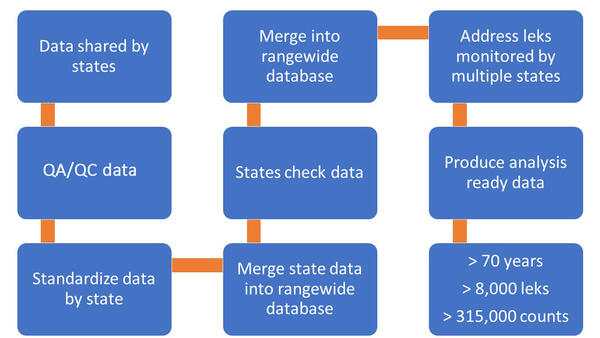
The range-wide sage-grouse population database presents one of the most extensive wildlife monitoring efforts worldwide and provides a significant resource to inform wildlife and habitat management for a species previously considered for listing under the Endangered Species Act. Eleven state agencies provided the lek count data that serve as the foundation of the database (Figure 1). The database is housed at CSU based on established agreements between CSU and state wildlife agencies. The USGS and CSU used this database to develop the population monitoring framework. The compilation of lek data across the range enables new, comprehensive inferences about sage-grouse population trends that inform effective management. Because the database is updated annually with the most recent available information, it supports real-time management decisions.
The clusters provide new, biologically relevant boundaries for monitoring sage-grouse trends across multiple spatial scales. Contrary to these new population units, wildlife management boundaries are typically interrupted by state borders and other administrative boundaries, disrupting the biological context and the methods used to evaluate populations. The hierarchical clusters capture factors that influence both regional trends and population structure and connectivity. These spatial units support future investigations of factors affecting populations by considering multiple biologically based scales and by alleviating the mismatch between jurisdictional units and the biological scale of sage-grouse population responses. This allows practitioners to manage sage-grouse at biologically relevant scales, thereby promoting effective outcomes.

Researchers developed the clusters (i.e., nested population units) by grouping leks across the species’ range (within the United States) at different spatial scales. These clusters were then used to estimate population trends across 13 spatial scales. Two of those scales were selected to represent a fine (Neighborhood Cluster [NC]) and a broad spatial scale (Climate Cluster [CC]) with input from state wildlife agencies. The researchers used movement data from radio and global positioning system (GPS) marked sage-grouse to inform the NC scale, and relationships between precipitation and rate of change in population abundance to inform the CC scale.
Trends estimated at the CC scale capture regional environmental conditions (Figure 2). The lek and NC scales capture environmental conditions and local disturbances, ranging in size from point sources such as infrastructure development to large wildfires. The NCs have an additional advantage: the location of their boundaries minimizes movement among clusters, thereby reducing the potential effects that those movements could have on estimating trends in population size.
Together, the range-wide sage-grouse population database and the population Clusters serve as the basis for developing a hierarchical population monitoring framework for sage-grouse management. This framework allows managers to assess regional and local sage-grouse population trends over time, identify populations that may warrant additional monitoring or management, and adjust management actions based on near-real-time population changes. Therefore, these products can greatly assist state and federal agencies in making informed, targeted, and cost-effective decisions within an adaptive management framework.
Co-production
We continue to work with all collaborators to advance the science needed for sage-grouse management. Each year, we develop an updated version of a range-wide standardized lek count database to include new counts and historical corrections with improvements to data quality using rigorous quality control and assurance methods. During this process, software is updated, peer-reviewed, and released to the public. The trends and TAWS models are run with the most recent lek data provided by state partners. The results are published in a USGS Data Series report and incorporated into the trends and TAWS decision-support software. We continue to inform partners of updates and improvements to the model and facilitate the incorporation of new features and outputs within the application.
Data restrictions
State wildlife agencies collect and manage lek databases. Because sage-grouse are a species of conservation concern and sensitive to activities during breeding, these data are available only after acquiring formal data-sharing agreements with individual states.
Funders
U.S. Geological Survey (Ecosystem Mission Area, Land Management Research Program and Species Management Research Program, Wyoming Landscape Conservation Initiative) and U.S. Bureau of Land Management.
Partners
State Wildlife Agencies (California Department of Fish and Wildlife; Colorado Parks and Wildlife; Idaho Department of Fish and Game; Montana Fish, Wildlife & Parks; Nevada Department of Wildlife; North Dakota Game and Fish Department; Oregon Department of Fish and Wildlife; South Dakota Department of Game, Fish and Parks; Utah Division of Wildlife Resources; Wyoming Game and Fish Department; Washington Department of Fish and Wildlife), Colorado State University, BLM, US Fish and Wildlife Service, US Forest Service, researchers who provided field data to evaluate results.

Data Harmonization for Greater Sage-Grouse Populations

Greater Sage-Grouse Population Monitoring Framework

Hierarchical Units of Greater Sage-Grouse Populations Informing Wildlife Management
To support management decisions, western state wildlife agencies identified the need for a range-wide database that tracks annual counts of greater sage-grouse (Centrocercus urophasianus; sage-grouse) at leks (breeding sites), which have been recorded since the early 1950s. Researchers at Colorado State University (CSU) and U.S. Geological Survey (USGS) worked with state wildlife agencies to: 1) construct this range-wide lek count database, and 2) develop biologically relevant and spatially nested sage-grouse clusters that could inform monitoring and management actions intended to benefit sage-grouse populations and habitats.
Research Objective
The range-wide sage-grouse population database presents one of the most extensive wildlife monitoring efforts worldwide and provides a significant resource to inform wildlife and habitat management for a species previously considered for listing under the Endangered Species Act. Eleven state agencies provided the lek count data that serve as the foundation of the database (Figure 1). The database is housed at CSU based on established agreements between CSU and state wildlife agencies. The USGS and CSU used this database to develop the population monitoring framework. The compilation of lek data across the range enables new, comprehensive inferences about sage-grouse population trends that inform effective management. Because the database is updated annually with the most recent available information, it supports real-time management decisions.
The clusters provide new, biologically relevant boundaries for monitoring sage-grouse trends across multiple spatial scales. Contrary to these new population units, wildlife management boundaries are typically interrupted by state borders and other administrative boundaries, disrupting the biological context and the methods used to evaluate populations. The hierarchical clusters capture factors that influence both regional trends and population structure and connectivity. These spatial units support future investigations of factors affecting populations by considering multiple biologically based scales and by alleviating the mismatch between jurisdictional units and the biological scale of sage-grouse population responses. This allows practitioners to manage sage-grouse at biologically relevant scales, thereby promoting effective outcomes.
Researchers developed the clusters (i.e., nested population units) by grouping leks across the species’ range (within the United States) at different spatial scales. These clusters were then used to estimate population trends across 13 spatial scales. Two of those scales were selected to represent a fine (Neighborhood Cluster [NC]) and a broad spatial scale (Climate Cluster [CC]) with input from state wildlife agencies. The researchers used movement data from radio and global positioning system (GPS) marked sage-grouse to inform the NC scale, and relationships between precipitation and rate of change in population abundance to inform the CC scale.
Trends estimated at the CC scale capture regional environmental conditions (Figure 2). The lek and NC scales capture environmental conditions and local disturbances, ranging in size from point sources such as infrastructure development to large wildfires. The NCs have an additional advantage: the location of their boundaries minimizes movement among clusters, thereby reducing the potential effects that those movements could have on estimating trends in population size.
Together, the range-wide sage-grouse population database and the population Clusters serve as the basis for developing a hierarchical population monitoring framework for sage-grouse management. This framework allows managers to assess regional and local sage-grouse population trends over time, identify populations that may warrant additional monitoring or management, and adjust management actions based on near-real-time population changes. Therefore, these products can greatly assist state and federal agencies in making informed, targeted, and cost-effective decisions within an adaptive management framework.
Co-production
We continue to work with all collaborators to advance the science needed for sage-grouse management. Each year, we develop an updated version of a range-wide standardized lek count database to include new counts and historical corrections with improvements to data quality using rigorous quality control and assurance methods. During this process, software is updated, peer-reviewed, and released to the public. The trends and TAWS models are run with the most recent lek data provided by state partners. The results are published in a USGS Data Series report and incorporated into the trends and TAWS decision-support software. We continue to inform partners of updates and improvements to the model and facilitate the incorporation of new features and outputs within the application.
Data restrictions
State wildlife agencies collect and manage lek databases. Because sage-grouse are a species of conservation concern and sensitive to activities during breeding, these data are available only after acquiring formal data-sharing agreements with individual states.
Funders
U.S. Geological Survey (Ecosystem Mission Area, Land Management Research Program and Species Management Research Program, Wyoming Landscape Conservation Initiative) and U.S. Bureau of Land Management.
Partners
State Wildlife Agencies (California Department of Fish and Wildlife; Colorado Parks and Wildlife; Idaho Department of Fish and Game; Montana Fish, Wildlife & Parks; Nevada Department of Wildlife; North Dakota Game and Fish Department; Oregon Department of Fish and Wildlife; South Dakota Department of Game, Fish and Parks; Utah Division of Wildlife Resources; Wyoming Game and Fish Department; Washington Department of Fish and Wildlife), Colorado State University, BLM, US Fish and Wildlife Service, US Forest Service, researchers who provided field data to evaluate results.
Data Harmonization for Greater Sage-Grouse Populations
Greater Sage-Grouse Population Monitoring Framework