



Digital Shoreline Analysis System (DSAS)
Software for calculating positional boundary change over time
The Digital Shoreline Analysis System (DSAS) version 6 is a standalone application that calculates shoreline or boundary change over time. The GIS of a user’s choice is used to prepare the data for DSAS. Like previous versions, DSAS v.6 enables a user to calculate rate-of-change statistics from multiple historical shoreline positions. It provides an automated method for establishing measurement transects, performs rate calculations, and provides uncertainties associated with rates of change. A user-friendly interface allows the user to complete the workflow for shoreline change analysis.
Suggested citation:
Henderson, R.E., Farris, A.S., Kratzmann, M.G., Bartlett, M.K., Ergul, A., McAndrews, J., Cibaj, R., Zichichi, J.L., Himmelstoss, E.A., and Thieler, E.R., 2026, Digital Shoreline Analysis System version 6.2: U.S. Geological Survey software release, https://doi.org/10.5066/P1YPRKBM.
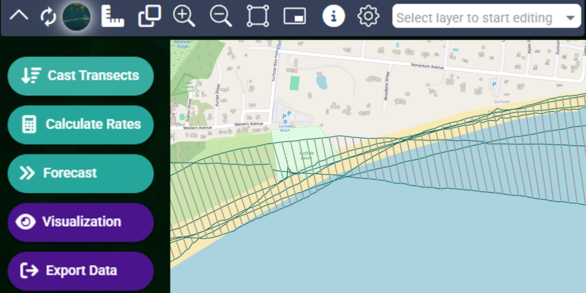
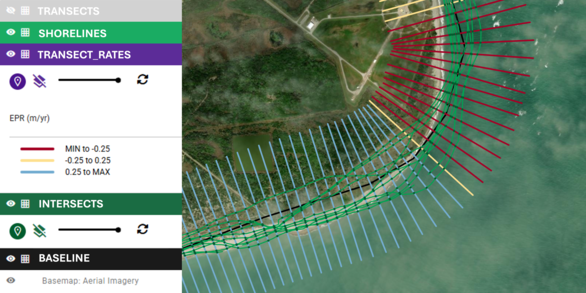
The existing user guide written for DSAS v.5.1 is available and applicable to many aspects of DSAS v6.2. Please see the current "Quick Start Guide" for details on using the existing guide with the new stand-alone application. Relevant information providing instruction on the DSAS workflow including how to define a reference baseline for measurements, attribute requirements for baselines and shorelines, and supporting information on rate calculations and statistics is documented in the original user guide.
For additional questions please contact DSAS_help@usgs.gov
Current Version
DSAS version 6.2 was released in October 2026 and is publicly available.
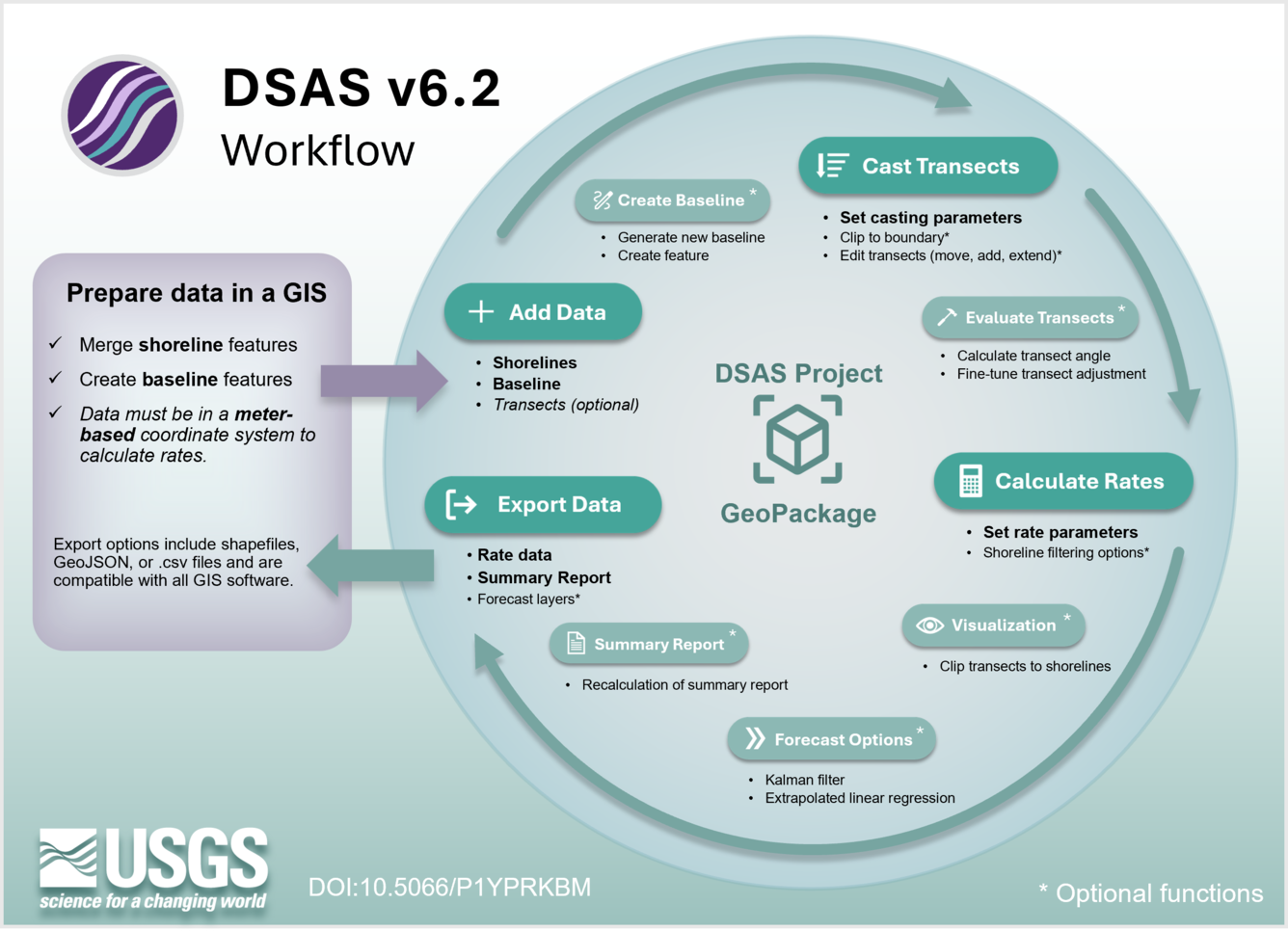
Baseline and shoreline data are prepared in a GIS, then uploaded to DSAS in either shapefile or GeoJSON format. Once uploaded, data are stored in a GeoPackage. Basic editing tools may be used to edit within DSAS, but extensive editing is recommended to be done in a GIS.
DSAS version 6.2 combines all prior functionality including: regression metrics and distance measurements; FDGC-consistent metadata; a summary report; shoreline forecasting; the application of the proxy-datum bias; data editing options; and enhanced data visualization options. In addition, features NEW to DSAS include: a tool for baseline creation; the option to clip transects to an imported feature; the visualization of shorelines by date; a tool to calculate and record the average angle of the shorelines to the transect, with an advanced option to automatically adjust the transect angle; options to filter rate calculation by subsampling shorelines (using date range, month, or other feature attributes), and the per-transect visualization of shoreline positions through time. These advancements make DSAS a powerful boundary change tool with broad applications for research, while also improving accessibility and flexibility for a wide range of projects and users.
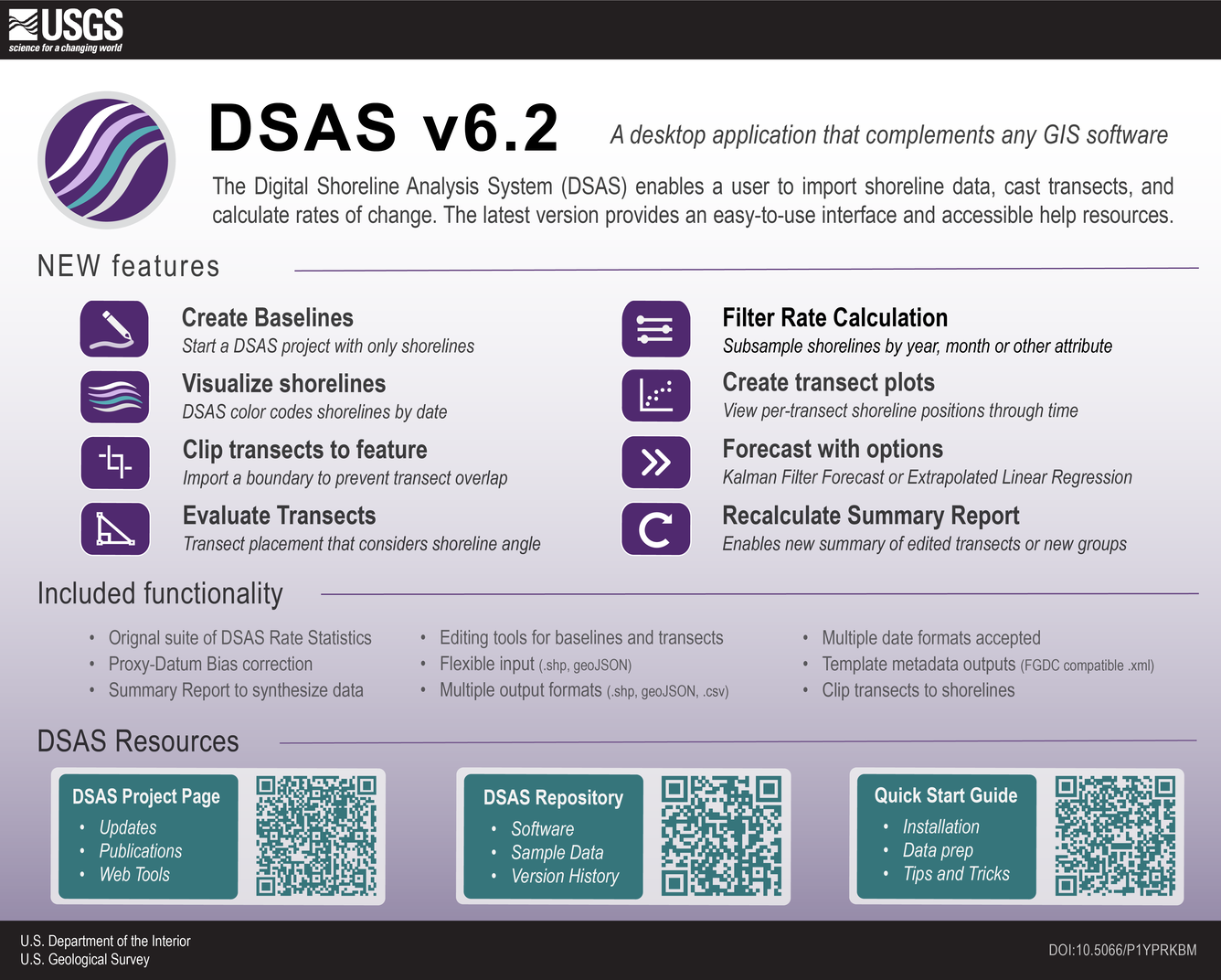
In DSAS v6.2, data layers are stored in a GeoPackage (.gpkg), a single simple file format that is able to contain multiple datasets of geographic features. It is an open, standards-based, platform-independent, vendor-independent, SQLite database file.
When a data file (shapefile or GeoJSON) is added to a DSAS project, it is then contained in the GeoPackage (see Add Layer > GEOPACKAGE tab). Any edits made in DSAS will ONLY apply to the layer within the GeoPackage. The original shapefile or geoJSON file that was uploaded remains unchanged.
To use DSAS-generated data externally (in Esri’s ArcGIS Pro, for example), the data can be exported. Users may export layers from the GeoPackage in several formats through the Export Data button on the DSAS function toolbar. For more information about GeoPackages, please consult the Open Geospatial Consortium (OGC) website.
Introduction
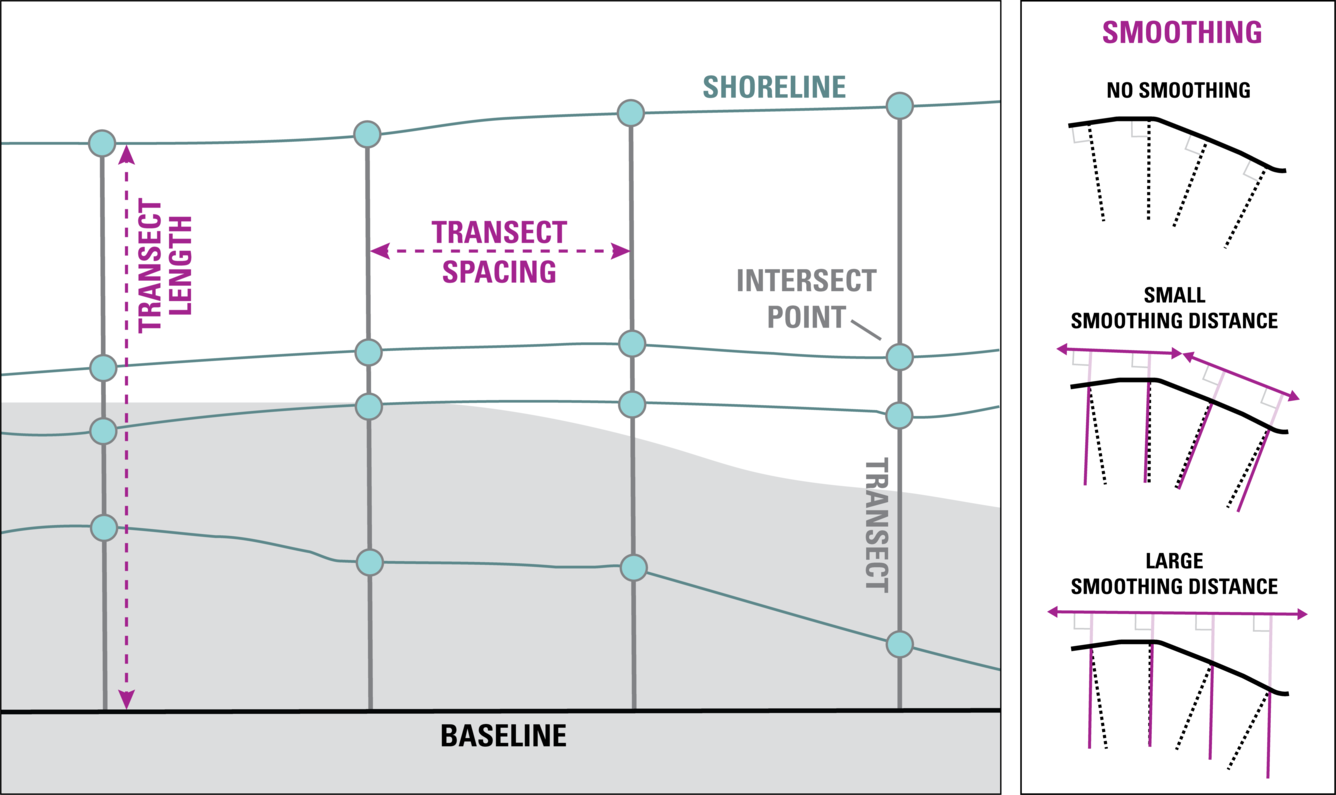
DSAS generates transects that are cast perpendicular to the reference baseline to intersect shorelines at a user-specified spacing alongshore. In DSAS v6.2, onshore, offshore, and midshore (or combination) baselines are accepted.
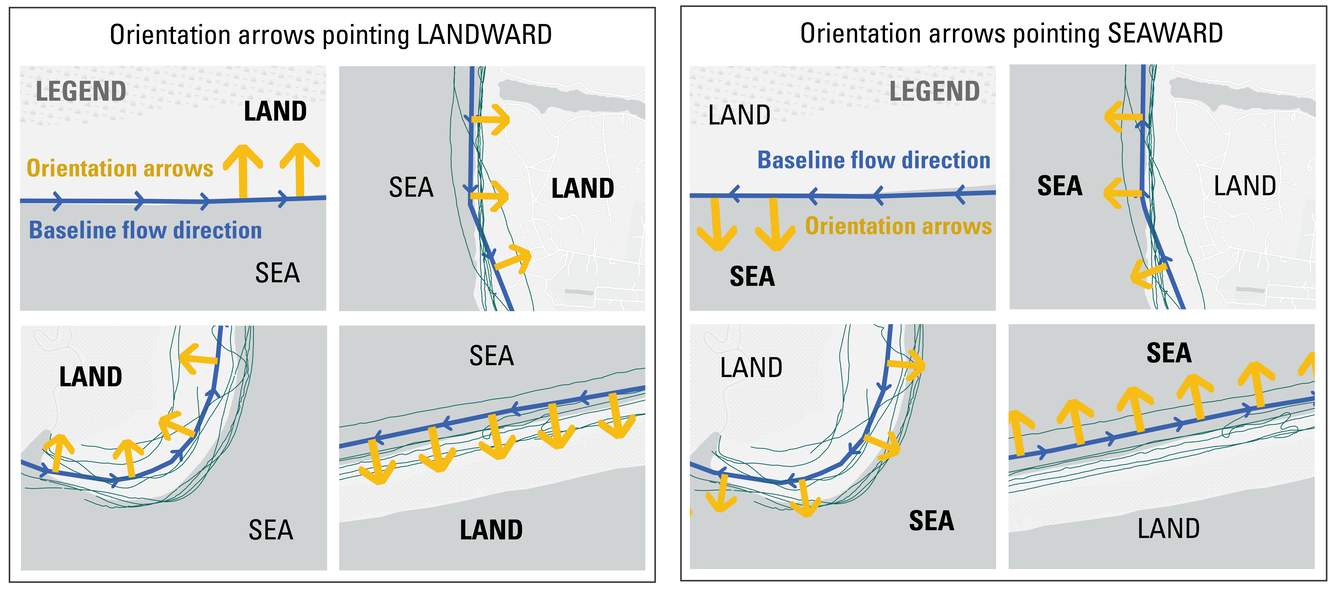
If a midshore baseline is uploaded, the user must accurately identify orientation of the baseline with respect to land so that DSAS calculates rates with the correct sign indicating accretion (+) or erosion (-). See the graphic below for demonstration of various baseline orientations, and the correct identification of baseline orientation arrows.
DSAS measures the distance between the baseline and each shoreline intersection along a transect, and combines date information, and positional uncertainty for each shoreline, to generate the following change metrics (see DSAS v.5.1 user guide for more detail):
Distance measurements:
- Shoreline Change Envelope (SCE)
- Net Shoreline Movement (NSM)
Statistics:
- End Point Rate (EPR)
- Uncertainty of the End Point Rate (EPRunc)
- Linear Regression Rate (LRR)
- Confidence Interval (LCI)
- Standard Error (LSE)
- R-squared (LR2)
- Weighted Linear Regression Rate (WLR)
- Confidence Interval (WCI)
- Standard Error (WSE)
- R-squared (WR2)
The results of all calculations are output to a rates layer, an intersects file, and associated metadata files within the DSAS project GeoPackage. Data may be exported as shapefiles, GeoJSON files, .csv files, or be used as a GeoPackage (.gpkg). Users also have the option to generate a summary report (.txt) of the calculation.
History
DSAS has been a central component of the U.S. Geological Survey’s Coastal Change Hazards programmatic focus, providing a robust suite of regression rates in a standardized and easily repeatable method that can be executed on large volumes of data collected at a national scale. The DSAS software is intended to facilitate the shoreline change-calculation process and to provide rate-of-change information and the statistical data necessary to establish the reliability of the calculated results.
The software is also suitable for any application that calculates positional change over time, such as assessing change of glacier limits in sequential aerial photos, river edge boundaries, or land-cover changes. National and state governments worldwide have used the tool in support of resource management and critical coastal decision-making.
The DSAS software was originally developed in the early 1990s and has undergone continuous refinement since that time.
PLEASE NOTE: The USGS End of Life (EOL) date for ArcMap was February 1, 2024, and as of August 2025 the USGS can no longer provide comprehensive support for Esri dependent DSAS versions.
- DSAS version 1.0 (1992) was written in the C and awk programming languages for use with the MapGrafix and ArcInfo Geographic Information Systems
- DSAS version 2.0 was written in Avenue for ArcView 3.x
- DSAS version 3.x (ArcGIS 9)
- DSAS version 4.2 (ArcGIS 9.2-9.3.x)
- DSAS version 4.3 (ArcGIS 10.0-10.3)
- DSAS version 4.4 (ArcGIS 10.4 -10.5)
- DSAS version 5.0 - 5.1 (ArcGIS 10.4 - 10.x)
- DSAS version 6.0 (standalone application)
- DSAS version 6.1 (standalone application)
Current version, 6.2, is a standalone application to be used in conjunction with a GIS.
Software for calculating positional boundary change over time
The Digital Shoreline Analysis System (DSAS) version 6 is a standalone application that calculates shoreline or boundary change over time. The GIS of a user’s choice is used to prepare the data for DSAS. Like previous versions, DSAS v.6 enables a user to calculate rate-of-change statistics from multiple historical shoreline positions. It provides an automated method for establishing measurement transects, performs rate calculations, and provides uncertainties associated with rates of change. A user-friendly interface allows the user to complete the workflow for shoreline change analysis.
Suggested citation:
Henderson, R.E., Farris, A.S., Kratzmann, M.G., Bartlett, M.K., Ergul, A., McAndrews, J., Cibaj, R., Zichichi, J.L., Himmelstoss, E.A., and Thieler, E.R., 2026, Digital Shoreline Analysis System version 6.2: U.S. Geological Survey software release, https://doi.org/10.5066/P1YPRKBM.
The existing user guide written for DSAS v.5.1 is available and applicable to many aspects of DSAS v6.2. Please see the current "Quick Start Guide" for details on using the existing guide with the new stand-alone application. Relevant information providing instruction on the DSAS workflow including how to define a reference baseline for measurements, attribute requirements for baselines and shorelines, and supporting information on rate calculations and statistics is documented in the original user guide.
For additional questions please contact DSAS_help@usgs.gov
Current Version
DSAS version 6.2 was released in October 2026 and is publicly available.
Baseline and shoreline data are prepared in a GIS, then uploaded to DSAS in either shapefile or GeoJSON format. Once uploaded, data are stored in a GeoPackage. Basic editing tools may be used to edit within DSAS, but extensive editing is recommended to be done in a GIS.
DSAS version 6.2 combines all prior functionality including: regression metrics and distance measurements; FDGC-consistent metadata; a summary report; shoreline forecasting; the application of the proxy-datum bias; data editing options; and enhanced data visualization options. In addition, features NEW to DSAS include: a tool for baseline creation; the option to clip transects to an imported feature; the visualization of shorelines by date; a tool to calculate and record the average angle of the shorelines to the transect, with an advanced option to automatically adjust the transect angle; options to filter rate calculation by subsampling shorelines (using date range, month, or other feature attributes), and the per-transect visualization of shoreline positions through time. These advancements make DSAS a powerful boundary change tool with broad applications for research, while also improving accessibility and flexibility for a wide range of projects and users.
In DSAS v6.2, data layers are stored in a GeoPackage (.gpkg), a single simple file format that is able to contain multiple datasets of geographic features. It is an open, standards-based, platform-independent, vendor-independent, SQLite database file.
When a data file (shapefile or GeoJSON) is added to a DSAS project, it is then contained in the GeoPackage (see Add Layer > GEOPACKAGE tab). Any edits made in DSAS will ONLY apply to the layer within the GeoPackage. The original shapefile or geoJSON file that was uploaded remains unchanged.
To use DSAS-generated data externally (in Esri’s ArcGIS Pro, for example), the data can be exported. Users may export layers from the GeoPackage in several formats through the Export Data button on the DSAS function toolbar. For more information about GeoPackages, please consult the Open Geospatial Consortium (OGC) website.
Introduction
DSAS generates transects that are cast perpendicular to the reference baseline to intersect shorelines at a user-specified spacing alongshore. In DSAS v6.2, onshore, offshore, and midshore (or combination) baselines are accepted.
If a midshore baseline is uploaded, the user must accurately identify orientation of the baseline with respect to land so that DSAS calculates rates with the correct sign indicating accretion (+) or erosion (-). See the graphic below for demonstration of various baseline orientations, and the correct identification of baseline orientation arrows.
DSAS measures the distance between the baseline and each shoreline intersection along a transect, and combines date information, and positional uncertainty for each shoreline, to generate the following change metrics (see DSAS v.5.1 user guide for more detail):
Distance measurements:
- Shoreline Change Envelope (SCE)
- Net Shoreline Movement (NSM)
Statistics:
- End Point Rate (EPR)
- Uncertainty of the End Point Rate (EPRunc)
- Linear Regression Rate (LRR)
- Confidence Interval (LCI)
- Standard Error (LSE)
- R-squared (LR2)
- Weighted Linear Regression Rate (WLR)
- Confidence Interval (WCI)
- Standard Error (WSE)
- R-squared (WR2)
The results of all calculations are output to a rates layer, an intersects file, and associated metadata files within the DSAS project GeoPackage. Data may be exported as shapefiles, GeoJSON files, .csv files, or be used as a GeoPackage (.gpkg). Users also have the option to generate a summary report (.txt) of the calculation.
History
DSAS has been a central component of the U.S. Geological Survey’s Coastal Change Hazards programmatic focus, providing a robust suite of regression rates in a standardized and easily repeatable method that can be executed on large volumes of data collected at a national scale. The DSAS software is intended to facilitate the shoreline change-calculation process and to provide rate-of-change information and the statistical data necessary to establish the reliability of the calculated results.
The software is also suitable for any application that calculates positional change over time, such as assessing change of glacier limits in sequential aerial photos, river edge boundaries, or land-cover changes. National and state governments worldwide have used the tool in support of resource management and critical coastal decision-making.
The DSAS software was originally developed in the early 1990s and has undergone continuous refinement since that time.
PLEASE NOTE: The USGS End of Life (EOL) date for ArcMap was February 1, 2024, and as of August 2025 the USGS can no longer provide comprehensive support for Esri dependent DSAS versions.
- DSAS version 1.0 (1992) was written in the C and awk programming languages for use with the MapGrafix and ArcInfo Geographic Information Systems
- DSAS version 2.0 was written in Avenue for ArcView 3.x
- DSAS version 3.x (ArcGIS 9)
- DSAS version 4.2 (ArcGIS 9.2-9.3.x)
- DSAS version 4.3 (ArcGIS 10.0-10.3)
- DSAS version 4.4 (ArcGIS 10.4 -10.5)
- DSAS version 5.0 - 5.1 (ArcGIS 10.4 - 10.x)
- DSAS version 6.0 (standalone application)
- DSAS version 6.1 (standalone application)
Current version, 6.2, is a standalone application to be used in conjunction with a GIS.