
U.S. flag

An official website of the United States government

Invasive Species Ecology

Filter Total Items: 8
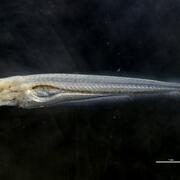
Early Life History of Bighead, Silver, Black, and Grass Carps

Grass, bighead, black, and silver carps spawn in turbulent rivers, their eggs develop and hatch while drifting downriver. The larvae have a short period of development in the drift, and then they must swim from the mainstem of the river and find appropriate low- or no-flow nursery areas. Rivers which are not long enough, turbulent enough, or without nursery areas in the correct locations are not...
Early Life History of Bighead, Silver, Black, and Grass Carps

Early Life History of Bighead, Silver, Black, and Grass Carps

Grass, bighead, black, and silver carps spawn in turbulent rivers, their eggs develop and hatch while drifting downriver. The larvae have a short period of development in the drift, and then they must swim from the mainstem of the river and find appropriate low- or no-flow nursery areas. Rivers which are not long enough, turbulent enough, or without nursery areas in the correct locations are not...
Learn More

Modeling and Ecology in Action: Informing Invasive Species Management

The modeling team is at the forefront of developing and applying advanced quantitative methods to better understand and manage invasive species.
Modeling and Ecology in Action: Informing Invasive Species Management

Modeling and Ecology in Action: Informing Invasive Species Management

The modeling team is at the forefront of developing and applying advanced quantitative methods to better understand and manage invasive species.
Learn More

Black Carp Biology, Assessment, and Control

Black Carp ( Mylopharyngodon piceus) is the largest of the four non-indigenous carp species, reaching sizes well in excess of 100 pounds. Scientists at the Columbia Environmental Research Center, in cooperation with federal and state partners, are studying the biology, ecology, and behavior of black carp and developing tools to monitor, assess, and control this non-indigenous species.
Black Carp Biology, Assessment, and Control

Black Carp Biology, Assessment, and Control

Black Carp ( Mylopharyngodon piceus) is the largest of the four non-indigenous carp species, reaching sizes well in excess of 100 pounds. Scientists at the Columbia Environmental Research Center, in cooperation with federal and state partners, are studying the biology, ecology, and behavior of black carp and developing tools to monitor, assess, and control this non-indigenous species.
Learn More

Use and Evaluation of Stimuli for Herding Bigheaded Carps to Increase their Capture Efficiency

Mass removal of the invasive silver carp Hypophthalmichthys molitrix and bighead carp Hypophthalmichthys nobilis (collectively referred to as bigheaded carp) is a primary management action in the United States to contain population growth and reduce upstream dispersal. Efficient capture and removal techniques are required to achieve this goal, and the USGS is working to develop and evaluate such...
Use and Evaluation of Stimuli for Herding Bigheaded Carps to Increase their Capture Efficiency

Use and Evaluation of Stimuli for Herding Bigheaded Carps to Increase their Capture Efficiency

Mass removal of the invasive silver carp Hypophthalmichthys molitrix and bighead carp Hypophthalmichthys nobilis (collectively referred to as bigheaded carp) is a primary management action in the United States to contain population growth and reduce upstream dispersal. Efficient capture and removal techniques are required to achieve this goal, and the USGS is working to develop and evaluate such...
Learn More

Development and Evaluation of Novel Capture Gears for Bigheaded Carps

Mass removal of Silver Carp Hypophthalmichthys molitrix and Bighead Carp Hypophthalmichthys nobilis, hereafter referred to as bigheaded carps, is a primary management action to contain the population growth and reduce upstream dispersal. The use of passive trap nets to harvest bigheaded carps may effectively supplement active capture techniques. The USGS is working with partner agencies to develop...
Development and Evaluation of Novel Capture Gears for Bigheaded Carps

Development and Evaluation of Novel Capture Gears for Bigheaded Carps

Mass removal of Silver Carp Hypophthalmichthys molitrix and Bighead Carp Hypophthalmichthys nobilis, hereafter referred to as bigheaded carps, is a primary management action to contain the population growth and reduce upstream dispersal. The use of passive trap nets to harvest bigheaded carps may effectively supplement active capture techniques. The USGS is working with partner agencies to develop...
Learn More

Chemical Attractant Investigations to Increase Aggregation and Harvest for the Control of Invasive Carp

Silver Carp Hypophthalmichthys molitrix and Bighead Carp Hypophthalmichthys nobilis, hereafter referred to as bigheaded carps, are rapidly expanding their range. Federal agencies and the Illinois Department of Natural Resources are focused on keeping invasive carps out of the Great Lakes. The development of an effective attractant may assist managers with capturing carps in low-density areas such...
Chemical Attractant Investigations to Increase Aggregation and Harvest for the Control of Invasive Carp

Chemical Attractant Investigations to Increase Aggregation and Harvest for the Control of Invasive Carp

Silver Carp Hypophthalmichthys molitrix and Bighead Carp Hypophthalmichthys nobilis, hereafter referred to as bigheaded carps, are rapidly expanding their range. Federal agencies and the Illinois Department of Natural Resources are focused on keeping invasive carps out of the Great Lakes. The development of an effective attractant may assist managers with capturing carps in low-density areas such...
Learn More

Assessment of Acoustic Stimuli for Manipulating Movement of Bigheaded Carps

Invasive Silver Carp Hypophthalmichthys molitrix and Bighead Carp Hypophthalmichthys nobilis, hereafter referred to as bigheaded carps, have displayed a negative phonotactic response when presented with a broadband acoustic stimulus. Additional study is needed to identify effective acoustic stimuli for manipulating bigheaded carp behavior, and to test bigheaded carp responses to those stimuli in...
Assessment of Acoustic Stimuli for Manipulating Movement of Bigheaded Carps

Assessment of Acoustic Stimuli for Manipulating Movement of Bigheaded Carps

Invasive Silver Carp Hypophthalmichthys molitrix and Bighead Carp Hypophthalmichthys nobilis, hereafter referred to as bigheaded carps, have displayed a negative phonotactic response when presented with a broadband acoustic stimulus. Additional study is needed to identify effective acoustic stimuli for manipulating bigheaded carp behavior, and to test bigheaded carp responses to those stimuli in...
Learn More

High Resolution Vegetation Mapping at Palmyra Atoll Using Unoccupied Aerial Systems (UAS)-Acquired Imagery

Lying 1000 miles south of Hawaii, Palmyra Atoll is a marine wilderness co-managed by the US Fish and Wildlife Service and The Nature Conservancy. Beach forests of Pisonia grandis and other vegetation communities provide habitat for thousands of nesting terns, boobies, and other birds. Introduced coconut ( Cocos nucifera) groves and use of Palmyra as a World War II airfield left a legacy of...
High Resolution Vegetation Mapping at Palmyra Atoll Using Unoccupied Aerial Systems (UAS)-Acquired Imagery

High Resolution Vegetation Mapping at Palmyra Atoll Using Unoccupied Aerial Systems (UAS)-Acquired Imagery

Lying 1000 miles south of Hawaii, Palmyra Atoll is a marine wilderness co-managed by the US Fish and Wildlife Service and The Nature Conservancy. Beach forests of Pisonia grandis and other vegetation communities provide habitat for thousands of nesting terns, boobies, and other birds. Introduced coconut ( Cocos nucifera) groves and use of Palmyra as a World War II airfield left a legacy of...
Learn More
Was this page helpful?