



Data Harmonization for Greater Sage-Grouse Populations
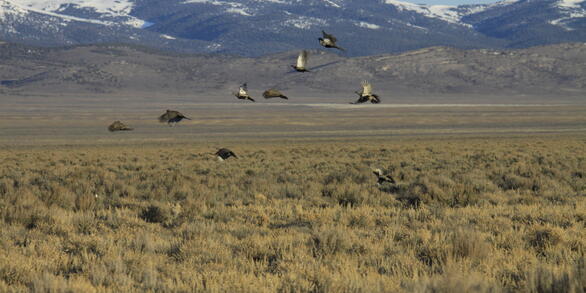
Long-term wildlife monitoring is imperative for understanding population changes that can inform managers. However, working with population data collected by different organizations across multiple jurisdictions and over long time periods can be challenging due to varying data management approaches and organizational priorities. Through this project, we aimed to collaborate with eleven state wildlife agencies to standardize data on greater sage-grouse (Centrocercus urophasianus) populations collected across the sagebrush biome.
Software for compiling and standardizing greater sage-grouse lek databases
Explore the most recent greater sage-grouse lek database (grsg_lekdb) software update.
Additional Framework Components
Explore other components of the Greater Sage-Grouse Monitoring Framework or return to the framework's homepage using the links below.

Background
Each state wildlife agency that manages sage-grouse maintains a database of breeding site locations (leks) and counts of birds collected during the breeding season at each lek. These data help state and federal agencies manage sage-grouse populations and can inform habitat management by understanding when, where, and why populations decline, stabilize, or increase. Monitoring of sage-grouse began as early as the 1950s, but data structures and monitoring protocols varied widely until states established a coordinated effort in the 1990s (Autenrieth and others, 1982)1. However, these monitoring protocols did not specify data standards for combining and using data collected across state boundaries. Therefore, we sought to standardize sage-grouse population data to support a collaborative environment between state and federal agencies that improves management across jurisdictional boundaries.
Methods
Researchers at USGS and Colorado State University (CSU) worked with state wildlife agencies to develop data-sharing agreements detailing the use and handling of sensitive sage-grouse data. Sage-grouse are a species of conservation concern and require protection of lek sites because they return to the same locations for generations, creating a direct link to breeding habitats. We examined all state-level data for errors and inconsistencies in formatting, terminology, and definitions before proposing a method to standardize and correct them. Our approach included developing software to systematically standardize data using repeatable scientific methods, ensuring consistent definitions (for example, survey method), and correcting any errors (for example, typographic errors, blank records, missing values).

Results
We produced a standardized, range-wide sage-grouse database of populations monitored by states since the 1950s. We published all standardized field names and values used within data, as well as standardized terminology and changes made to the data.2 We highlighted analyses of monitoring efforts by state wildlife agencies, occurrences of abandoned lek sites, and revisitation statistics during years following lek abandonment. Lastly, we outlined broad considerations for long-term monitoring, which can inform similar studies of other flora and fauna.
Research Implications
Our efforts to create a unified sage-grouse population database have significantly improved the usability of data on sage-grouse populations documented across agencies since the early 1950s. These data present one of the most geographically extensive and comprehensive wildlife monitoring efforts for any species to date, and provide a significant resource for informing wildlife and habitat management.
Co-production
Each year, we work with all partners to update the standardized database by incorporating the current breeding season’s count data, newly digitized historical data, and data-quality improvements. During this process, software is updated and released to the public.
Funders
U.S. Geological Survey (Ecosystem Mission Area, Status and Trends Program, Land Management Resources Program, Wyoming Landscape Conservation Initiative) and U.S. Bureau of Land Management.
Partners
State Wildlife Agencies (California Department of Fish and Wildlife; Colorado Parks and Wildlife; Idaho Department of Fish and Game; Montana Fish, Wildlife & Parks; Nevada Department of Wildlife; North Dakota Game and Fish Department; Oregon Department of Fish and Wildlife; South Dakota Department of Game, Fish and Parks; Utah Division of Wildlife Resources; Wyoming Game and Fish Department; Washington Department of Fish and Wildlife), Colorado State University, BLM, US Fish and Wildlife Service, US Forest Service, researchers who provided field data to evaluate results.
References
1. Autenrieth, R., Molini, W., Braun. C., Sage Grouse management practices. Western States Sage Grouse Committee Technical Bulletin 1:1-42. 1982.
2. O'Donnell, M.S., Edmunds, D.R., Aldridge, C.L., Heinrichs, J.A., Monroe, A.P., Coates, P.S., Prochazka, B.G., Hanser, S.E., Wiechman, L.A., Christiansen, T.J., Cook, A.A., Espinosa, S.P., Foster, L.J., Griffin, K.A., Kolar, J.L., Miller, K.S., Moser, A.M., Remington, T.E., Runia, T.J., Schreiber, L.A., Schroeder, M.A., Stiver, S.J., Whitford, N.A., Wightman, C.S., Synthesizing and analyzing long-term monitoring data: A greater sage-grouse case study: Ecological Informatics, 2021, v. 63. https://doi.org/10.1016/j.ecoinf.2021.101327
Long-term wildlife monitoring is imperative for understanding population changes that can inform managers. However, working with population data collected by different organizations across multiple jurisdictions and over long time periods can be challenging due to varying data management approaches and organizational priorities. Through this project, we aimed to collaborate with eleven state wildlife agencies to standardize data on greater sage-grouse (Centrocercus urophasianus) populations collected across the sagebrush biome.
Software for compiling and standardizing greater sage-grouse lek databases
Explore the most recent greater sage-grouse lek database (grsg_lekdb) software update.
Additional Framework Components
Explore other components of the Greater Sage-Grouse Monitoring Framework or return to the framework's homepage using the links below.
Background
Each state wildlife agency that manages sage-grouse maintains a database of breeding site locations (leks) and counts of birds collected during the breeding season at each lek. These data help state and federal agencies manage sage-grouse populations and can inform habitat management by understanding when, where, and why populations decline, stabilize, or increase. Monitoring of sage-grouse began as early as the 1950s, but data structures and monitoring protocols varied widely until states established a coordinated effort in the 1990s (Autenrieth and others, 1982)1. However, these monitoring protocols did not specify data standards for combining and using data collected across state boundaries. Therefore, we sought to standardize sage-grouse population data to support a collaborative environment between state and federal agencies that improves management across jurisdictional boundaries.
Methods
Researchers at USGS and Colorado State University (CSU) worked with state wildlife agencies to develop data-sharing agreements detailing the use and handling of sensitive sage-grouse data. Sage-grouse are a species of conservation concern and require protection of lek sites because they return to the same locations for generations, creating a direct link to breeding habitats. We examined all state-level data for errors and inconsistencies in formatting, terminology, and definitions before proposing a method to standardize and correct them. Our approach included developing software to systematically standardize data using repeatable scientific methods, ensuring consistent definitions (for example, survey method), and correcting any errors (for example, typographic errors, blank records, missing values).
Results
We produced a standardized, range-wide sage-grouse database of populations monitored by states since the 1950s. We published all standardized field names and values used within data, as well as standardized terminology and changes made to the data.2 We highlighted analyses of monitoring efforts by state wildlife agencies, occurrences of abandoned lek sites, and revisitation statistics during years following lek abandonment. Lastly, we outlined broad considerations for long-term monitoring, which can inform similar studies of other flora and fauna.
Research Implications
Our efforts to create a unified sage-grouse population database have significantly improved the usability of data on sage-grouse populations documented across agencies since the early 1950s. These data present one of the most geographically extensive and comprehensive wildlife monitoring efforts for any species to date, and provide a significant resource for informing wildlife and habitat management.
Co-production
Each year, we work with all partners to update the standardized database by incorporating the current breeding season’s count data, newly digitized historical data, and data-quality improvements. During this process, software is updated and released to the public.
Funders
U.S. Geological Survey (Ecosystem Mission Area, Status and Trends Program, Land Management Resources Program, Wyoming Landscape Conservation Initiative) and U.S. Bureau of Land Management.
Partners
State Wildlife Agencies (California Department of Fish and Wildlife; Colorado Parks and Wildlife; Idaho Department of Fish and Game; Montana Fish, Wildlife & Parks; Nevada Department of Wildlife; North Dakota Game and Fish Department; Oregon Department of Fish and Wildlife; South Dakota Department of Game, Fish and Parks; Utah Division of Wildlife Resources; Wyoming Game and Fish Department; Washington Department of Fish and Wildlife), Colorado State University, BLM, US Fish and Wildlife Service, US Forest Service, researchers who provided field data to evaluate results.
References
1. Autenrieth, R., Molini, W., Braun. C., Sage Grouse management practices. Western States Sage Grouse Committee Technical Bulletin 1:1-42. 1982.
2. O'Donnell, M.S., Edmunds, D.R., Aldridge, C.L., Heinrichs, J.A., Monroe, A.P., Coates, P.S., Prochazka, B.G., Hanser, S.E., Wiechman, L.A., Christiansen, T.J., Cook, A.A., Espinosa, S.P., Foster, L.J., Griffin, K.A., Kolar, J.L., Miller, K.S., Moser, A.M., Remington, T.E., Runia, T.J., Schreiber, L.A., Schroeder, M.A., Stiver, S.J., Whitford, N.A., Wightman, C.S., Synthesizing and analyzing long-term monitoring data: A greater sage-grouse case study: Ecological Informatics, 2021, v. 63. https://doi.org/10.1016/j.ecoinf.2021.101327