
When was the Landsat 9 satellite launched?
Landsat 9—a partnership between the USGS and NASA—was launched from Space Launch Complex 3E at Vandenberg Air Force Base in California upon a United Launch Alliance Atlas V 401 launch vehicle on September 27, 2021.
Learn more: Landsat 9 Mission
Media
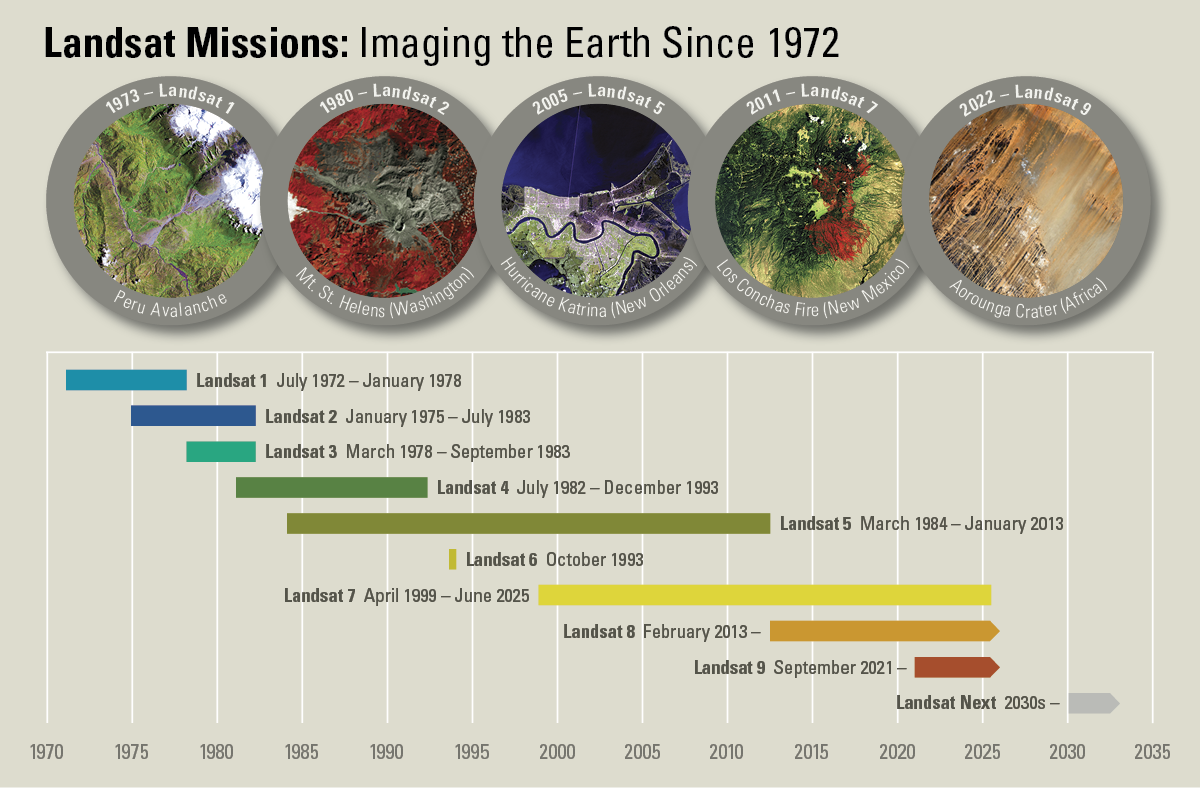
Sources/Usage: Public Domain. View Media Details
Related
After a Landsat scene is collected, when will it become available for search and download? After a Landsat scene is collected, when will it become available for search and download?
Landsat scenes become available through EarthExplorer within 6 hours after acquisition and become visible in GloVis within 24 hours. See Landsat Acquisitions for acquisition calendars and information about daily schedules.
Landsat eyes help guard the world's forests Landsat eyes help guard the world's forests
Summary The Landsat program is a joint effort between the U.S. Geological Survey (USGS) and the National Aeronautics and Space Administration (NASA), but the partner agencies have distinct roles. NASA develops remote-sensing instruments and spacecraft, launches satellites, and validates their performance in orbit. The USGS owns and operates Landsat satellites in space and manages their...
Authors
Jon Campbell
Landsat helps bolster food security Landsat helps bolster food security
One of the cruelest, most complex narratives in the world today (2019) is written in the hunger of sub-Saharan Africa. When famine is the only yield from the scorched Earth, survival often depends on a heart-rending calculation—how far is the distant feeding center and how close is the nearest well?
Authors
Landsat plays a key role in reducing hunger on earth Landsat plays a key role in reducing hunger on earth
The United Nations’ Department of Economic and Social Affairs predicts 9.7 billion people will sit down every day to the global dinner table by 2050. If this prediction is correct, the world is going to need more crops, more livestock, and more efficient and sustainable agricultural practices.
Authors
Landsat brings understanding to the impact of industrialization Landsat brings understanding to the impact of industrialization
In his 1963 book, “The Quiet Crisis,” former Interior Secretary Stewart Udall lamented what he called the decline of natural resources in the United States under the advancements of industrialization and urbanization.
Authors
When wildfire damage threatens humans, Landsat provides answers When wildfire damage threatens humans, Landsat provides answers
A wildfire’s devastation of forest and rangeland seldom ends when the last embers die. In the western United States, rain on a scorched mountainside can turn ash into mudslides. Debris flows unleashed by rainstorms can put nearby homes into harm’s way and send people scrambling for safety. The infrared capabilities of Landsat satellite imagery provide vita information about potential...
Authors
Steven Young
Landsat—The watchman that never sleeps Landsat—The watchman that never sleeps
In western North America, where infestations of mountain pine beetles continue to ravage thousands of acres of forest lands, Landsat satellites bear witness to the onslaught in a way that neither humans nor most other satellites can see.
Authors
Steven Young
Related
After a Landsat scene is collected, when will it become available for search and download? After a Landsat scene is collected, when will it become available for search and download?
Landsat scenes become available through EarthExplorer within 6 hours after acquisition and become visible in GloVis within 24 hours. See Landsat Acquisitions for acquisition calendars and information about daily schedules.
Landsat eyes help guard the world's forests Landsat eyes help guard the world's forests
Summary The Landsat program is a joint effort between the U.S. Geological Survey (USGS) and the National Aeronautics and Space Administration (NASA), but the partner agencies have distinct roles. NASA develops remote-sensing instruments and spacecraft, launches satellites, and validates their performance in orbit. The USGS owns and operates Landsat satellites in space and manages their...
Authors
Jon Campbell
Landsat helps bolster food security Landsat helps bolster food security
One of the cruelest, most complex narratives in the world today (2019) is written in the hunger of sub-Saharan Africa. When famine is the only yield from the scorched Earth, survival often depends on a heart-rending calculation—how far is the distant feeding center and how close is the nearest well?
Authors
Landsat plays a key role in reducing hunger on earth Landsat plays a key role in reducing hunger on earth
The United Nations’ Department of Economic and Social Affairs predicts 9.7 billion people will sit down every day to the global dinner table by 2050. If this prediction is correct, the world is going to need more crops, more livestock, and more efficient and sustainable agricultural practices.
Authors
Landsat brings understanding to the impact of industrialization Landsat brings understanding to the impact of industrialization
In his 1963 book, “The Quiet Crisis,” former Interior Secretary Stewart Udall lamented what he called the decline of natural resources in the United States under the advancements of industrialization and urbanization.
Authors
When wildfire damage threatens humans, Landsat provides answers When wildfire damage threatens humans, Landsat provides answers
A wildfire’s devastation of forest and rangeland seldom ends when the last embers die. In the western United States, rain on a scorched mountainside can turn ash into mudslides. Debris flows unleashed by rainstorms can put nearby homes into harm’s way and send people scrambling for safety. The infrared capabilities of Landsat satellite imagery provide vita information about potential...
Authors
Steven Young
Landsat—The watchman that never sleeps Landsat—The watchman that never sleeps
In western North America, where infestations of mountain pine beetles continue to ravage thousands of acres of forest lands, Landsat satellites bear witness to the onslaught in a way that neither humans nor most other satellites can see.
Authors
Steven Young
Updated Date: August 1, 2025