



Lab Capabilities
We provide support for every step of the analytical process. Please see our analysis list below based on matrix and analyte.
Ready to send us samples or have questions about pricing? Please contact the lab!
Lab Description
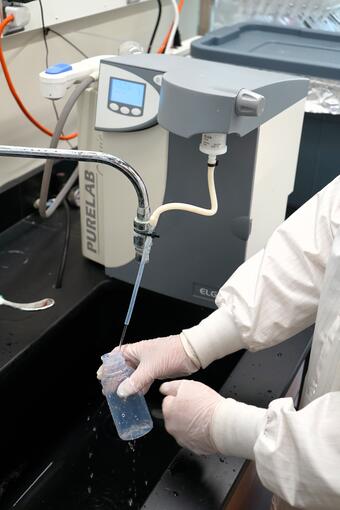
The USGS M3 has 2200 sqare feet of space dedicated across five labs for general trace metal and microplastics sample prep, instrumentation, acid cleaning, and solid material preparation. The laboratory houses three high purity water systems (Millipore, Elga, and Barnstead brands), three polypropylene fume hoods, and three laminar flow hoods. General lab equipment includes numerous analytical balances, freezers and refrigerators, ovens, freeze driers, microwave digestors, and distillation set-ups for methylmercury sample analysis. In addition to general lab operations, the USGS M3 has a dedicated 440 sq ft space for mercury isotope sample analysis and pre-concentration work. This lab is outfitted with a custom resin pre-concentration space equipped to handle samples requiring >20 L of water.
The USGS M3 has several instruments for the analysis of elemental concentrations as well as a multicollector-inductively coupled plasma mass spectrometer (MC-ICP-MS, Neptune Plus, Thermo Scientific) for isotope measurements.
Instrumentation for mercury includes two automated total mercury analyzers (Brooks Rand, MERX-T), one manual total mercury analyzer (Brooks Rand, TDM-II), one direct combustion mercury analyzer (Nippon, MA-3000), and two automated methylmercury analyzers (Brooks Rand, MERX-M).
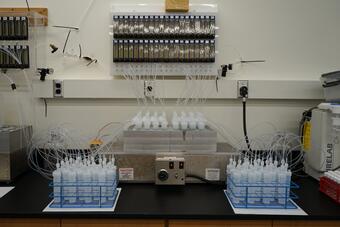
Instrumentation for trace elemental analysis include an inductively coupled plasma (ICP) optical emission spectrometer (Agilent 5110), an ICP mass spectrometer (Thermo Scientific, iCAP), and a multicollector ICP-MS (Thermo Scientific, Neptune Plus). The MC-ICP-MS is fitted with a custom clip for faraday cups that give it the ability to simultaneously measure all Hg isotopes, a capability that is not standard on this instrumentation. In addition, the MC-ICP-MS is fitted with a mix of 10-11 and two upgraded 10-13 amplifiers. A suite of sample introduction equipment supports operation of the MC-ICP-MS including three desolvating nebulizers (two ESI Apex-Q units and one CETAC Aridus II unit), three custom designed gas liquid separators, and numerous peristaltic pumps.
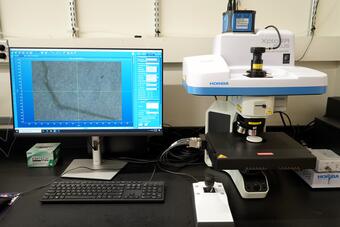
Instrumentation for microplastics include a confocal Raman microscope (Horiba XploRA Plus) and a laser-direct infrared spectrometer (Agilent LDIR). A dedicated laminar flow hood and all glass equipment is used for sample preparation for microplastics. The laboratory also has a sputter coater to make gold coated filters to decrease background interferences and improve spectra collection.
Other analytes including dissolved organic carbon, sulfide, and suspended particulate matter are also measured. Instrumentation to support these analyses include a total organic carbon analyzer (Shimadzu, TOC-LCSH) and an emission/excitation matrix fluorometer (Hobiba, Aqualog), and a field portable spectrophotometer (Hach D1900).
Quality Control and Assurance
The USGS M3 has been a leader in data traceability and quality assurance. All samples are assigned a unique ID at the time of sampling or upon arrival at the laboratory. Sample information and analytical results are tied to the unique ID in our laboratory information management system. Analytical instrumentation is calibrated daily, and each batch of samples includes a series of blanks, check standards, replicates, spikes and certified reference material to validate the results. The USGS Quality Management System has been fully implemented at the laboratory. If you would like copies of our Quality Control and Management Plan or our Standard Operating Procedures, please reach out!
| Analysis Category | Available Analyses | Matrices | Instrumentation |
|---|---|---|---|
| Mercury | Total mercury concentration, Methylmercury concentration | Waters (unfiltered and filtered), sediments, soils, plant tissue, animal tissue, air | Brooks Rand MERX-T, Brooks Rand MERX-M, Brooks Rand TDM II, Thermo Fisher Scientific iCAP |
| Metals | Full elemental suite for concentration | Waters (unfiltered and filtered), sediments, soils, plant tissue, animal tissue | Thermo Fisher Scientific iCAP, Agilent ICP-OES (5110) |
| Microplastics | Microplastics enumeration and identification (> 20 µm), Low micrometer microplastics (LMMP) characterization (<20 µm) | Waters (unfiltered), sediments, soils, animal tissue | Agilent LDIR, Horiba XploRA Plus |
| Elemental Stable Isotopes | Natural abundance stable isotope analyses for mercury, lithium, and copper (other elements available upon request) | Waters (unfiltered and filtered), sediments, soils, plant tissue, animal tissue (dependent on element) | Thermo Fisher Neptune Plus |
| Carbon | Dissolved organic carbon Concentration, Dissolved inorganic carbon concentration, Dissolved organic matter absorbance (250-800 nm), Dissolved organic matter fluorescence (Ex200-Ex400, Em240-Em600) | Waters (unfiltered and filtered) | Shimadzu TOC, Horiba Aqualog |
| Other | Suspended particulate matter concentration, Moisture percentage, Lypholization and sample homogenization, Sulfide concentration (upon request) | Analysis dependent | Gravimetric or colormetric measurement |