



Volcano Watch — Discovery of a massive submarine landslide near the 1957 Aleutian earthquake epicenter
As part of a growing national effort to understand seafloor hazards, scientists from the United States Geological Survey’s (USGS) Volcano Science Center (VSC) are working across agencies to investigate how submarine earthquakes, landslides, and volcanic activity shape tsunami risk—not just in Hawaiʻi, but across the broader Pacific.
Volcano Watch is a weekly article and activity update written by U.S. Geological Survey Hawaiian Volcano Observatory scientists and affiliates.
In June 2025, a multi-agency expedition led by the USGS, the Bureau of Ocean Energy Management (BOEM), the National Oceanic and Atmospheric Administration (NOAA), the Smithsonian, and the Woods Hole Oceanographic Institution, explored over 2,200 miles of the Aleutian margin aboard the Office of Naval Research’s Research Vessel (R/V) Atlantis.
USGS geophysicist and oceanographer Dr. Ashton Flinders of the Hawaiian Volcano Observatory (HVO) led the volcano, earthquake, and landslide hazard component of the expedition. Using the U.S. Navy’s human-occupied vehicle (HOV) Alvin, the mission focused on understanding how tectonic activity, submarine volcanoes, and deep-sea ecosystems interact to shape geologic hazards and ocean-floor habitats.
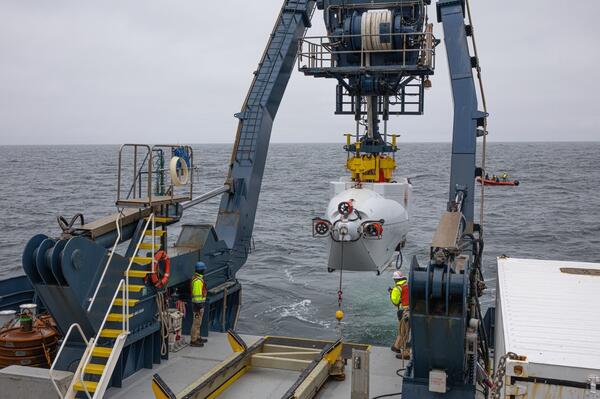
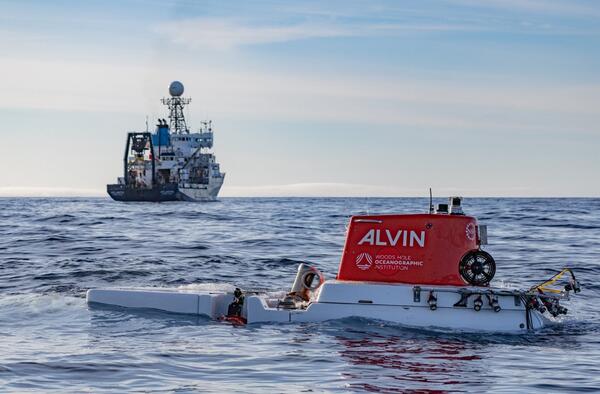
(HOV) Alvin is a deep-diving submarine capable of carrying two scientists and a pilot to depths of more than 20,000 feet to explore and sample the seafloor. First launched in 1964, Alvin has undergone numerous upgrades—including a major retrofit completed in 2022—and has played a key role in historic missions such as the exploration of the RMS Titanic wreck and hydrothermal vent discoveries. A highlight of the mission included Flinders’ dive to 5,300 feet below the sea surface on the flanks of Bogoslof Volcano to investigate its eruptive history and submarine structure.
Over the course of the expedition, the team collected 884 scientific samples, including 444 biological specimens, 29 geologic samples, and hundreds of liters of seawater. The Atlantis traveled nearly 2,200 miles, with the ship’s multibeam sonar mapping more than 2,500 square miles of previously uncharted seafloor.
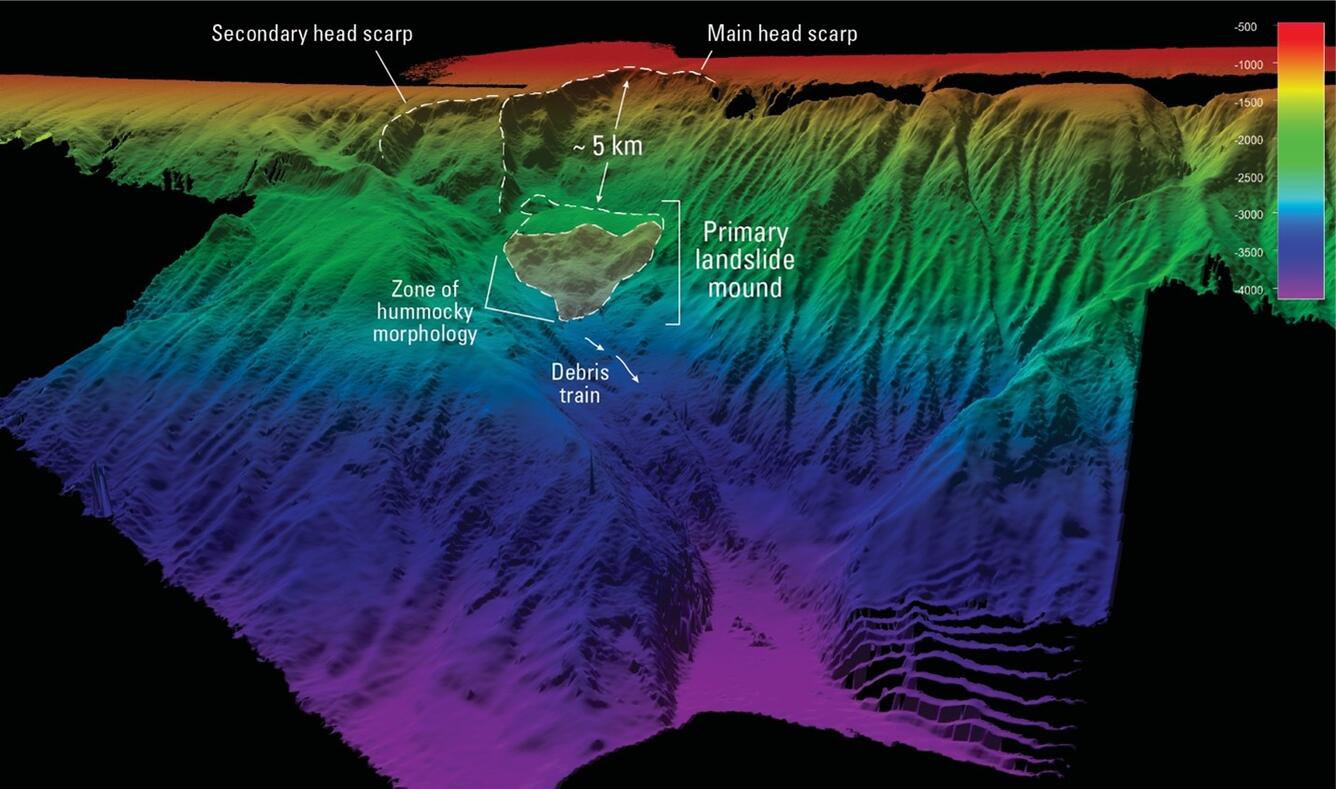
Among the most significant discoveries was a massive submarine landslide structure along the southern slope of the Aleutian Shelf, about 10 miles (16 km) northwest of the epicenter of the 1957 Andreanof Islands earthquake. The landslide spans over 10 miles (16 km) across and exhibits classic signs of rapid slope failure: a scalloped headwall, a chaotic debris zone, and long runout lobes descending toward the deeper basin.
The 1957 earthquake, which struck on March 9 with a magnitude of 8.6, produced a Pacific-wide tsunami that devastated parts of Alaska and Hawaiʻi. In the Hawaiian Islands, waves reached 53 feet at Hāʻena, Kauaʻi, and up to 12 feet in Hilo Bay, and caused millions of dollars in damage. Seismic and tsunami models have raised questions about whether a submarine landslide helped generate the large run-ups observed, similar to 1946.
The newly discovered landslide may help resolve this mystery. If it was triggered by shaking from the 1957 earthquake, the submarine landslide could have acted as a secondary tsunami source, enhancing wave energy directed toward Hawaiʻi. This would parallel the 1946 Aleutian tsunami, which was later linked to a massive submarine landslide off Unimak Island that killed 159 people in Hawaiʻi and destroyed the Scotch Cap Lighthouse on Unimak Island, Alaska, and killed 5 persons there.
Further study is needed to determine the slide’s precise age and volume, but its scale, location, and alignment with tsunami deposits preserved locally in the onshore stratigraphy on several Aleutian islands and in Hawaiʻi, make it a potential candidate for involvement in the 1957 earthquake and tsunami. USGS scientists from the Alaska Volcano Observatory will be leading follow-up investigations to assess the potential tsunami effects of this slide, as well as several newly mapped volcanic landslides throughout the Aleutian Arc.
This discovery highlights the power of modern ocean exploration tools such as multibeam and backscatter sonar to uncover long-hidden geologic hazards as well as the importance of imaging the submarine geology. It also underscores the importance of revisiting historical disasters with new perspectives—and new technology—to better assess tsunami risks for Alaska, Hawaiʻi, and the broader Pacific region.
Volcano Activity Updates
Kīlauea has been erupting episodically within the summit caldera since December 23, 2024. Its USGS Volcano Alert level is WATCH.
Episode 30 of the Kīlauea summit eruption in Halemaʻumaʻu crater occurred on August 6. Summit region inflation since the end of episode 30, along with low-level tremor, suggests that another episode is possible. Sulfur dioxide emission rates are elevated in the summit region during active eruption episodes. No unusual activity has been noted along Kīlauea’s East Rift Zone or Southwest Rift Zone.
Mauna Loa is not erupting. Its USGS Volcano Alert Level is at NORMAL.
There was 1 earthquake that was reported felt in the Hawaiian Islands during the past week: A M-3.2 earthquake 3 km (1 mi) S of Pāhala at 30 km (19 mi) depth occurred on Aug. 6 at 3:43 a.m. HST.
HVO continues to closely monitor Kīlauea and Mauna Loa.
Please visit HVO’s website for past Volcano Watch articles, Kīlauea and Mauna Loa updates, volcano photos, maps, recent earthquake information, and more. Email questions to askHVO@usgs.gov.