



California’s Seasonally Rotating Pocket Beaches
New research led by USGS finds that along California’s rugged coastline, some of the state’s most scenic “pocket beaches”—short stretches of sand nestled between rocky headlands—undergo predictable rotations each year in response to changing wave conditions.
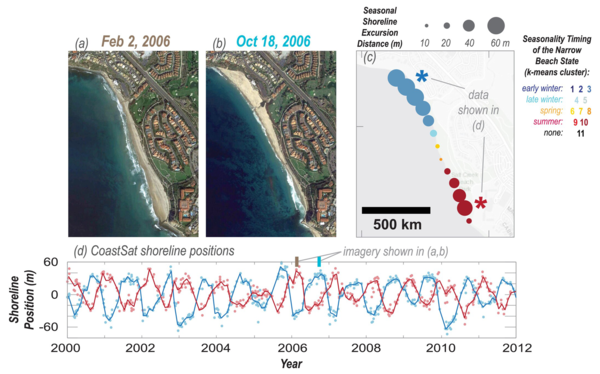
Using 22 years of satellite-derived shoreline data, researchers found that these beaches seasonally shift their orientation as sand is moved by waves. The team identified two general styles of rotation that reflect the diversity of California’s coastal conditions.
- In Southern California, pocket beaches tend to rotate clockwise during the winter months, driven by strong west swells that dominate the colder season. This “winter southward” movement of sand causes the shoreline to tilt toward the south before reversing in summer under the influence of southerly swells. These southern beaches exhibit a relatively symmetrical back-and-forth pattern tied closely to seasonal changes in longshore sediment transport.
- By contrast, Northern California’s pocket beaches display counterclockwise rotation in winter, when large west-to-northwest swells push sand northward. These beaches are more asymmetrical, with narrower winter shorelines that result from a combination of cross-shore (in and out) and longshore (alongshore) sand movement. The interplay between powerful winter swells and smaller northwest wind waves in summer shapes these more complex rotation patterns.
“This study shows that there is a seasonal predictability to these pocket beaches, which are a fundamental landform type along California’s rocky shore,” said USGS Research Geologist Jon Warrick, lead author of the study.
Because the dataset used primarily captured medium and large beaches, researchers believe many more pocket beaches exhibit similar rotational behavior but went undetected due to their small size. That means the number of seasonally rotating beaches may be significantly undercounted.
Understanding how these pocket beaches behave over time is important not only for managing erosion and habitat change, but also for improving models that forecast coastal response to climate-driven shifts in wave energy and sea level.
Read the study, Seasonal rotation of California pocket beaches, in Earth Surface Processes and Landforms.
Related

Remote Sensing Coastal Change
Related