



We study legacy and active mine wastes to understand whether they could be a source of critical minerals and other commodities, to inform reclamation of mine lands and to improve current and future mining operations.
Mineral production requires moving a lot of rock that is not wanted to get to the minerals that are. “Mine wastes” are the minerals and other materials left behind after the targeted minerals have been mined, processed and refined.
Could mine wastes, whether produced decades ago or during current mining operations, be a resource for the future?
Mine wastes could be a resource to supplement traditional mineral development, providing a way of strengthening domestic mineral supply chains.
We study mine wastes, both past and present, to inform efforts to recover critical minerals from mine wastes, reclaim mine lands, and learn from the past to improve current and future mining.
Explore below to learn about our mine waste science.
What are mine wastes?
Why are we studying mine wastes?
How are we studying mine wastes?
The Materials Left Behind
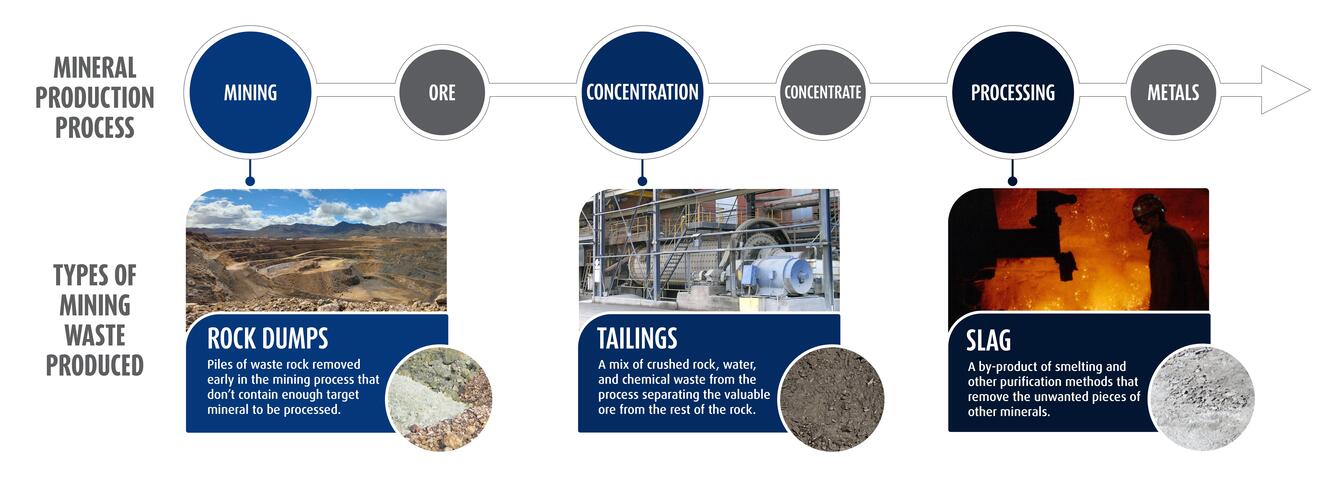
From in-the-ground to in-a-product, minerals go through many steps. Rock is extracted from the ground, crushed and ground into pieces, separated and concentrated using physical and chemical methods, and purified to remove any unwanted pieces of other minerals.
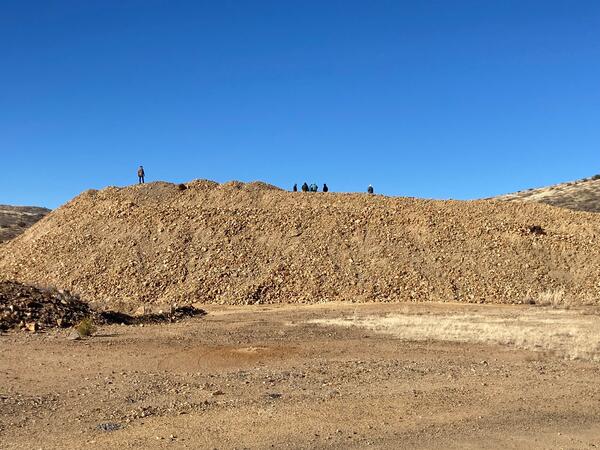
At each step, material is left behind: this is “mine waste”. Mine wastes often look like piles of rock. For instance, rock dumps are piles of waste rock removed early in the mining process because they don’t contain enough target mineral to be processed. Tailings and slag piles are produced later in the process and may contain smaller rocks. Mine wastes also often contain chemicals used during the processing and refining process, some of which can be hazardous.
In addition to active mining operations, there are tens of thousands of legacy mine waste sites across the American landscape left behind from over 200 years of mining in our country. In recent years, scientists and decision-makers have been eyeing these wastes as a potential resource for critical minerals.
Critical Minerals in Mine Wastes
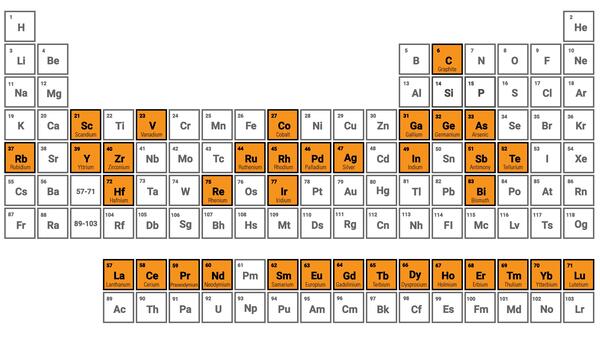
Many critical minerals are geologically sparse, mixed in small amounts into geologic deposits rich in another mineral. These are primarily produced as coproduct or byproduct minerals during mining of another mineral because they are too expensive to mine as the primary product.
However, many critical minerals also end up in mine waste instead. Historically, many critical minerals were left behind in mine wastes because they were not recognized, profitable enough or technologically feasible to extract and process. Even today, with advanced mining techniques and new demand for minerals essential to modern, advanced technologies, critical minerals still end up in mine wastes because of economic and other limitations.
To Inform Recovery of Critical Minerals from Mine Wastes
The U.S. currently relies on imports to meet demand for many of the minerals that we rely on. Reprocessing mine wastes for critical minerals could supplement traditional mineral development, strengthening domestic mineral supply chains with minimal environmental impact.
But first, many questions need to be answered. Where are mine wastes? What is their resource potential? What are the costs, benefits and risks of recovering critical minerals from wastes?
To Inform Reclamation of Mine Lands
In addition to critical minerals, mine wastes can also contain chemicals like arsenic or other materials that are hazardous. Understanding what is in mine wastes, and how those materials interact with natural processes around them, is critical to supporting effective reclamation plans.
Pairing recovery and reclamation efforts could turn damaged areas into useful resources and help make reclamation more economically and logistically achievable.
To Inform Current and Future Mining Operations
Understanding the composition of mine wastes and studying mine lands from the past can help improve outcomes for current and future mining. Our science and data can support decisions on where mining operations occur, whether wastes can be minimized, and how to manage mine wastes.
We provide science and data about many aspects of mine wastes, from where mine wastes are, what they contain, and how they interact with wildfires and water, to the ins and outs of supply chains of byproduct minerals, and beyond. Our science is designed to answer pragmatic questions about recovering minerals from past and present mine wastes, reclaiming legacy mine lands and informing current and future mining operations. We work closely with and advise a number of partners on mine waste science.
Learn More
MAPPING MINE WASTES
Characterizing Mine Wastes
Studying Geoenvironmental Processes
Moving from Theory to Practice

A National Mine Waste Inventory
Our USGS USMIN Mineral Project is the authoritative source of data on mine features across the U.S. So far, we have documented over 600,000 mine features in the U.S. These data can be used to identify both potential resources like mine wastes and potential hazards like old mining infrastructure. In cooperation with State and federal partners, we are currently using USMIN data to develop an Abandoned Mines Database and the first ever Mine Waste Inventory of the United States – a fundamental cornerstone for evaluating the potential for recovering valuable minerals from mine wastes.
Earth MRI: Earth Mapping Resources Initiative
Through the Earth Mapping Resources Initiative (Earth MRI), we are also working with State partners to fill in gaps in our understanding of where mine wastes might be, and what minerals they might contain. We are developing high resolution maps of the geology, topography, and spectral (light) patterns of the Earth’s surface and developing novel methods for using these data to identify and quantify mine wastes on the Earth’s surface. For instance, we are developing techniques to use these and other remote sensing data to quantify volumes of mine wastes across the landscape and exploring ways to automate the process using artificial intelligence.
Actionable insight: As of 2025, there are over 13,000 mine features identified in Michigan alone – or, on average, one mine feature for every 7 square miles in the state. These features include over 300 quarries, 200 mine shafts, and 200 tailings and mine dump piles. Source: USMIN dataset.
Knowing where mine wastes are is the essential first step towards assessing critical minerals in mine wastes and informing reclamation efforts.
Learn More
Using Remote Sensing to Turn Trash into Treasure
Earth MRI Mine Waste Science
The Abandoned Mine Inventory
USMIN data: Mine-related features
Evaluating the Resource Potential of Legacy Mine Wastes
In addition to mapping mine wastes, we study the composition of legacy and active mine wastes to understand what critical minerals might be present in them and at what amounts. These kinds of geochemical studies also provide information that can be used to identify hazardous materials in mine wastes. Both USGS scientists and State partners are sampling legacy mine wastes and evaluating their chemical and mineral qualities – an essential step towards assessing mineral resource potential.
Examining the Wastes of Active Mines
We have also partnered with active mines to characterize the minerals in their wastes and understand how critical minerals partition during mining and processing. This will help mines understand whether any minerals currently being removed could instead be economically recovered as a byproduct. Through a partnership with Apple, we also quantified how much ore and waste rock must be mined, moved and processed to produce different commodities. In addition to providing information about the environmental footprint of different minerals, these results can be used to estimate potential byproduct production.
Actionable Insight: To produce just one gram of gold, an average of three metric tons of ore and waste rock is moved and processed. That's a lot of rock that can be processed to produce additional minerals. Source: Rocks-to-Metal Ratio: A Foundational Metric for Understanding Mine Wastes
We are identifying and measuring the mineral content in active and legacy mine wastes to evaluate their potential as a resource.
Learn More
Critical Mineral Recovery Potential from Tailings
Alaska Mine Waste
Earth MRI Mine Waste Science
About the Rock-to-Metal Ratio
“Geoenvironmental” means the interactions between geology or minerals with their settings, including local chemistry, geology, and hydrology.

Geoenvironmental Science
We study how mine wastes interact with their local settings, including the geologic, geophysical and geochemical processes that control how materials in mine wastes enter air, land and water. For instance, we study how different minerals weather or erode from historically mined sites under different conditions. This science is important for predicting, mitigating and remediating potential environmental risks associated with mineral recovery or development.
Tools for Decision-Makers
Our data and science have also contributed to interactive tools and geoenvironmental assessments that help users understand where minerals and mine wastes might intersect with important natural resources, such as water, and man made features, such as roads or infrastructure, that can influence the feasibility of recovering critical minerals from mine wastes.
These data and tools provide decision-makers the context they need to assess both opportunities and risks associated with reclaiming legacy mine lands, recovering critical minerals from legacy mine wastes, and future mining operations.
Understanding how mine wastes interact with geologic, geophysical and geochemical processes helps decisionmakers identify opportunities and risks related to mine wastes from the past and into the future.
Examples of Our Geoenvironmental Science
The Life Cycle of Critical Minerals
Mining areas and stream water solutes
Salmon River Mountains Legacy Mining Studies
Tellurium in Semi-Arid Mine Tailings
Explore Geoenvironmental Tools and Assessments
Mine Reclamation Screening Tool
Mined Lands Mapping Tool
Multi-resource Assessments
Geoenvironmental models and public lands
Demonstration Sites for Mineral Recovery
Even if critical minerals are found in mine wastes, there may be challenges to recovering them, including technical, economic and access challenges. We are working closely with partners across the federal government to learn about these challenges and help identify potential solutions.
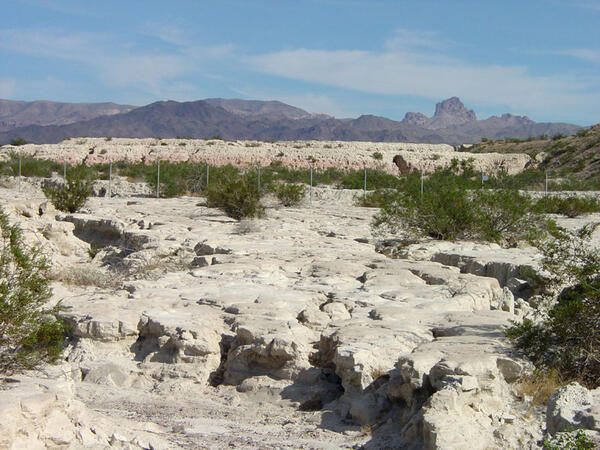
We are leading efforts through the Federal Mining Dialogue’s Critical Mineral Subcommittee to help identify mine waste sites where the steps needed to recover critical minerals from mine waste can be demonstrated. These demonstration sites are bringing together Federal partners to provide clarity about the steps that would required to turn mine waste into a commodity – from sampling to permitting to processing.
We are currently characterizing hard rock mine waste sites as potential demonstration sites, as well as working with partners to identify valuable critical minerals in coal and uranium sites.
What is the Federal Mining Dialogue?
The Federal Mining Dialogue (FMD) is a cooperative initiative focused on bringing together federal agencies to identify, discuss, and clarify key policy, regulatory, and technical issues associated with the cleanup and potential reuse of abandoned mine lands sites across the country. In 2022, the FMD Critical Minerals Subcommittee was established so that Federal Agencies could work together to determine how best to support demonstration projects to reprocess, reclaim, remediate and restore abandoned mine lands and recover minerals.
We are supporting on-the-ground efforts to demonstrate how mineral recovery from mine wastes might work, from beginning to end.

USMIN Mineral Deposit Database

Salmon River Mountains Legacy Mining Studies

Critical Mineral Recovery Potential from Tailings and Other Mine Waste Streams

Life Cycles of Byproduct Critical Minerals
We study legacy and active mine wastes to understand whether they could be a source of critical minerals and other commodities, to inform reclamation of mine lands and to improve current and future mining operations.
Mineral production requires moving a lot of rock that is not wanted to get to the minerals that are. “Mine wastes” are the minerals and other materials left behind after the targeted minerals have been mined, processed and refined.
Could mine wastes, whether produced decades ago or during current mining operations, be a resource for the future?
Mine wastes could be a resource to supplement traditional mineral development, providing a way of strengthening domestic mineral supply chains.
We study mine wastes, both past and present, to inform efforts to recover critical minerals from mine wastes, reclaim mine lands, and learn from the past to improve current and future mining.
Explore below to learn about our mine waste science.
What are mine wastes?
Why are we studying mine wastes?
How are we studying mine wastes?
The Materials Left Behind
From in-the-ground to in-a-product, minerals go through many steps. Rock is extracted from the ground, crushed and ground into pieces, separated and concentrated using physical and chemical methods, and purified to remove any unwanted pieces of other minerals.
At each step, material is left behind: this is “mine waste”. Mine wastes often look like piles of rock. For instance, rock dumps are piles of waste rock removed early in the mining process because they don’t contain enough target mineral to be processed. Tailings and slag piles are produced later in the process and may contain smaller rocks. Mine wastes also often contain chemicals used during the processing and refining process, some of which can be hazardous.
In addition to active mining operations, there are tens of thousands of legacy mine waste sites across the American landscape left behind from over 200 years of mining in our country. In recent years, scientists and decision-makers have been eyeing these wastes as a potential resource for critical minerals.
Critical Minerals in Mine Wastes
Many critical minerals are geologically sparse, mixed in small amounts into geologic deposits rich in another mineral. These are primarily produced as coproduct or byproduct minerals during mining of another mineral because they are too expensive to mine as the primary product.
However, many critical minerals also end up in mine waste instead. Historically, many critical minerals were left behind in mine wastes because they were not recognized, profitable enough or technologically feasible to extract and process. Even today, with advanced mining techniques and new demand for minerals essential to modern, advanced technologies, critical minerals still end up in mine wastes because of economic and other limitations.
To Inform Recovery of Critical Minerals from Mine Wastes
The U.S. currently relies on imports to meet demand for many of the minerals that we rely on. Reprocessing mine wastes for critical minerals could supplement traditional mineral development, strengthening domestic mineral supply chains with minimal environmental impact.
But first, many questions need to be answered. Where are mine wastes? What is their resource potential? What are the costs, benefits and risks of recovering critical minerals from wastes?
To Inform Reclamation of Mine Lands
In addition to critical minerals, mine wastes can also contain chemicals like arsenic or other materials that are hazardous. Understanding what is in mine wastes, and how those materials interact with natural processes around them, is critical to supporting effective reclamation plans.
Pairing recovery and reclamation efforts could turn damaged areas into useful resources and help make reclamation more economically and logistically achievable.
To Inform Current and Future Mining Operations
Understanding the composition of mine wastes and studying mine lands from the past can help improve outcomes for current and future mining. Our science and data can support decisions on where mining operations occur, whether wastes can be minimized, and how to manage mine wastes.
We provide science and data about many aspects of mine wastes, from where mine wastes are, what they contain, and how they interact with wildfires and water, to the ins and outs of supply chains of byproduct minerals, and beyond. Our science is designed to answer pragmatic questions about recovering minerals from past and present mine wastes, reclaiming legacy mine lands and informing current and future mining operations. We work closely with and advise a number of partners on mine waste science.
Learn More
MAPPING MINE WASTES
Characterizing Mine Wastes
Studying Geoenvironmental Processes
Moving from Theory to Practice
A National Mine Waste Inventory
Our USGS USMIN Mineral Project is the authoritative source of data on mine features across the U.S. So far, we have documented over 600,000 mine features in the U.S. These data can be used to identify both potential resources like mine wastes and potential hazards like old mining infrastructure. In cooperation with State and federal partners, we are currently using USMIN data to develop an Abandoned Mines Database and the first ever Mine Waste Inventory of the United States – a fundamental cornerstone for evaluating the potential for recovering valuable minerals from mine wastes.
Earth MRI: Earth Mapping Resources Initiative
Through the Earth Mapping Resources Initiative (Earth MRI), we are also working with State partners to fill in gaps in our understanding of where mine wastes might be, and what minerals they might contain. We are developing high resolution maps of the geology, topography, and spectral (light) patterns of the Earth’s surface and developing novel methods for using these data to identify and quantify mine wastes on the Earth’s surface. For instance, we are developing techniques to use these and other remote sensing data to quantify volumes of mine wastes across the landscape and exploring ways to automate the process using artificial intelligence.
Actionable insight: As of 2025, there are over 13,000 mine features identified in Michigan alone – or, on average, one mine feature for every 7 square miles in the state. These features include over 300 quarries, 200 mine shafts, and 200 tailings and mine dump piles. Source: USMIN dataset.
Knowing where mine wastes are is the essential first step towards assessing critical minerals in mine wastes and informing reclamation efforts.
Learn More
Using Remote Sensing to Turn Trash into Treasure
Earth MRI Mine Waste Science
The Abandoned Mine Inventory
USMIN data: Mine-related features
Evaluating the Resource Potential of Legacy Mine Wastes
In addition to mapping mine wastes, we study the composition of legacy and active mine wastes to understand what critical minerals might be present in them and at what amounts. These kinds of geochemical studies also provide information that can be used to identify hazardous materials in mine wastes. Both USGS scientists and State partners are sampling legacy mine wastes and evaluating their chemical and mineral qualities – an essential step towards assessing mineral resource potential.
Examining the Wastes of Active Mines
We have also partnered with active mines to characterize the minerals in their wastes and understand how critical minerals partition during mining and processing. This will help mines understand whether any minerals currently being removed could instead be economically recovered as a byproduct. Through a partnership with Apple, we also quantified how much ore and waste rock must be mined, moved and processed to produce different commodities. In addition to providing information about the environmental footprint of different minerals, these results can be used to estimate potential byproduct production.
Actionable Insight: To produce just one gram of gold, an average of three metric tons of ore and waste rock is moved and processed. That's a lot of rock that can be processed to produce additional minerals. Source: Rocks-to-Metal Ratio: A Foundational Metric for Understanding Mine Wastes
We are identifying and measuring the mineral content in active and legacy mine wastes to evaluate their potential as a resource.
Learn More
Critical Mineral Recovery Potential from Tailings
Alaska Mine Waste
Earth MRI Mine Waste Science
About the Rock-to-Metal Ratio
“Geoenvironmental” means the interactions between geology or minerals with their settings, including local chemistry, geology, and hydrology.
Geoenvironmental Science
We study how mine wastes interact with their local settings, including the geologic, geophysical and geochemical processes that control how materials in mine wastes enter air, land and water. For instance, we study how different minerals weather or erode from historically mined sites under different conditions. This science is important for predicting, mitigating and remediating potential environmental risks associated with mineral recovery or development.
Tools for Decision-Makers
Our data and science have also contributed to interactive tools and geoenvironmental assessments that help users understand where minerals and mine wastes might intersect with important natural resources, such as water, and man made features, such as roads or infrastructure, that can influence the feasibility of recovering critical minerals from mine wastes.
These data and tools provide decision-makers the context they need to assess both opportunities and risks associated with reclaiming legacy mine lands, recovering critical minerals from legacy mine wastes, and future mining operations.
Understanding how mine wastes interact with geologic, geophysical and geochemical processes helps decisionmakers identify opportunities and risks related to mine wastes from the past and into the future.
Examples of Our Geoenvironmental Science
The Life Cycle of Critical Minerals
Mining areas and stream water solutes
Salmon River Mountains Legacy Mining Studies
Tellurium in Semi-Arid Mine Tailings
Explore Geoenvironmental Tools and Assessments
Mine Reclamation Screening Tool
Mined Lands Mapping Tool
Multi-resource Assessments
Geoenvironmental models and public lands
Demonstration Sites for Mineral Recovery
Even if critical minerals are found in mine wastes, there may be challenges to recovering them, including technical, economic and access challenges. We are working closely with partners across the federal government to learn about these challenges and help identify potential solutions.
We are leading efforts through the Federal Mining Dialogue’s Critical Mineral Subcommittee to help identify mine waste sites where the steps needed to recover critical minerals from mine waste can be demonstrated. These demonstration sites are bringing together Federal partners to provide clarity about the steps that would required to turn mine waste into a commodity – from sampling to permitting to processing.
We are currently characterizing hard rock mine waste sites as potential demonstration sites, as well as working with partners to identify valuable critical minerals in coal and uranium sites.
What is the Federal Mining Dialogue?
The Federal Mining Dialogue (FMD) is a cooperative initiative focused on bringing together federal agencies to identify, discuss, and clarify key policy, regulatory, and technical issues associated with the cleanup and potential reuse of abandoned mine lands sites across the country. In 2022, the FMD Critical Minerals Subcommittee was established so that Federal Agencies could work together to determine how best to support demonstration projects to reprocess, reclaim, remediate and restore abandoned mine lands and recover minerals.
We are supporting on-the-ground efforts to demonstrate how mineral recovery from mine wastes might work, from beginning to end.
USMIN Mineral Deposit Database
Salmon River Mountains Legacy Mining Studies
Critical Mineral Recovery Potential from Tailings and Other Mine Waste Streams