An official website of the United States government
Here's how you know
Official websites use .gov
A .gov website belongs to an official government organization in the United States.
Secure .gov websites use HTTPS
A lock () or https:// means you’ve safely connected to the .gov website. Share sensitive information only on official, secure websites.
Spring migration has officially begun and now is the time to make sure your windows are safer for birds!
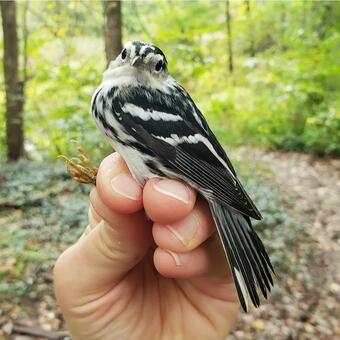
One banded bird struck a building in downtown Newark, New Jersey in September 2023 but lived to tell the tale! This Black-and-white Warbler was likely headed south to its wintering grounds, perhaps in the forests of Florida or even as far south as Colombia. We can only hope to see this bird again someday, somewhere along its migratory pathway! The story below was provided by Cailin O’Connor of Kean University in New Jersey, who banded the bird one week before it collided with a building.
Banded female Black-and-white Warbler rehabilitated and released after hitting a window in downtown Newark during fall migration.
On the morning of Sept. 30, 2023, an adult female Black-and-white Warbler was transported to The Raptor Trust after having hit a window in downtown Newark, New Jersey, a tragically common occurrence for migrating birds during fall migration. Upon examination, staff noticed that the bird had a USGS federal band on its right leg. The band number confirmed that this bird had been banded by seasonal Raptor Trust volunteer Cailin O’Connor, at the Meadowlands Bird Banding Station in North Arlington, New Jersey, just a week before on Sept. 22. On its banding date, the warbler had little fat, meaning it may have just flown into the Meadowlands to refuel for its migration. It clearly ate very well during its stopover because, a week later, the warbler had gained about a quarter of its body weight in fat, the fuel for migration! Luckily, this bird sustained only minor injuries from its collision and recovered quickly. The warbler was released later to continue its journey south. Good luck, little lady!
Banding encounters like this give us amazing insight into the lives of these little birds. For example, because the bird was weighed when it first was banded and again after it hit a window, we know it gained significant fat over the course of just one week. This bird may have left the Meadowlands overnight on Sept. 29 as Newark is directly across the Hudson River from the banding station. Bright lights of cities disorient and attract migrating birds and, unfortunately, this bird was one of the hundreds of millions across the globe drawn into urban environments each year. This warbler was one of the lucky ones: many birds that hit windows die on impact and many others need long-term care in rehabilitation centers. The Raptor Trust alone treats dozens of window-struck birds daily during periods of heavy migration each fall. It is only with skilled supportive care of their staff and volunteers that some of these birds are able to recover and be released to continue their journeys south.
More information from the BBL
If you find a banded bird, please submit a report to the USGS Bird Banding Laboratory at www.reportband.gov. If the bird has collided with glass, be sure to indicate that the bird struck a building or window in the “How Obtained” data field.
There are simple, inexpensive, and unobtrusive ways you can help prevent bird collisions by making windows more visible to birds. To be effective, window patterns should be spaced in a 2-inch by 2-inch grid pattern and be placed on the outside of windows. As a low-cost and temporary solution (think renter friendly!), you can make and hang a paracord bird curtain or create decorative patterns using tempera paint and stencils. A more long-term solution could be to apply dense decal markers (such as dots) to the outside of your windows or install “fritted” glass that includes exterior patterns to make the glass more visible to birds. For more information about bird collisions and possible solutions, visit the U.S. Fish and Wildlife Service’s website about threats to birds here.
Bird Collisions: Current Science and Future Opportunities
The USGS Eastern Ecological Science Center Bird Banding Lab webinar on the threat of bird collisions, current science and future opportunities. It is estimated that over 1 billion birds are killed annually by collisions with glass every year in the United States.
The USGS Eastern Ecological Science Center Bird Banding Lab webinar on the threat of bird collisions, current science and future opportunities. It is estimated that over 1 billion birds are killed annually by collisions with glass every year in the United States.
A Surprising Band Recovery from the USGS Bird Banding Lab’s Fall Migration Station
The Bird Banding Lab recently got a report of an amazing banding recovery! A Cape May warbler that was banded at the lab’s fall migration station in...
Bird Collisions: Current Science and Future Opportunities
The USGS Eastern Ecological Science Center Bird Banding Lab webinar on the threat of bird collisions, current science and future opportunities. It is estimated that over 1 billion birds are killed annually by collisions with glass every year in the United States.
The USGS Eastern Ecological Science Center Bird Banding Lab webinar on the threat of bird collisions, current science and future opportunities. It is estimated that over 1 billion birds are killed annually by collisions with glass every year in the United States.
A Surprising Band Recovery from the USGS Bird Banding Lab’s Fall Migration Station
The Bird Banding Lab recently got a report of an amazing banding recovery! A Cape May warbler that was banded at the lab’s fall migration station in...