



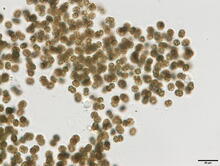
A colony of cyanobacteria cells from Lake Okeechobee, Florida


Detailed Description
A colony of cyanobacteria cells, Microcystis aeruginosa, from Lake Okeechobee, Florida. The cells are grainy in appearance from aerotopes. Aerotopes are gas vesicles that allow for buoyancy regulation in many planktonic species of cyanobacteria.
Sources/Usage
Public Domain.
Related

Understanding Drivers of Cyanotoxin Production in the Lake Okeechobee Waterway
The U.S. Geological Survey (USGS) and other researchers combined field and laboratory approaches in two studies to understand the factors that drive cyanobacterial bloom development and associated cyanotoxin production in Lake Okeechobee, the St. Lucie River and Estuary, and the Indian River Lagoon in response to the large-scale Lake Okeechobee cyanobacteria bloom in 2016.
Related
Understanding Drivers of Cyanotoxin Production in the Lake Okeechobee Waterway
The U.S. Geological Survey (USGS) and other researchers combined field and laboratory approaches in two studies to understand the factors that drive cyanobacterial bloom development and associated cyanotoxin production in Lake Okeechobee, the St. Lucie River and Estuary, and the Indian River Lagoon in response to the large-scale Lake Okeechobee cyanobacteria bloom in 2016.