



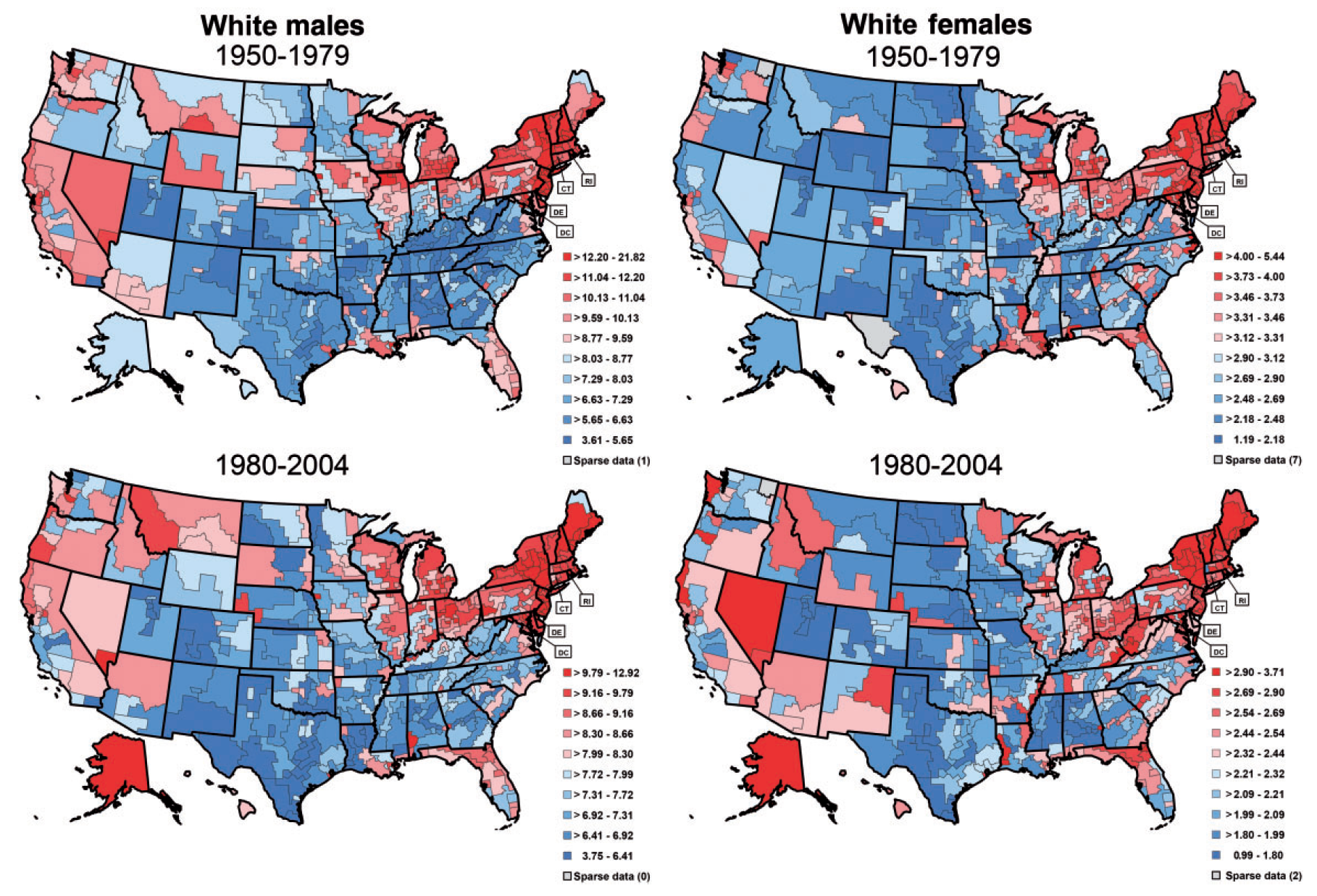
A map of bladder cancer mortality rates



Detailed Description
Bladder cancer rates have been elevated in northern New England for at least 5 decades in males and females, which suggests environmental causal factors. The high proportion of private domestic wells in this region and the prevalence of arsenic in such wells led to the hypothesis that arsenic in drinking water from private wells may play a role the elevated bladder cancer rates. A map of bladder cancer mortality rates (age-adjusted 2000 U.S. population per 100 000) among white men and women by state economic area and time period (1950-1979 and 1980-2004). Figure 1 from Baris and others, 2016.
Sources/Usage
Public Domain.
Related

Elevated Bladder Cancer in Northern New England—Drinking Water and Arsenic
Study finds bladder cancer risk was associated with water intake among participants with a history of private domestic well use. The trend was significant for participants who used shallow dug wells exclusively—a well type that typically has low arsenic concentrations but may have had higher concentrations historically.
Elevated Bladder Cancer in Northern New England—Drinking Water and Arsenic
Study finds bladder cancer risk was associated with water intake among participants with a history of private domestic well use. The trend was significant for participants who used shallow dug wells exclusively—a well type that typically has low arsenic concentrations but may have had higher concentrations historically.
Elevated Bladder Cancer in Northern New England—Drinking Water and Arsenic
Study finds bladder cancer risk was associated with water intake among participants with a history of private domestic well use. The trend was significant for participants who used shallow dug wells exclusively—a well type that typically has low arsenic concentrations but may have had higher concentrations historically.
Related
Elevated Bladder Cancer in Northern New England—Drinking Water and Arsenic
Study finds bladder cancer risk was associated with water intake among participants with a history of private domestic well use. The trend was significant for participants who used shallow dug wells exclusively—a well type that typically has low arsenic concentrations but may have had higher concentrations historically.
Elevated Bladder Cancer in Northern New England—Drinking Water and Arsenic
Study finds bladder cancer risk was associated with water intake among participants with a history of private domestic well use. The trend was significant for participants who used shallow dug wells exclusively—a well type that typically has low arsenic concentrations but may have had higher concentrations historically.
Elevated Bladder Cancer in Northern New England—Drinking Water and Arsenic
Study finds bladder cancer risk was associated with water intake among participants with a history of private domestic well use. The trend was significant for participants who used shallow dug wells exclusively—a well type that typically has low arsenic concentrations but may have had higher concentrations historically.