U.S. flag

An official website of the United States government

Publications

The Center publishes analyses critical to national security on domestic and international mineral supply chains.

Filter Total Items: 614

Mineral resource of the month: vanadium Mineral resource of the month: vanadium

Vanadium, the name of which comes from Vanadis, a goddess in Scandinavian mythology, is one of the most important ferrous metals. Vanadium has many uses, but the metal’s metallurgical applications, such as an alloying element in iron and steel, account for more than 85 percent of U.S. consumption. The dominant nonmetallurgical use of the metal is as a catalyst for the production of...
Authors
Michael J. Magyar

Mineral resource of the month: lithium Mineral resource of the month: lithium

Lithium, the lightest metallic element, is silvery, white and soft, and highly reactive. It is used most frequently in chemical compounds or traded as mineral concentrates. Its thermal properties make it an ideal component in thermal shock-resistant ceramics, and its electrochemical properties make it an ideal material for several types of batteries.
Authors
Joyce A. Ober

Fire clay Fire clay

In 2005, six companies mined fire clay in Missouri, Ohio and South Carolina. Production was estimate to be 300 kt with a value of $8.3 million. Missouri was the leading producer state followed by Ohio and South Carolina. For the third consecutive year, sales and use of fire clays have been relatively unchanged. For the next few years, sales of fire clay is forecasted to remain around 300...
Authors
R.L. Virta

Mineral Commodity Summaries 2006 Mineral Commodity Summaries 2006

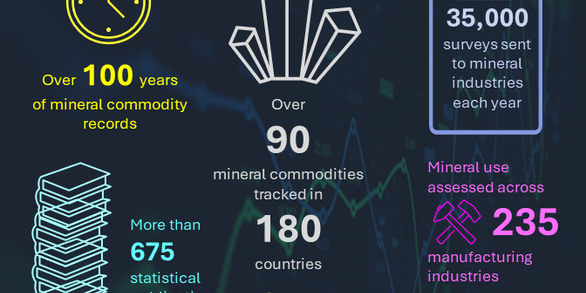
Published on an annual basis, this report is the earliest Government publication to furnish estimates covering nonfuel mineral industry data. Data sheets contain information on the domestic industry structure, Government programs, tariffs, and 5-year salient statistics for over 90 individual minerals and materials.
Authors
Water Resources Division U.S. Geological Survey

Exploration review Exploration review

This summary of international mineral exploration activities for the year 2005 draws upon available information from literature, industry and U.S. Geological Survey (USGS) specialists. It provides data on exploration budgets by global region and mineral commodity and identifies significant mineral discoveries and exploration target areas. It also discusses government programs affecting...
Authors
D.R. Wilburn

Mineral resource of the month: soda ash Mineral resource of the month: soda ash

Soda ash, also known as sodium carbonate, is an alkali chemical that can be refined from the mineral trona and from sodium carbonate-bearing brines. Several chemical processes exist for manufacturing synthetic soda ash.
Authors
Dennis S. Kostic

Mineral resource of the month: tellurium Mineral resource of the month: tellurium

Global demand for tellurium has grown significantly in recent years owing to increased use in solar cells in the United States and Europe, thermoelectronics (especially in China) and steelmaking worldwide. Estimated global production, however, has remained relatively unchanged over the same period, while accumulated inventories have been exhausted, leading to a supply shortfall.
Authors
Micheal W. George

Mineral resource of the month: diatomite Mineral resource of the month: diatomite

Diatomite is a soft, very fine-grained, siliceous sedimentary rock that is usually very light grey or beige in color. It is very finely porous, very low in density and essentially chemically inert. Rocks containing diatomite are excellent reservoir rocks for hydrocarbons.
Authors
Alan Founie

Mineral of the month: cement Mineral of the month: cement

Hydraulic cement is a virtually ubiquitous construction material that, when mixed with water, serves as the binder in concrete and most mortars. Only about 13 percent of concrete by weight is cement (the rest being water and aggregates), but the cement contributes all of the concrete’s compressional strength. The term “hydraulic” refers to the cement’s ability to set and harden...
Authors
Hendrik G. van Oss

Mineral resource of the month: mercury Mineral resource of the month: mercury

The ore of mercury, cinnabar, is soft and dark red, and native mercury is one of a few metals that is liquid at room temperatures. Cinnabar from Almaden, Spain, the world’s oldest producing mercury mine, was used during Roman times, and the chemical symbol for mercury (Hg) is from "hydrargyrum," from the Greek word meaning liquid silver. Cinnabar and mercury are associated with some...
Authors
William E. Brooks

Mineral resource of the month: nickel Mineral resource of the month: nickel

Together with chromium, nickel makes steel more resistant to corrosion. Stainless steel thus accounts for more than 65 percent of primary nickel consumption in the world. One of the more common grades of stainless steel is Type 304, which contains 18 to 20 percent chromium and 10.5 to 12 percent nickel. Owing to their high corrosion resistance, nickel-bearing stainless steels are widely...
Authors
Peter H. Kuck

Mineral resource of the month: beryllium Mineral resource of the month: beryllium

Beryllium metal is lighter than aluminum and stiffer than steel. These and other properties, including its strength, dimensional stability, thermal properties and reflectivity, make it useful for aerospace and defense applications, such as satellite and space-vehicle structural components. Beryllium’s nuclear properties, combined with its low density, make it useful as a neutron...
Authors
Kim B. Shedd
Was this page helpful?