



Publications
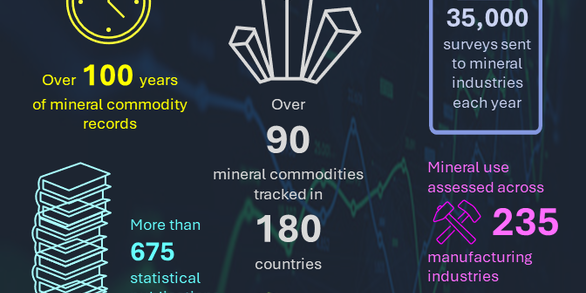
The Center publishes analyses critical to national security on domestic and international mineral supply chains.
Mineral statistics
Mineral statistics

The Minerals Yearbook, Mineral Commodity Summaries, Mineral Industry Surveys, and more periodicals.
Materials flow
Materials flow

Reports on materials flow -- the movement of materials through a supply chain, from extraction to processing to finished product.
Specialty
Specialty
Facts sheets on mineral commodities, materials flow, and supply chain topics.
Filter Total Items: 763
Use of raw materials in the United States from 1900 through 2010 Use of raw materials in the United States from 1900 through 2010
Since the beginning of the 20th century, the types and quantities of raw materials used by U.S. manufacturers and consumers have changed over time. This fact sheet quantifies the amounts of those materials (other than food and fuel) that have been input into the U.S. economy annually for a period of 111 years, from 1900 through 2010. It provides a broad overview of all materials used but
Authors
Grecia R. Matos
Byproduct metals and rare-earth elements used in the production of light-emitting diodes—Overview of principal sources of supply and material requirements for selected markets Byproduct metals and rare-earth elements used in the production of light-emitting diodes—Overview of principal sources of supply and material requirements for selected markets
The use of light-emitting diodes (LEDs) is expanding because of environmental issues and the efficiency and cost savings achieved compared with use of traditional incandescent lighting. The longer life and reduced power consumption of some LEDs have led to annual energy savings, reduced maintenance costs, and lower emissions of carbon dioxide, sulfur dioxide, and nitrogen oxides from...
Authors
David R. Wilburn
Global exploration and production capacity for platinum-group metals from 1995 through 2015 Global exploration and production capacity for platinum-group metals from 1995 through 2015
Platinum-group metals (PGMs) are required in a variety of commercial, industrial, and military applications for many existing and emerging technologies, yet the United States is highly dependent on foreign sources of PGMs. Information on global exploration for PGMs since 1995 has been used in this study as a basis for identifying locations where the industry has determined that...
Authors
David R. Wilburn
Materials flow of indium in the United States in 2008 and 2009 Materials flow of indium in the United States in 2008 and 2009
Indium is a material that has many applications. It is used by anyone who watches television or views a computer screen. It is found in solar energy arrays and in soldering applications that are required to be lead free. In 2009, about 550 metric tons (t) of indium metal was produced from primary sources world-wide; it was estimated that the United States consumed about 110 t of indium...
Authors
Thomas G. Goonan
Estimated water requirements for the conventional flotation of copper ores Estimated water requirements for the conventional flotation of copper ores
This report provides a perspective on the amount of water used by a conventional copper flotation plant. Water is required for many activities at a mine-mill site, including ore production and beneficiation, dust and fire suppression, drinking and sanitation, and minesite reclamation. The water required to operate a flotation plant may outweigh all of the other uses of water at a mine...
Authors
Donald I. Bleiwas
Estimated water requirements for gold heap-leach operations Estimated water requirements for gold heap-leach operations
This report provides a perspective on the amount of water necessary for conventional gold heap-leach operations. Water is required for drilling and dust suppression during mining, for agglomeration and as leachate during ore processing, to support the workforce (requires water in potable form and for sanitation), for minesite reclamation, and to compensate for water lost to evaporation...
Authors
Donald I. Bleiwas
Mineral Commodity Summaries 2012 Mineral Commodity Summaries 2012
Each chapter of the 2012 edition of the U.S. Geological Survey (USGS) Mineral Commodity Summaries (MCS) includes information on events, trends, and issues for each mineral commodity as well as discussions and tabular presentations on domestic industry structure, Government programs, tariffs, 5-year salient statistics, and world production and resources. The MCS is the earliest...
Sulfur, carbon, hydrogen, and oxygen isotope geochemistry of the Idaho cobalt belt Sulfur, carbon, hydrogen, and oxygen isotope geochemistry of the Idaho cobalt belt
Cobalt-copper ± gold deposits of the Idaho cobalt belt, including the deposits of the Blackbird district, have been analyzed for their sulfur, carbon, hydrogen, and oxygen isotope compositions to improve the understanding of ore formation. Previous genetic hypotheses have ranged widely, linking the ores to the sedimentary or diagenetic history of the host Mesoproterozoic sedimentary...
Authors
Craig A. Johnson, Arthur A. Bookstrom, John F. Slack
Occurrence model for volcanogenic beryllium deposits Occurrence model for volcanogenic beryllium deposits
Current global and domestic mineral resources of beryllium (Be) for industrial uses are dominated by ores produced from deposits of the volcanogenic Be type. Beryllium deposits of this type can form where hydrothermal fluids interact with fluorine and lithophile-element (uranium, thorium, rubidium, lithium, beryllium, cesium, tantalum, rare earth elements, and tin) enriched volcanic...
Authors
Nora K. Foley, Albert H. Hofstra, David A. Lindsey, Robert R. Seal, Brian W. Jaskula, Nadine M. Piatak
Mineral resource of the month: tungsten Mineral resource of the month: tungsten
The article offers information on tungsten. It says that tungsten is a metal found in chemical compounds such as in the scheelite and ore minerals wolframite. It states that tungsten has the highest melting point and it forms a compound as hard as diamond when combined with carbon. It states that tungsten can be used as a substitute for lead in fishing weights, ammunition, and hunting...
Authors
Kim B. Shedd
Mineral resource of the month: dimension stone Mineral resource of the month: dimension stone
The article offers information on dimension stone (DS) that are quarried as natural rock for a specific size and dimension chosen for its color, strength, durability. Varieties of metamorphic, igneous or sedimentary rocks are used but DS rocks are mainly marble, granite and slate that can be found from Maine to Alabama in the U.S., in the Carrara District of Italy as well as in Greece...
Authors
Thomas P. Dolley