An official website of the United States government
Here's how you know
Official websites use .gov
A .gov website belongs to an official government organization in the United States.
Secure .gov websites use HTTPS
A lock () or https:// means you’ve safely connected to the .gov website. Share sensitive information only on official, secure websites.
Part of the 1998 Industrial Minerals Review. Activities in the kaolin industry in 1999 are reviewed. U.S. production of kaolin in 1999 was estimated to be 10.7 million st, an increase of 0.3 million st from the previous year. The paper industry is the largest user of kaolin, accounting for 59 percent of domestic sales. Company activities, announcements, and plans of interest to the...
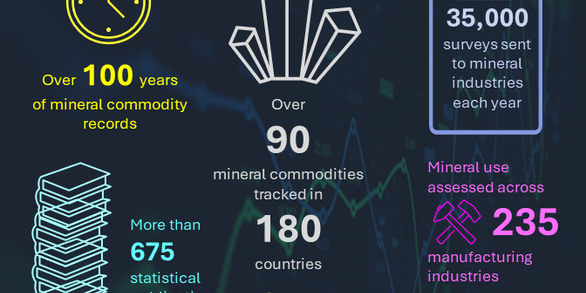
Published on an annual basis, this report is the earliest Government publication to furnish estimates covering nonfuel mineral industry data. Data sheets contain information on the domestic industry structure, Government programs, tariffs, and 5-year salient statistics for over 90 individual minerals and materials.
This summary of international nonfuel mineral exploration activities for 1998 draws on available data from literature, industry and US Geological Survey (USGS) specialists. Data on exploration budgets by region and commodity are reported, significant mineral discoveries and exploration target areas are identified and government programs affecting the mineral exploration industry are...
Scheelite and wolframite are the principal minerals currently mined for tungsten. Both occur in hard-rock deposits; wolframite is also recovered from placer deposits. Most current mine production of tungsten is from vein/stockwork, skarn, porphyry, and strata-bound deposits. Minor amounts are produced from disseminated, pegmatite, breccia, and placer deposits. Most tungsten is used to...
Authors
Antony B. T. Werner, W. David Sinclair, Earle B. Amey
Part of a special section on the state of industrial minerals in 1997. The state of the common clay industry worldwide for 1997 is discussed. Sales of common clay in the U.S. increased from 26.2 Mt in 1996 to an estimated 26.5 Mt in 1997. The amount of common clay and shale used to produce structural clay products in 1997 was estimated at 13.8 Mt.
Part of a special section on the state of industrial minerals in 1997. The state of the specialty clay industry worldwide for 1997 is discussed. The specialty clays mined in the U.S. are ball clay, fuller's earth, bentonite, fire clay, and kaolin. Sales of specialty clays in the U.S. were around 17 Mt in 1997. Approximately 53 kt of specialty clays were imported.
This summary of international nonfuel mineral exploration activities for 1997 draws upon available data from literature, industry and US Geological Sulvey (USGS) specialists. Data on exploration budgets by region and commodity are reported, significant mineral discoveries and exploration target areas are identified and government programs affecting the mineral exploration industry are...
Part of a special section on the state of industrial minerals in 1997. The state of the asbestos industry in 1997 is discussed. World production of asbestos in 1997 was estimated to be 2.07 Mt. Consumption in the U.S. fell 3 percent to 21 kt, and it is expected to continue to decline at a rate of 2–4 percent per year.
Published on an annual basis, this report is the earliest Government publication to furnish estimates covering nonfuel mineral industry data. Data sheets contain information on the domestic industry structure, Government programs, tariffs, and 5-year salient statistics for over 90 individual minerals and materials.
The United States continued as a significant producer and consumer of peat for horticultural, agricultural and industrial applications in 1997. Several operations in the Great Lakes and the Southeast regions dominated US production. Florida, Michigan and Minnesota were the largest producing states.
The lithium industry can be divided into two sectors: ore concentrate producers and chemical producers. Ore concentrate producers mine lithium minerals. They beneficiate the ores to produce material for use in ceramics and glass manufacturing.
The state of the fluorspar industry worldwide for 1997 is discussed. The U.S. had no reported mining of fluorspar in 1997. Reported consumption in the U.S. decreased to 490 kt. U.S. imports, mainly from China, totaled 533 kt. Exports, synthetic fluorspar production, and industry developments are also reviewed.