An official website of the United States government
Here's how you know
Official websites use .gov
A .gov website belongs to an official government organization in the United States.
Secure .gov websites use HTTPS
A lock () or https:// means you’ve safely connected to the .gov website. Share sensitive information only on official, secure websites.
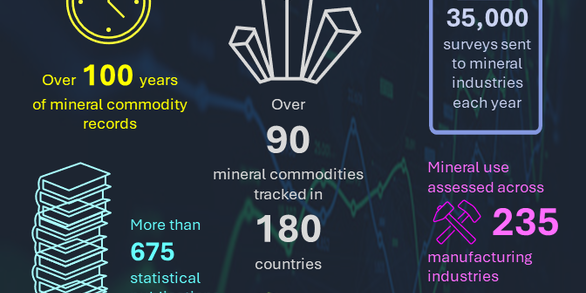
Published on an annual basis, this report is the earliest Government publication to furnish estimates covering nonfuel mineral industry data. Data sheets contain information on the domestic industry structure, Government programs, tariffs, and 5-year salient statistics for over 90 individual minerals and materials.
Lithium, the lightest metallic element, is silvery, white and soft, and highly reactive. It is used most frequently in chemical compounds or traded as mineral concentrates. Its thermal properties make it an ideal component in thermal shock-resistant ceramics, and its electrochemical properties make it an ideal material for several types of batteries.
Diatomite is a soft, very fine-grained, siliceous sedimentary rock that is usually very light grey or beige in color. It is very finely porous, very low in density and essentially chemically inert. Rocks containing diatomite are excellent reservoir rocks for hydrocarbons.
Bismuth compounds are most known for their soothing effects on the stomach, wounds and sores. These properties make the compounds an essential part of many medicinal and cosmetic preparations, which until 1930 accounted for about 90 percent of the bismuth used. The subsequent development of low-melting alloys and chemical catalysts containing bismuth, as well as its use as an additive to...
The ore of mercury, cinnabar, is soft and dark red, and native mercury is one of a few metals that is liquid at room temperatures. Cinnabar from Almaden, Spain, the world’s oldest producing mercury mine, was used during Roman times, and the chemical symbol for mercury (Hg) is from "hydrargyrum," from the Greek word meaning liquid silver. Cinnabar and mercury are associated with some...
Tungsten has the highest melting point of all metals, one of the highest densities and, when combined with carbon, is almost as hard as diamond. These and other properties make it useful in a wide variety of important commercial, industrial and military applications.
Also called barytes, barite forms in various geologic environments and is frequently found with both metallic and nonmetallic minerals. Most barite is produced by open-pit mining techniques, and most crude barite requires some upgrading to meet minimum purity or specific gravity levels.
In 2005, 22 companies mined kaolin in nine US states. Production in Georgia declined to 6.19 Mt down from 6.78 Mt in 2004. Despite the decline, Georgia remained the leading producer state followed by Alabama, South Carolina, Arkansas, Texas, Nevada, California, North Carolina and Florida. In the next year or two, domestic and export sales of kaolin for paper application are not expected...
In 2005, four companies including H.C. Spinks Clay, Kentucky-Tennessee Clay, Old Hickory Clay and Unimin mined ball clay in four states. Based on a preliminary survey of the ball clay industry, production reached 1.32 Mt valued at $53.3 million. Tennessee was the leading ball clay producer state with 61% of domestic production, followed by Texas, Mississippi and Kentucky.
Garnet is one of the most common minerals in the world. Occurring in almost any color, it is most widely known for its beauty as a gem stone. Because of its hardness and other properties, garnet is also an essential industrial mineral used in abrasive products, non-slip surfaces, and filtration. To help manage our Nation's resources of such essential minerals, the U.S. Geological Survey...
Authors
James G. Evans, Phillip R. Moyle, David G. Frank, Donald W. Olson
Global demand for tellurium has grown significantly in recent years owing to increased use in solar cells in the United States and Europe, thermoelectronics (especially in China) and steelmaking worldwide. Estimated global production, however, has remained relatively unchanged over the same period, while accumulated inventories have been exhausted, leading to a supply shortfall.
Hydraulic cement is a virtually ubiquitous construction material that, when mixed with water, serves as the binder in concrete and most mortars. Only about 13 percent of concrete by weight is cement (the rest being water and aggregates), but the cement contributes all of the concrete’s compressional strength. The term “hydraulic” refers to the cement’s ability to set and harden...