U.S. flag

An official website of the United States government

Images

Images related to Cascades Volcano Observatory.

Filter Total Items: 481
USGS scientist Alex Iezzi fixing permanent monitoring stations in Alaska.
CVO Seismologist Wes Thelen pointing out a small earthquake at Mount Adams.
USGS Scientists Maciej Obryk sits in ice at the HJ Andrews Experimental Forest in Blue River, Oregon.

Maciej Obryk is a Research Hydrologist at the Cascades Volcano Observatory. He manages the large-scale experimental debris flow flume facility, and his primary research is on the initiation and rapid movement of icy/rocky debris flows at volcanoes.

A person stands on a platform above the debris flow shoot.
Working on the USGS debris flow flume in Oregon.

The experimental flume was the idea of USGS scientist Richard Iverson. Through collaboration between the USGS and the U.S. Forest Service, this dream was realized, and the debris flow flume was constructed in 1991 and use began in 1992. 

The experimental flume was the idea of USGS scientist Richard Iverson. Through collaboration between the USGS and the U.S. Forest Service, this dream was realized, and the debris flow flume was constructed in 1991 and use began in 1992. 

USGS Scientists adding water to an experiment at the debris flow flume with a hose.
USGS Scientists water to an experiment at the debris flow flume in Oregon.

USGS Scientists adding water to an experiment at the debris flow flume with a hose. The experimental flume was the idea of USGS scientist Richard Iverson. Through collaboration between the USGS and the U.S. Forest Service, this dream was realized, and the debris flow flume was constructed in 1991 and use began in 1992. 

USGS Scientists adding water to an experiment at the debris flow flume with a hose. The experimental flume was the idea of USGS scientist Richard Iverson. Through collaboration between the USGS and the U.S. Forest Service, this dream was realized, and the debris flow flume was constructed in 1991 and use began in 1992. 

Maciej Obryk conducts research at the experimental debris flow flume in the rain.
Maciej Obryk is a Research Hydrologist at the Cascades Volcano Observatory working at the debris flow flume.

Maciej Obryk is a Research Hydrologist at the Cascades Volcano Observatory. He manages the large-scale experimental debris flow flume facility and his primary research is on the initiation and rapid movement of icy/rocky debris flows at volcanoes. 

Photo of the experimental debris flow flume looking up towards the top of the wooden flume.
The USGS debris flow flume on the HJ Andrews Experimental Forest in Blue River, Oregon.

The experimental flume was the idea of USGS scientist Richard Iverson. Through collaboration between the USGS and the U.S. Forest Service, this dream was realized, and the debris flow flume was constructed in 1991 and use began in 1992. 

The experimental flume was the idea of USGS scientist Richard Iverson. Through collaboration between the USGS and the U.S. Forest Service, this dream was realized, and the debris flow flume was constructed in 1991 and use began in 1992. 

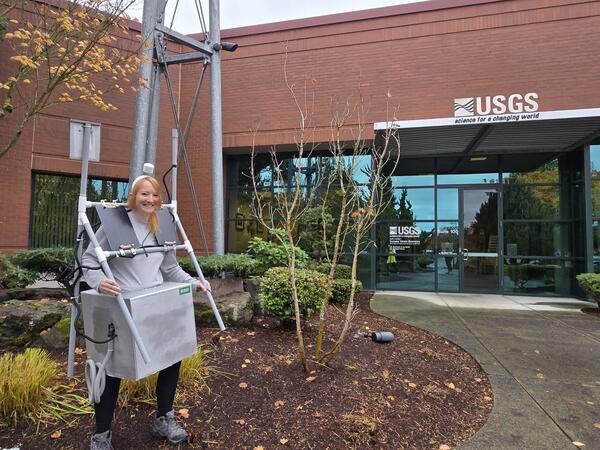
Cascades Volcano Observatory Exterior

Cascades Volcano Observatory exterior of the building in Vancouver, WA. The Cascades Volcano Observatory is one of five volcano Observatories within the Volcano Science Center of the USGS.   

Cascades Volcano Observatory exterior of the building in Vancouver, WA. The Cascades Volcano Observatory is one of five volcano Observatories within the Volcano Science Center of the USGS.   

Inside the Operations Room at the Cascades Volcano Observatory. Scientists look at large monitors displaying data.
Inside the Operations Room at the Cascades Volcano Observatory.

Inside the Operations Room at the Cascades Volcano Observatory, scientists participating in an international volcano observatory education program look at large monitors displaying data. 

Inside the Operations Room at the Cascades Volcano Observatory, scientists participating in an international volcano observatory education program look at large monitors displaying data. 

Erin Lysne teaches student from a local elementary school about how the Sediment Analysis Laboratory Instrument, better known
Erin Lysne teaches student from a local elementary school about how the Sediment Analysis Laboratory Instrument, better known as SALI, helps in sediment analysis.

Erin Lysne teaches student from a local elementary school about how the Sediment Analysis Laboratory Instrument, better known as SALI, helps in sediment analysis. 

Scientist lays on the ground while installing seismic sensor.
Scientist installing temporary seismic sensor at Mount Adams.

On October 3, 2024, sciences from the USGS Cascades Volcano Observatory and U.S. Forest Service installed new temporary seismic stations at Mount Adams volcano in southcentral Washington. 

On October 3, 2024, sciences from the USGS Cascades Volcano Observatory and U.S. Forest Service installed new temporary seismic stations at Mount Adams volcano in southcentral Washington. 

photo of mount Adams and the new ASCR station.
Installation of the new temporary seismic station ASCR at Mount Adams.

On October 3, 2024, USGS and the USFS installed a new temporary seismic station Adams South Climbers Route (ASCR) at Mount Adams.

Was this page helpful?