Densely welded rhyolites from the central Snake River Plain
Densely welded rhyolites from the central Snake River PlainDensely welded rhyolites from the central Snake River Plain. USGS Photo by L. A. Morgan (May 2004).


Official websites use .gov
A .gov website belongs to an official government organization in the United States.

Secure .gov websites use HTTPS
A lock () or https:// means you’ve safely connected to the .gov website. Share sensitive information only on official, secure websites.

Images related to Yellowstone Volcano Observatory.

Densely welded rhyolites from the central Snake River Plain. USGS Photo by L. A. Morgan (May 2004).
Densely welded rhyolites from the central Snake River Plain. USGS Photo by L. A. Morgan (May 2004).

Slow cooling of a basaltic lava flow that was erupted about 500,000 years ago resulted in the formation of hexagonal columns at Sheepeater Cliff, in Yellowstone National Park.
Slow cooling of a basaltic lava flow that was erupted about 500,000 years ago resulted in the formation of hexagonal columns at Sheepeater Cliff, in Yellowstone National Park.
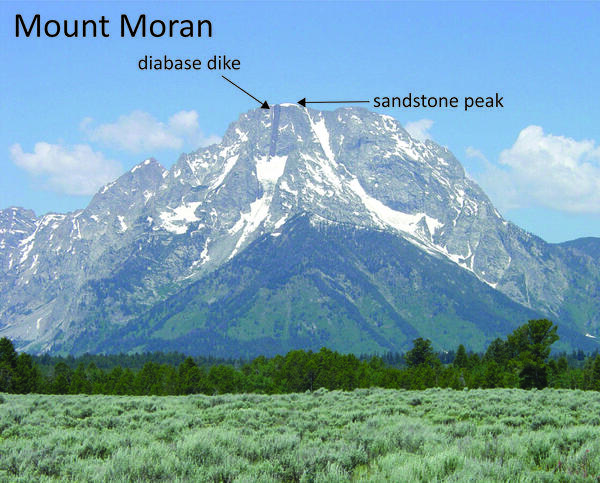
Image of the western face of Mount Moran. Note the dark stripe that marks a mafic intrusion (the “diabase dike”) and the vestiges of the Cambrian-aged Flathead Sandstone Formation (about 50 vertical feet in thickness) at the summit.
Image of the western face of Mount Moran. Note the dark stripe that marks a mafic intrusion (the “diabase dike”) and the vestiges of the Cambrian-aged Flathead Sandstone Formation (about 50 vertical feet in thickness) at the summit.
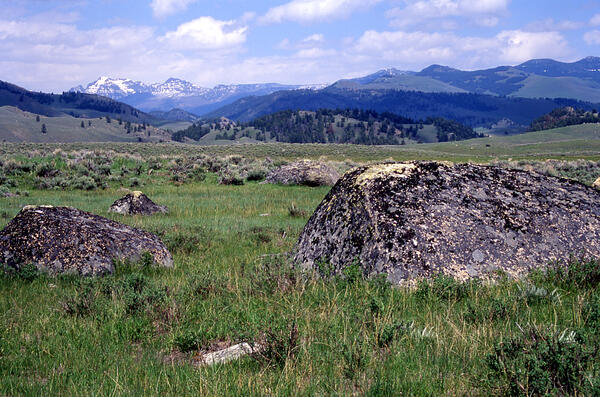
Moraines and glacial erratics (boulders) near Junction Butte in northeast Yellowstone National Park. Cosmogenic age dating of these erratics was used to determine when glaciers retreated from the Yellowstone Plateau.
Moraines and glacial erratics (boulders) near Junction Butte in northeast Yellowstone National Park. Cosmogenic age dating of these erratics was used to determine when glaciers retreated from the Yellowstone Plateau.

Simplified geologic map detailing locations of volcanics at Sepulcher Mountain and igneous intrusion at Electric Peak and surrounding area. This map is Fig. 2.
Simplified geologic map detailing locations of volcanics at Sepulcher Mountain and igneous intrusion at Electric Peak and surrounding area. This map is Fig. 2.

Angel Terrace, Mammoth Hot Springs, Yellowstone National Park. Travertine deposits are abundant in the area. Photo by JoAnn Holloway, 2003.
Angel Terrace, Mammoth Hot Springs, Yellowstone National Park. Travertine deposits are abundant in the area. Photo by JoAnn Holloway, 2003.

A 1.5-million-year-old basaltic lava flow in the canyon wall of the Yellowstone River as viewed from Calcite Springs Overlook near Tower Junction in Yellowstone National Park. Slow cooling of this lava flow resulted in the formation of vertical columns. Glacial gravels are present above and below the lava flow.
A 1.5-million-year-old basaltic lava flow in the canyon wall of the Yellowstone River as viewed from Calcite Springs Overlook near Tower Junction in Yellowstone National Park. Slow cooling of this lava flow resulted in the formation of vertical columns. Glacial gravels are present above and below the lava flow.

Gas bubbles through a sample bottle containing alkaline solution, allowing for separation of different gas phases.
Gas bubbles through a sample bottle containing alkaline solution, allowing for separation of different gas phases.

Bathymetric map of Yellowstone Lake showing hydrothermal features in the north part of the lake, including Elliott's Crater, Mary Bay, and Deep Hole. Colors correspond to lake depth, with cooler colors indicating greater depths.
Bathymetric map of Yellowstone Lake showing hydrothermal features in the north part of the lake, including Elliott's Crater, Mary Bay, and Deep Hole. Colors correspond to lake depth, with cooler colors indicating greater depths.

Criteria for estimation of the Volcanic Explosivity Index (VEI). Modified from: Newhall, C.G., and Self, S., 1982, The volcanic explosivity index (VEI): An estimate of explosive magnitude for historical volcanism. Journal of Geophysical Research, v. 87, no. C2, p.
Criteria for estimation of the Volcanic Explosivity Index (VEI). Modified from: Newhall, C.G., and Self, S., 1982, The volcanic explosivity index (VEI): An estimate of explosive magnitude for historical volcanism. Journal of Geophysical Research, v. 87, no. C2, p.

MODIS satellite image of New Zealand’s North Island acquired on October 23, 2002 (https://earthobservatory.nasa.gov/images/3101/new-zealand). Lake Taupō is located in the center of North Island.
MODIS satellite image of New Zealand’s North Island acquired on October 23, 2002 (https://earthobservatory.nasa.gov/images/3101/new-zealand). Lake Taupō is located in the center of North Island.
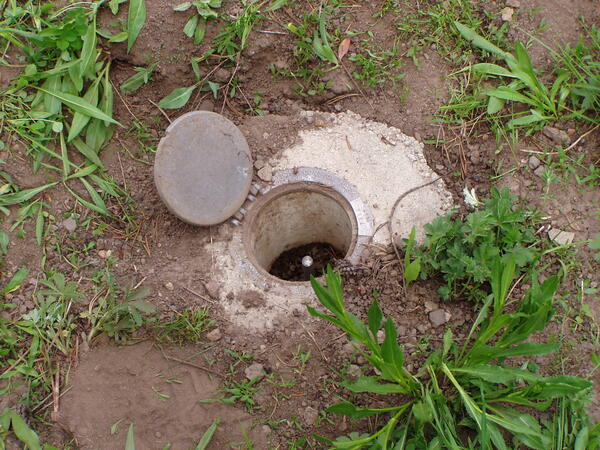
Benchmark T366, was installed in 1987 a few miles north of Canyon Junction in Yellowstone National Park. Rather than being a brass or aluminum disk, the benchmark is a rod that was driven into the ground until it would not sink any lower. The precise elevation of the top of the rod was established by surveying methods, and an access cover flush with the g
Benchmark T366, was installed in 1987 a few miles north of Canyon Junction in Yellowstone National Park. Rather than being a brass or aluminum disk, the benchmark is a rod that was driven into the ground until it would not sink any lower. The precise elevation of the top of the rod was established by surveying methods, and an access cover flush with the g

Map of the northwestern U.S., showing the approximate locations of Yellowstone hotspot volcanic fields (orange) and Columbia River Basalts (gray). Boundary of Yellowstone National Park is shown in yellow. Modified from Barry et al. (GSA Special Paper 497, p.
Map of the northwestern U.S., showing the approximate locations of Yellowstone hotspot volcanic fields (orange) and Columbia River Basalts (gray). Boundary of Yellowstone National Park is shown in yellow. Modified from Barry et al. (GSA Special Paper 497, p.

Geological Map of the area around Monument Geyser Basin and Beryl Spring, taken from the Geological Map of the Yellowstone Plateau Area (Christiansen, 2001)
Geological Map of the area around Monument Geyser Basin and Beryl Spring, taken from the Geological Map of the Yellowstone Plateau Area (Christiansen, 2001)

Interpretive reconstruction of the Yellowstone Plateau region before initial plateau volcanism (a little before 2 million years ago). The region was entirely an elevated and faulted mountainous terrain with no basin in the present plateau area.
Interpretive reconstruction of the Yellowstone Plateau region before initial plateau volcanism (a little before 2 million years ago). The region was entirely an elevated and faulted mountainous terrain with no basin in the present plateau area.

Geologic map of the Yellowstone Plateau Volcanic field generated by Bob Christiansen and published in 2001. Available from https://pubs.usgs.gov/pp/pp729g/plate1.pdf.
Geologic map of the Yellowstone Plateau Volcanic field generated by Bob Christiansen and published in 2001. Available from https://pubs.usgs.gov/pp/pp729g/plate1.pdf.
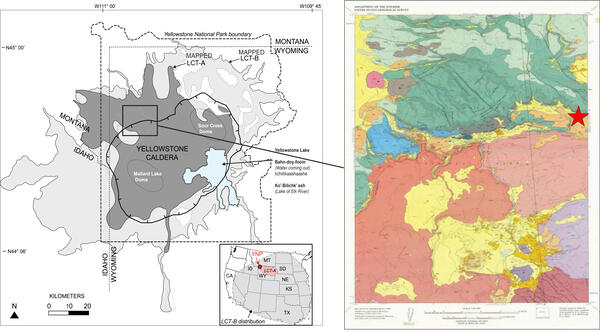
Left: Map of Yellowstone showing the extent of mapped Lava Creek Tuff members A and B, which erupted during the formation of Yellowstone Caldera about 631,000 years ago. Right: Geologic map of Madison Junction (1:125,000).
Left: Map of Yellowstone showing the extent of mapped Lava Creek Tuff members A and B, which erupted during the formation of Yellowstone Caldera about 631,000 years ago. Right: Geologic map of Madison Junction (1:125,000).

Landsat-7 satellite image of Jemez Mountains and Valles Caldera, New Mexico. The Valles and Toledo Caldera margins are approximated by dashed yellow lines, and the resurgent dome and lava domes are labeled. The Banco Bonito lava flow is the youngest in the region at 68,000 years old. The town of Los Alamos is located just east of the caldera.
Landsat-7 satellite image of Jemez Mountains and Valles Caldera, New Mexico. The Valles and Toledo Caldera margins are approximated by dashed yellow lines, and the resurgent dome and lava domes are labeled. The Banco Bonito lava flow is the youngest in the region at 68,000 years old. The town of Los Alamos is located just east of the caldera.

Mount Epomeo on the island of Ischia. The visible western slope of the resurgent block consists of 55,000 year old rocks that formed one of the most widespread Late Quaternary pyroclastic deposits in the Mediterranean region. INGV photo (https://www.ingv.it/en/Ischia).
Mount Epomeo on the island of Ischia. The visible western slope of the resurgent block consists of 55,000 year old rocks that formed one of the most widespread Late Quaternary pyroclastic deposits in the Mediterranean region. INGV photo (https://www.ingv.it/en/Ischia).

View from the SE rim of McDermitt caldera, Nevada and Oregon, showing rhyolite lavas overlain by thin outflow McDermitt Tuff in the south wall of the caldera. The low area that makes up most of the photo is intracaldera tuffaceous sediment. This is Thacker Pass, the site of largest and highest-grade lithium deposits in the region.
View from the SE rim of McDermitt caldera, Nevada and Oregon, showing rhyolite lavas overlain by thin outflow McDermitt Tuff in the south wall of the caldera. The low area that makes up most of the photo is intracaldera tuffaceous sediment. This is Thacker Pass, the site of largest and highest-grade lithium deposits in the region.

Schematic illustration showing the 1912 Novarupta eruption in Alaska and the caldera collapse at Mount Katmai, 10.6 km (about 6.6 miles) to the northeast.
Schematic illustration showing the 1912 Novarupta eruption in Alaska and the caldera collapse at Mount Katmai, 10.6 km (about 6.6 miles) to the northeast.