



The history of Earth’s glacial and interglacial periods for the last 700 thousand years is reflected in the variation of oxygen isotope composition of marine sediments. The different glacial-interglacial cycles are called marine isotope stages and are numbered from young to old. The vertical red lines mark dated volcanic eruptions in Yellowstone.
Images
Images related to Yellowstone Volcano Observatory.
Filter Total Items: 797
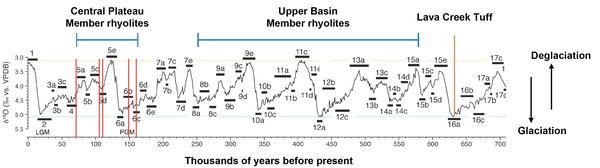
Marine isotope stages over the past 700,000 years
The history of Earth’s glacial and interglacial periods for the last 700 thousand years is reflected in the variation of oxygen isotope composition of marine sediments. The different glacial-interglacial cycles are called marine isotope stages and are numbered from young to old. The vertical red lines mark dated volcanic eruptions in Yellowstone.

Rheomorphism in outflow sheets of McDermitt Tuff, Nevada and Oregon
Rheomorphism in outflow sheets of McDermitt Tuff, Nevada and OregonFolds in outflow sheets of McDermitt Tuff, from the eruption that formed McDermitt Caldera in Nevada and Oregon about 16.4 million years ago. The folding is called “rheomorphism” and occurred as the hot ash deposit flowed under its own weight shortly after it was deposited over preexisting topographic highs and lows. The texture resembles that of rhyolit
Rheomorphism in outflow sheets of McDermitt Tuff, Nevada and Oregon
Rheomorphism in outflow sheets of McDermitt Tuff, Nevada and OregonFolds in outflow sheets of McDermitt Tuff, from the eruption that formed McDermitt Caldera in Nevada and Oregon about 16.4 million years ago. The folding is called “rheomorphism” and occurred as the hot ash deposit flowed under its own weight shortly after it was deposited over preexisting topographic highs and lows. The texture resembles that of rhyolit

Agua Shuca thermal area, El Salvador
Steam rises above a hot pool at Agua Shuca, one of many thermal areas of the Ahuachapán geothermal field of El Salvador. A sudden hydrothermal explosion at Agua Shuca in October 1990 ejected steam and debris within a 200-m-radius, and about 25 people living adjacent to the thermal area were killed.
Steam rises above a hot pool at Agua Shuca, one of many thermal areas of the Ahuachapán geothermal field of El Salvador. A sudden hydrothermal explosion at Agua Shuca in October 1990 ejected steam and debris within a 200-m-radius, and about 25 people living adjacent to the thermal area were killed.
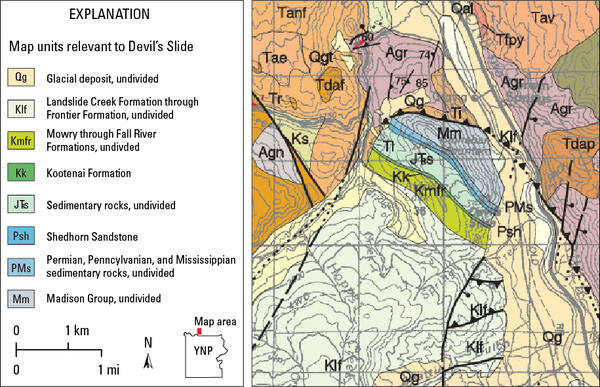
Excerpt from the MBMG Geological Map of the Gardiner 30’ x 60’ Quadrangle
Excerpt from the MBMG Geological Map of the Gardiner 30’ x 60’ QuadrangleExcerpt from the Geological Map of the Gardiner 30’ x 60’ Quadrangle, South-Central Montana, by Berg and others (1999), focused on Devil’s Slide (colorful blue-green stripes at center of map excerpt). Full unit description and map available online as Montana Bureau of Miles and Geology Open File No.
Excerpt from the MBMG Geological Map of the Gardiner 30’ x 60’ Quadrangle
Excerpt from the MBMG Geological Map of the Gardiner 30’ x 60’ QuadrangleExcerpt from the Geological Map of the Gardiner 30’ x 60’ Quadrangle, South-Central Montana, by Berg and others (1999), focused on Devil’s Slide (colorful blue-green stripes at center of map excerpt). Full unit description and map available online as Montana Bureau of Miles and Geology Open File No.

Geologists in Little Dipper boat on Grand Prismatic Spring
Geologists in Little Dipper boat on Grand Prismatic SpringYellowstone National Park employees Rick Hutchinson (right) and Jim Peaco (left) guide the specially designed Little Dipper boat into the boiling waters of Grand Prismatic Spring to collect measurements of the temperature and structure of the feature. National Park Service photo by Josh Robbins in 1996.
Geologists in Little Dipper boat on Grand Prismatic Spring
Geologists in Little Dipper boat on Grand Prismatic SpringYellowstone National Park employees Rick Hutchinson (right) and Jim Peaco (left) guide the specially designed Little Dipper boat into the boiling waters of Grand Prismatic Spring to collect measurements of the temperature and structure of the feature. National Park Service photo by Josh Robbins in 1996.
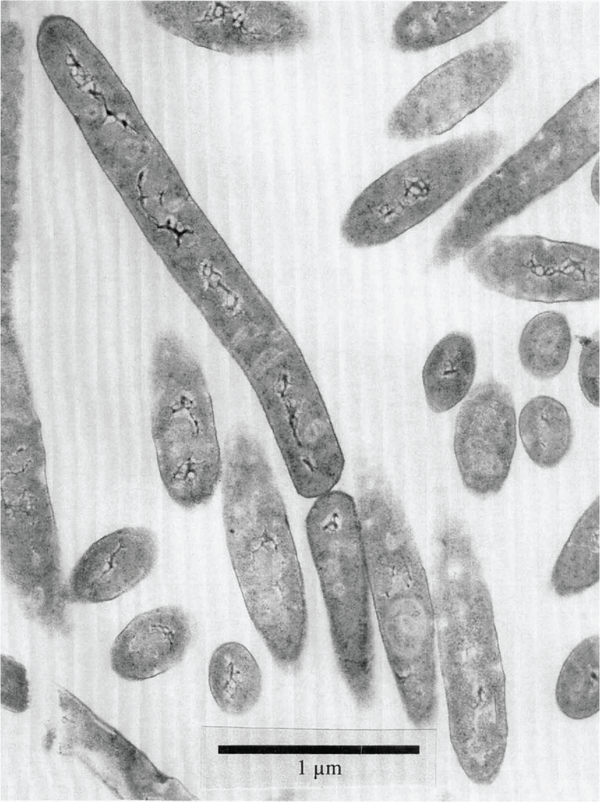
Electron-microscope image of a microbe (Bacillus infernus)
Electron-microscope image of a microbe (Bacillus infernus)An electron-microscope image of a microbe (Bacillus infernus) found 2,700 meters (8,860 feet) underground in Virginia. From Boone et al., 1995 (https://doi.org/10.1099/00207713-45-3-441).
Electron-microscope image of a microbe (Bacillus infernus)
Electron-microscope image of a microbe (Bacillus infernus)An electron-microscope image of a microbe (Bacillus infernus) found 2,700 meters (8,860 feet) underground in Virginia. From Boone et al., 1995 (https://doi.org/10.1099/00207713-45-3-441).

Queen's Laundry bathhouse, in Yellowstone's Lower Geyser Basin
Queen's Laundry bathhouse, in Yellowstone's Lower Geyser BasinQueen's Laundry bathhouse, in the Lower Geyser Basin of Yellowstone National Park. Building began under superintendent Philetus Norris in 1881 but was never finished.
Queen's Laundry bathhouse, in Yellowstone's Lower Geyser Basin
Queen's Laundry bathhouse, in Yellowstone's Lower Geyser BasinQueen's Laundry bathhouse, in the Lower Geyser Basin of Yellowstone National Park. Building began under superintendent Philetus Norris in 1881 but was never finished.

Cross section of the Western Snake River Plain, Idaho
Cross section of the Western Snake River Plain, IdahoCross section of the Western Snake River Plain, Idaho.
Cross section of the Western Snake River Plain, Idaho
Cross section of the Western Snake River Plain, IdahoCross section of the Western Snake River Plain, Idaho.

Gas plume rises above lava fountains in a lava lake in the summit crater of Nyiragongo volcano, Democratic Republic of the Congo, on 20 August 1994
Gas plume rises above lava fountains in a lava lake in the summit crater of Nyiragongo volcano, Democratic Republic of the Congo, on 20 August 1994A gas plume rises above lava fountains in a lava lake in the summit crater of Nyiragongo volcano on 20 August 1994. USGS photo by Jack Lockwood.
Gas plume rises above lava fountains in a lava lake in the summit crater of Nyiragongo volcano, Democratic Republic of the Congo, on 20 August 1994
Gas plume rises above lava fountains in a lava lake in the summit crater of Nyiragongo volcano, Democratic Republic of the Congo, on 20 August 1994A gas plume rises above lava fountains in a lava lake in the summit crater of Nyiragongo volcano on 20 August 1994. USGS photo by Jack Lockwood.

Geologic map of the Wind River Range, Wyoming
Geologic map of the Wind River Range from Blackstone, 1993 (The Wind River Range, Wyoming: An Overview. Wyoming Geological Association. Jubilee Anniversary Field Conference Guidebook: Wyoming Geology, Past, Present, and Future. Pg. 121-140).
Geologic map of the Wind River Range from Blackstone, 1993 (The Wind River Range, Wyoming: An Overview. Wyoming Geological Association. Jubilee Anniversary Field Conference Guidebook: Wyoming Geology, Past, Present, and Future. Pg. 121-140).

Deep-ocean hydrothermal vent system from the East Pacific Rise
Deep-ocean hydrothermal vent system from the East Pacific RisePhoto of a deep-ocean hydrothermal vent system from the East Pacific Rise at 9º39’N latitude and 2550 m (8366 ft) depth showing vigorously venting “black smoker” hydrothermal fluids (329 °C, or 624 °F) that are dark gray to black due to rapid precipitation of iron, copper, and zinc sulfide minerals as the hot water mixes with cold bottom waters.
Deep-ocean hydrothermal vent system from the East Pacific Rise
Deep-ocean hydrothermal vent system from the East Pacific RisePhoto of a deep-ocean hydrothermal vent system from the East Pacific Rise at 9º39’N latitude and 2550 m (8366 ft) depth showing vigorously venting “black smoker” hydrothermal fluids (329 °C, or 624 °F) that are dark gray to black due to rapid precipitation of iron, copper, and zinc sulfide minerals as the hot water mixes with cold bottom waters.
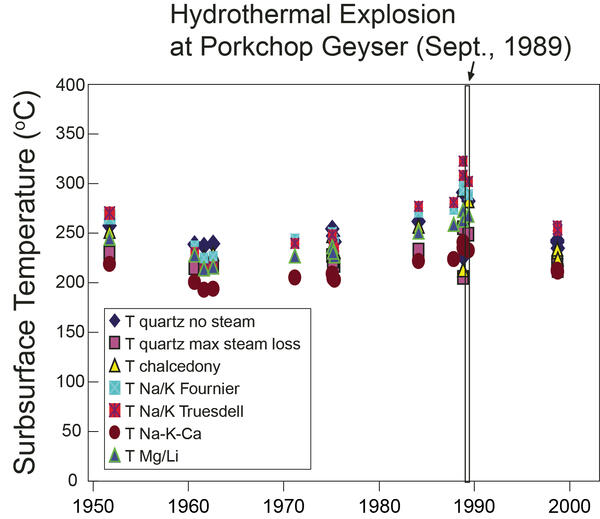
Chemical geothermometer temperatures for Porkchop Geyser, Yellowstone National Park, prior to its 1989 explosion
Chemical geothermometer temperatures for Porkchop Geyser, Yellowstone National Park, prior to its 1989 explosionFluid chemical geothermometer temperatures for Porkchop Geyser in Norris Geyser Basin, Yellowstone National Park, showing an increase of 40–60 °C (72–108 °F) for deep subsurface fluid temperatures near the time of the September 1989 Porkchop hydrothermal explosion. Note the significant scatter and variations of estimates using the conventional geothermometers.&
Chemical geothermometer temperatures for Porkchop Geyser, Yellowstone National Park, prior to its 1989 explosion
Chemical geothermometer temperatures for Porkchop Geyser, Yellowstone National Park, prior to its 1989 explosionFluid chemical geothermometer temperatures for Porkchop Geyser in Norris Geyser Basin, Yellowstone National Park, showing an increase of 40–60 °C (72–108 °F) for deep subsurface fluid temperatures near the time of the September 1989 Porkchop hydrothermal explosion. Note the significant scatter and variations of estimates using the conventional geothermometers.&

Track of the Yellowstone hotspot showing the ages and locations of volcanic fields
Track of the Yellowstone hotspot showing the ages and locations of volcanic fieldsColor-shaded relief topographic map of the track of the Yellowstone hotspot showing the ages and locations of volcanic fields and faulting patterns which become younger to the northeast. Areas in cooler colors (greens and blues) represent low topographic elevations, whereas warmer colors (oranges and reds) represent high elevations. Adapted from
Track of the Yellowstone hotspot showing the ages and locations of volcanic fields
Track of the Yellowstone hotspot showing the ages and locations of volcanic fieldsColor-shaded relief topographic map of the track of the Yellowstone hotspot showing the ages and locations of volcanic fields and faulting patterns which become younger to the northeast. Areas in cooler colors (greens and blues) represent low topographic elevations, whereas warmer colors (oranges and reds) represent high elevations. Adapted from

Porkchop Geyser erupting in August 1989
Porkchop Geyser erupting in August 1989.

Ice cone at Porkchop Geyser in March 1989
Ice cone at Porkchop Geyser in March 1989.

Apollinaris Spring, Yellowstone National Park, in 1987
Apollinaris Spring, Yellowstone National Park, in 1987Apollinaris Spring in 1987. The spring was modified in 1925 so that water would flow through pipes to be emitted from a rock wall. Yellowstone National Park photo by Jim Peaco.
Apollinaris Spring, Yellowstone National Park, in 1987
Apollinaris Spring, Yellowstone National Park, in 1987Apollinaris Spring in 1987. The spring was modified in 1925 so that water would flow through pipes to be emitted from a rock wall. Yellowstone National Park photo by Jim Peaco.
![La Garita Mountain (elevation 4179 m [13711 ft]), Colorado](https://d9-wret.s3.us-west-2.amazonaws.com/assets/palladium/production/s3fs-public/styles/masonry/public/media/images/Fig_5.32_LaGaritaMtns%20copy.jpeg?itok=G-UD0FEM)
La Garita Mountain (elevation 4179 m [13711 ft]), Colorado
La Garita Mountain (elevation 4179 m [13711 ft]), ColoradoLa Garita Mountain (elevation 4179 m [13711 ft]), Colorado. The mountain is a resurgent block of Fish Canyon Tuff that is more than 1 km (0.6 mi) thick—the top is eroded and the base is not exposed. The tuff formed during the eruption of La Garita caldera about 27.8 million years ago and has a volume of more than 5000 km3 (1200 mi3)
La Garita Mountain (elevation 4179 m [13711 ft]), Colorado
La Garita Mountain (elevation 4179 m [13711 ft]), ColoradoLa Garita Mountain (elevation 4179 m [13711 ft]), Colorado. The mountain is a resurgent block of Fish Canyon Tuff that is more than 1 km (0.6 mi) thick—the top is eroded and the base is not exposed. The tuff formed during the eruption of La Garita caldera about 27.8 million years ago and has a volume of more than 5000 km3 (1200 mi3)

Mount Vesuvius behind city of Naples, Italy
Mount Vesuvius behind city of Naples. The modern cone of Vesuvius is flanked on the left by Monte Somma, the rim of a caldera that formed about 17,000 years ago. Eight major explosive eruptions have occurred since, including the 79 CE eruption that destroyed Pompeii and other towns.
Mount Vesuvius behind city of Naples. The modern cone of Vesuvius is flanked on the left by Monte Somma, the rim of a caldera that formed about 17,000 years ago. Eight major explosive eruptions have occurred since, including the 79 CE eruption that destroyed Pompeii and other towns.

Novarupta dome, Alaska
Novarupta Dome, with Falling Mountain and the upper valley portion of the Valley of Ten Thousand Smokes in the background. Photo by Tom Miller, June 1979.
Novarupta Dome, with Falling Mountain and the upper valley portion of the Valley of Ten Thousand Smokes in the background. Photo by Tom Miller, June 1979.

1975 earthquake damage just south of Mammoth Hot Springs on the Mammoth-Norris highway
1975 earthquake damage just south of Mammoth Hot Springs on the Mammoth-Norris highwayPhoto of damage to the Mammoth-Norris highway, just south of Mammoth Hot Springs, caused by the June 30, 1975, magnitude-6 earthquake. Haynes Inc. photo for the Deseret News.
1975 earthquake damage just south of Mammoth Hot Springs on the Mammoth-Norris highway
1975 earthquake damage just south of Mammoth Hot Springs on the Mammoth-Norris highwayPhoto of damage to the Mammoth-Norris highway, just south of Mammoth Hot Springs, caused by the June 30, 1975, magnitude-6 earthquake. Haynes Inc. photo for the Deseret News.

Gibbon River in Gibbon Meadows immediate following the 1975 Yellowstone National Park earthquake
Gibbon River in Gibbon Meadows immediate following the 1975 Yellowstone National Park earthquakeGibbon River in Gibbon Meadows immediate following the June 30, 1975, magnitude-6 Yellowstone National Park earthquake. The muddy color is due to increased sediment load. NPS photo by Rick Hutchinson.
Gibbon River in Gibbon Meadows immediate following the 1975 Yellowstone National Park earthquake
Gibbon River in Gibbon Meadows immediate following the 1975 Yellowstone National Park earthquakeGibbon River in Gibbon Meadows immediate following the June 30, 1975, magnitude-6 Yellowstone National Park earthquake. The muddy color is due to increased sediment load. NPS photo by Rick Hutchinson.