



Publications
Scientific reports, journal articles, and information products produced by USGS Pacific Coastal and Marine Science Center scientists.
USGS Pubs Warehouse
USGS Pubs Warehouse

Browse the USGS Publications Warehouse to broaden your search with enhanced filtering.
Sound Waves Newsletter
Sound Waves Newsletter
Browse issues of the Sound Waves newsletter, featuring coastal and marine research news from across the USGS.
Filter Total Items: 1433
Surface wave site characterization at 27 locations near Boston, Massachusetts, including 2 strong-motion stations Surface wave site characterization at 27 locations near Boston, Massachusetts, including 2 strong-motion stations
The geotechnical properties of the soils in and around Boston, Massachusetts, have been extensively studied. This is partly due to the importance of the Boston Blue Clay and the extent of landfill in the Boston area. Although New England is not a region that is typically associated with seismic hazards, there have been several historical earthquakes that have caused significant ground...
Authors
Eric M. Thompson, Bradley A. Carkin, Laurie G. Baise, Robert E. Kayen
Development of the Coastal Storm Modeling System (CoSMoS) for predicting the impact of storms on high-energy, active-margin coasts Development of the Coastal Storm Modeling System (CoSMoS) for predicting the impact of storms on high-energy, active-margin coasts
The Coastal Storm Modeling System (CoSMoS) applies a predominantly deterministic framework to make detailed predictions (meter scale) of storm-induced coastal flooding, erosion, and cliff failures over large geographic scales (100s of kilometers). CoSMoS was developed for hindcast studies, operational applications (i.e., nowcasts and multiday forecasts), and future climate scenarios (i.e...
Authors
Patrick L. Barnard, Maarten van Ormondt, Li H. Erikson, Jodi Eshleman, Cheryl J. Hapke, Peter Ruggiero, Peter Adams, Amy C. Foxgrover
Wave-driven sediment mobilization on a storm-controlled continental shelf (Northwest Iberia) Wave-driven sediment mobilization on a storm-controlled continental shelf (Northwest Iberia)
Seafloor sediment mobilization on the inner Northwest Iberian continental shelf is caused largely by ocean surface waves. The temporal and spatial variability in the wave height, wave period, and wave direction has a profound effect on local sediment mobilization, leading to distinct sediment mobilization scenarios. Six grain-size specific sediment mobilization scenarios, representing...
Authors
Ferdinand Oberle, Curt D. Storlazzi, Till Hanebuth
210Pb dating 210Pb dating
Roughly fifty years ago, a small group of scientists from Belgium and the United States, trying to better constrain ice sheet accumulation rates, attempted to apply what was then know about environmental lead as a potential geochronometer. Thus Goldberg (1963) developed the first principles of the 210Pb dating method, which was soon followed by a paper by Crozaz et al. (1964), who...
Authors
Peter W. Swarzenski
Tsunamis: stochastic models of occurrence and generation mechanisms Tsunamis: stochastic models of occurrence and generation mechanisms
The devastating consequences of the 2004 Indian Ocean and 2011 Japan tsunamis have led to increased research into many different aspects of the tsunami phenomenon. In this entry, we review research related to the observed complexity and uncertainty associated with tsunami generation, propagation, and occurrence described and analyzed using a variety of stochastic methods. In each case...
Authors
Eric L. Geist, David D. Oglesby
California State Waters Map Series — Offshore of Half Moon Bay, California California State Waters Map Series — Offshore of Half Moon Bay, California
In 2007, the California Ocean Protection Council initiated the California Seafloor Mapping Program (CSMP), designed to create a comprehensive seafloor map of high-resolution bathymetry, marine benthic habitats, and geology within the 3-nautical-mile limit of California’s State Waters. The CSMP approach is to create highly detailed seafloor maps through collection, integration...
Authors
Guy R. Cochrane, Peter Dartnell, H. Gary Greene, Samuel Y. Johnson, Nadine E. Golden, Stephen R. Hartwell, Bryan E. Dieter, Michael W. Manson, Ray W. Sliter, Stephanie L. Ross, Janet Watt, Charles A. Endris, Rikk G. Kvitek, Eleyne L. Phillips, Mercedes D. Erdey, John L. Chin, Carrie K. Bretz
Late Holocene sedimentary environments of south San Francisco Bay, California, illustrated in gravity cores Late Holocene sedimentary environments of south San Francisco Bay, California, illustrated in gravity cores
Data are reported here from 51 gravity cores collected from the southern part of San Francisco Bay by the U.S. Geological Survey in 1990. The sedimentary record in the cores demonstrates a stable geographic distribution of facies and spans a few thousand years. Carbon-14 dating of the sediments suggests that sedimentation rates average about 1 mm/yr. The geometry of the bay floor and the...
Authors
Donald L. Woodrow, Theresa A. Fregoso, Florence L. Wong, Bruce E. Jaffe
The effectiveness of coral reefs for coastal hazard risk reduction and adaptation The effectiveness of coral reefs for coastal hazard risk reduction and adaptation
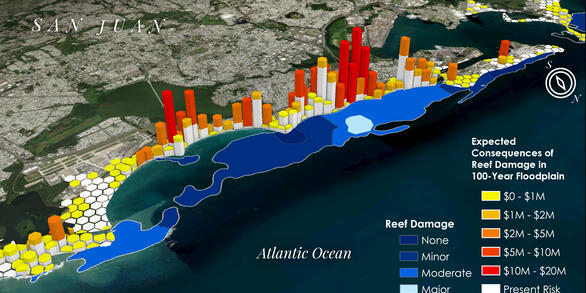
The world’s coastal zones are experiencing rapid development and an increase in storms and flooding. These hazards put coastal communities at heightened risk, which may increase with habitat loss. Here we analyse globally the role and cost effectiveness of coral reefs in risk reduction. Meta-analyses reveal that coral reefs provide substantial protection against natural hazards by...
Authors
Filippo Ferrario, Michael W. Beck, Curt D. Storlazzi, Fiorenza Micheli, Christine C. Shepard, Laura Airoldi
Subsurface geometry of the San Andreas-Calaveras fault junction: Influence of serpentinite and the Coast Range Ophiolite Subsurface geometry of the San Andreas-Calaveras fault junction: Influence of serpentinite and the Coast Range Ophiolite
While an enormous amount of research has been focused on trying to understand the geologic history and neotectonics of the San Andreas-Calaveras fault (SAF-CF) junction, fundamental questions concerning fault geometry and mechanisms for slip transfer through the junction remain. We use potential-field, geologic, geodetic, and seismicity data to investigate the 3-D geologic framework of...
Authors
Janet Tilden Watt, David A. Ponce, Russell W. Graymer, Robert C. Jachens, Robert W. Simpson
The destructive 1946 Unimak near-field tsunami: New evidence for a submarine slide source from reprocessed marine geophysical data The destructive 1946 Unimak near-field tsunami: New evidence for a submarine slide source from reprocessed marine geophysical data
The Mw 8.6 earthquake in 1946 off the Pacific shore of Unimak Island at the end of the Alaska Peninsula generated a far-field tsunami that crossed the Pacific to Antarctica. Its tsunami magnitude, 9.3, is comparable to the 9.1 magnitude of the 2011 Tohoku tsunami. On Unimak Island's Pacific shore, a runup of 42 m destroyed the lighthouse at Scotch Cap. Elsewhere, localized tsunamis with...
Authors
Roland E. von Huene, Stephen Kirby, John J. Miller, Peter Dartnell
Island outlook: Warm and swampy Island outlook: Warm and swampy
In his In Depth News story “Warming may not swamp islands” (1 August, p. 496), C. Pala argues that “coral reefs supporting sandy atoll islands will grow and rise in tandem with the sea,” based largely on studies that showed stable Pacific-island area over recent decades (1–4). He suggests that recent land losses are driven mostly by bad choices and that islanders are being affected “for...
Authors
Dennis Hubbard, Eberhard Gischler, Peter Davies, Lucien Montaggioni, Gilbert Camoin, Wolf-Christian Dullo, Curt D. Storlazzi, Michael E. Field, Charles Fletcher, Eric E. Grossman, C. Sheppard, Halard Lescinsky, Douglas Fenner, John McManus, Sander Scheffers
Earliest record of the invasive Foraminifera Trochammina hadai in San Francisco Bay, California, USA Earliest record of the invasive Foraminifera Trochammina hadai in San Francisco Bay, California, USA
In 1995, Trochammina hadai, a benthic Foraminifera prevalent in Japanese estuaries, was found in San Francisco Bay, California, USA. Subsequent field investigations determined that the species was also present in nearly all of the major ports and estuaries along the western United States. Because of its widespread colonization, it is of interest to determine when T. hadai first appeared...
Authors
Mary McGann