



All Multimedia
Access all multimedia to include images, video, audio, webcams, before-after imagery, and more. Filter and explore with filtering options to refine search.
Filter Total Items: 24981

Kīlauea Volcano — Morning Overflight (June 19, 2018)

Relict Acropora palmata coral-reef framework in the Dry Tortugas
Relict Acropora palmata coral-reef framework in the Dry TortugasAcropora palmata coral-reef framework in the Dry Tortugas National Park, Florida Keys built more than 3000 years ago. That framework, which serves as the foundation for all of the critical ecosystem services reefs provide to society, is now rapidly eroding away.
Relict Acropora palmata coral-reef framework in the Dry Tortugas
Relict Acropora palmata coral-reef framework in the Dry TortugasAcropora palmata coral-reef framework in the Dry Tortugas National Park, Florida Keys built more than 3000 years ago. That framework, which serves as the foundation for all of the critical ecosystem services reefs provide to society, is now rapidly eroding away.

Relict Holocene coral-reef framework in the Dry Tortugas National Park
Relict Holocene coral-reef framework in the Dry Tortugas National ParkRelict Holocene coral-reef framework in the Florida Keys. Like many reefs in the western Atlantic, reefs here were just a few coral species: primary Acropora palmata and Orbicella spp. Recent disturbances have led to declines in the populations of those corals and relative increases in the abundance of more weedy taxa.
Relict Holocene coral-reef framework in the Dry Tortugas National Park
Relict Holocene coral-reef framework in the Dry Tortugas National ParkRelict Holocene coral-reef framework in the Florida Keys. Like many reefs in the western Atlantic, reefs here were just a few coral species: primary Acropora palmata and Orbicella spp. Recent disturbances have led to declines in the populations of those corals and relative increases in the abundance of more weedy taxa.

Source and use of water in the U.S. in 2015
Source and Use of Water in the United States, 2015
This diagram uses a "cylinder and pipe" layout to show the source (surface water or groundwater) of the Nation's water and for what purposes the water was used in 2015. The data are broken out for each category of use by surface water and groundwater as the source.
Source and Use of Water in the United States, 2015
This diagram uses a "cylinder and pipe" layout to show the source (surface water or groundwater) of the Nation's water and for what purposes the water was used in 2015. The data are broken out for each category of use by surface water and groundwater as the source.

Kīlauea LERZ lava flows and fissures, June 18, 9:00 a.m.
Kīlauea LERZ lava flows and fissures, June 18, 9:00 a.m.Map as of 9:00 a.m. HST, June 18, 2018. Given the dynamic nature of Kīlauea's lower East Rift Zone eruption, with changing vent locations, fissures starting and stopping, and varying rates of lava effusion, map details shown here are accurate as of the date/time noted. Shaded purple areas indicate lava flows erupted in 1840, 1955, 1960, and 2014-2015.
Kīlauea LERZ lava flows and fissures, June 18, 9:00 a.m.
Kīlauea LERZ lava flows and fissures, June 18, 9:00 a.m.Map as of 9:00 a.m. HST, June 18, 2018. Given the dynamic nature of Kīlauea's lower East Rift Zone eruption, with changing vent locations, fissures starting and stopping, and varying rates of lava effusion, map details shown here are accurate as of the date/time noted. Shaded purple areas indicate lava flows erupted in 1840, 1955, 1960, and 2014-2015.

Kīlauea Volcano —
Fissure 8 lava fountains obscured by a longer exposure photograph taken early morning on June 18. The incandescent spots along a horizontal line mark the edge of the lava channel.
Fissure 8 lava fountains obscured by a longer exposure photograph taken early morning on June 18. The incandescent spots along a horizontal line mark the edge of the lava channel.

Kīlauea Volcano — Fissure 6
Fissure 6 (photo center) showed signs of activity overnight, producing small amounts of spatter and feeding short lava flows. Fissure 6 is located about 2.2 km (1.4 mi) downrift from Fissure 8.
Fissure 6 (photo center) showed signs of activity overnight, producing small amounts of spatter and feeding short lava flows. Fissure 6 is located about 2.2 km (1.4 mi) downrift from Fissure 8.

Kīlauea Volcano — Fissure 8 Lava Channels

Kīlauea Volcano — Fissure 8 Lava Flow
Fissure 8 cone and channelized lava flow.

Kīlauea Volcano — Halema`uma`u Crater
North side of the growing Halema‘uma‘u crater, marked by large cracks and large blocks that have slumped into the crater.
North side of the growing Halema‘uma‘u crater, marked by large cracks and large blocks that have slumped into the crater.

Kīlauea Volcano — Halema`uma`u Crater (with HVO)
During the helicopter overflight on June 18, crews captured this image of the growing Halema‘uma‘u crater viewed to the southeast.
During the helicopter overflight on June 18, crews captured this image of the growing Halema‘uma‘u crater viewed to the southeast.

Kīlauea Volcano — Halema‘uma‘u Crater (June 18, 2018)
Kīlauea Volcano — Halema‘uma‘u Crater (June 18, 2018)Halema‘uma‘u viewed toward the west during the June 18 helicopter overflight. HVO and Jaggar Museum can barely be seen on the caldera rim in the upper right of the photograph.
Kīlauea Volcano — Halema‘uma‘u Crater (June 18, 2018)
Kīlauea Volcano — Halema‘uma‘u Crater (June 18, 2018)Halema‘uma‘u viewed toward the west during the June 18 helicopter overflight. HVO and Jaggar Museum can barely be seen on the caldera rim in the upper right of the photograph.

Kīlauea Volcano — Halema‘uma‘u Crater Slumping
An overflight of Kīlauea's summit on June 18 showed the continued dramatic slumping and collapse of the Halema‘uma‘u crater area. This photo shows the area north-northwest of Halema‘uma‘u near a GPS station, North Pit. This station has subsided about 60 m (197 ft) in the past week.
An overflight of Kīlauea's summit on June 18 showed the continued dramatic slumping and collapse of the Halema‘uma‘u crater area. This photo shows the area north-northwest of Halema‘uma‘u near a GPS station, North Pit. This station has subsided about 60 m (197 ft) in the past week.
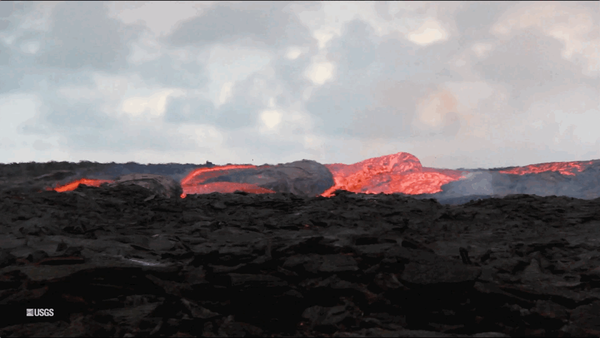
Kīlauea Volcano — Lava Flow (GIF)
An animated GIF showing lava bubbling out of fissure 8 at Kīlauea Volcano, Hawaii. Clip is taken from the full b-roll video listed as the source.
An animated GIF showing lava bubbling out of fissure 8 at Kīlauea Volcano, Hawaii. Clip is taken from the full b-roll video listed as the source.
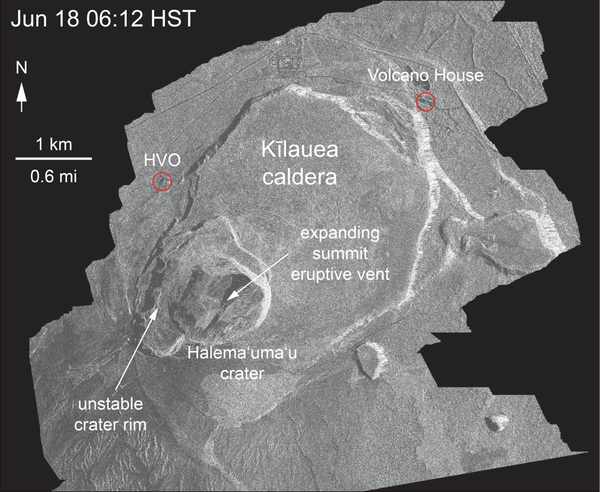
Kīlauea Volcano — Satellite Radar (Continued Slumping)
Kīlauea Volcano — Satellite Radar (Continued Slumping)This animated GIF shows a sequence of radar amplitude images that were acquired by the Agenzia Spaziale Italiana CosmoSkyMed satellite system. The images illustrate changes to the caldera area of Kīlauea Volcano that occurred between May 5 and June 18 at about 6:00 a.m. HST.
Kīlauea Volcano — Satellite Radar (Continued Slumping)
Kīlauea Volcano — Satellite Radar (Continued Slumping)This animated GIF shows a sequence of radar amplitude images that were acquired by the Agenzia Spaziale Italiana CosmoSkyMed satellite system. The images illustrate changes to the caldera area of Kīlauea Volcano that occurred between May 5 and June 18 at about 6:00 a.m. HST.

Kīlauea Volcano — Thermal Camera Measurement
An HVO geologist uses a thermal camera to measure the temperature (about 93 degrees C or 200 degrees F) of a ground crack near fissure 9.
An HVO geologist uses a thermal camera to measure the temperature (about 93 degrees C or 200 degrees F) of a ground crack near fissure 9.

Kīlauea Volcano — Weak Plume at Halem`uma`u (webcam)
Kīlauea Volcano — Weak Plume at Halem`uma`u (webcam)
Kīlauea's LERZ
Fissure 8 lava flows in an open channel all the way to the ocean. Kapoho Crater is the vegetated hill on the right side of the photograph. Ocean entry plume seen in the distance.
Fissure 8 lava flows in an open channel all the way to the ocean. Kapoho Crater is the vegetated hill on the right side of the photograph. Ocean entry plume seen in the distance.

magma in a shallow reservoir beneath the summit drains into the East R
magma in a shallow reservoir beneath the summit drains into the East RAs magma in a shallow reservoir beneath the summit drains into the East Rift Zone, the ground above it sags, cracks and subsides. The Halema‘uma‘u crater has dropped about 400 m (1300 ft) between early May and late June. Inward slumping of the surrounding Kīlauea Crater floor has doubled the diameter of Halema‘uma‘u.
magma in a shallow reservoir beneath the summit drains into the East R
magma in a shallow reservoir beneath the summit drains into the East RAs magma in a shallow reservoir beneath the summit drains into the East Rift Zone, the ground above it sags, cracks and subsides. The Halema‘uma‘u crater has dropped about 400 m (1300 ft) between early May and late June. Inward slumping of the surrounding Kīlauea Crater floor has doubled the diameter of Halema‘uma‘u.

Spawning Lost River suckers
Lost River suckers congregating to spawn on Sucker Springs in Upper Klamath Lake, Oregon.
Lost River suckers congregating to spawn on Sucker Springs in Upper Klamath Lake, Oregon.

USGS Status Update of Kīlauea Volcano - June 18, 2018
USGS Status Update of Kīlauea Volcano - June 18, 2018USGS Hawaiian Volcano Observatory, Status of Kīlauea Volcano, 10:00 a.m. HST, June 18, 2018, Liz Westby - USGS Geologist
USGS Status Update of Kīlauea Volcano - June 18, 2018
USGS Status Update of Kīlauea Volcano - June 18, 2018USGS Hawaiian Volcano Observatory, Status of Kīlauea Volcano, 10:00 a.m. HST, June 18, 2018, Liz Westby - USGS Geologist