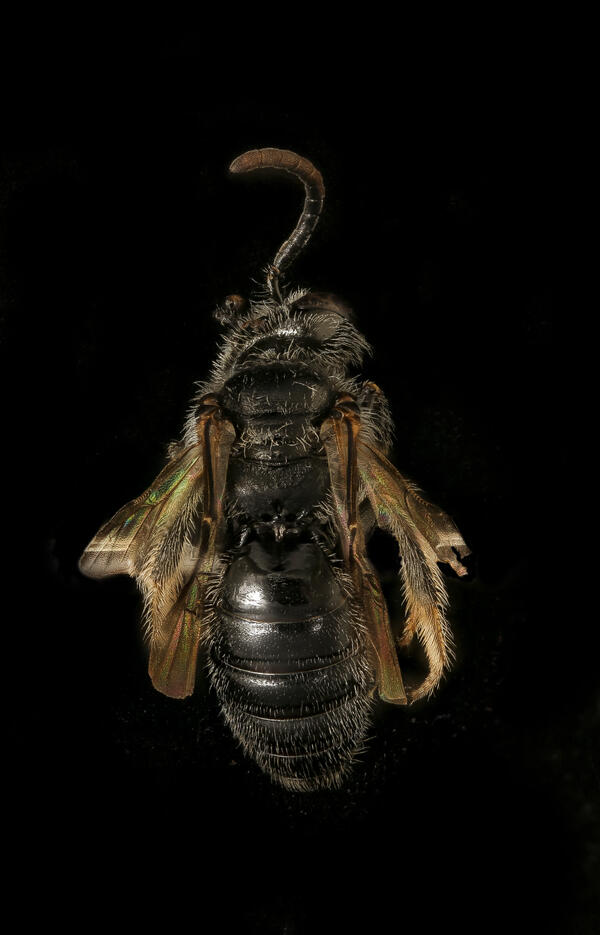
Perdita albihirta geraeae, female, Petrified Forest National Park
Images
Explore our planet through photography and imagery, including climate change and water all the way back to the 1800s when the USGS was surveying the country by horse and buggy.
Perdita albihirta geraeae, female, Petrified Forest National Park
petrified Forest national Park, Apache County, Arizona
Perdita asteris, Petrified Forest National Park, Arizona
Perdita bequaerti, F, face, Florida, St. Johns County
Perdita bequaerti, F, face, Florida, St. Johns CountyFort Matanzas National Monument, Florida - only about 6mm in length, notice characteristic sharp bend in mandibles. Doug Inkley from National Wildlife Federation has given this one the common name Mr Miyagi.
Perdita bequaerti, F, face, Florida, St. Johns County
Perdita bequaerti, F, face, Florida, St. Johns CountyFort Matanzas National Monument, Florida - only about 6mm in length, notice characteristic sharp bend in mandibles. Doug Inkley from National Wildlife Federation has given this one the common name Mr Miyagi.
Fort Mantanzas has more cool bees to share with use from a tiny coastal monument run by the park service along the upper coast of Florida. This time more junior bees in the genus Perdita. Photography by Sierra Williams, photoshopping by Elizabeth Garcia.
You never know what you are going to run into. This is Perdita bradleyi. A very uncommon bee and only the second record I know of for Maryland or any of the surrounding states. Found by Don Harvey and then Tim McMahon on Jug Bay Wetlands Reserve in Anne Arundel County.
Perdita halictoides, F, Back, VT, Chittenden County
Perdita halictoides, F, Back, VT, Chittenden CountyNew Vermont Species Record. This little tiny bee is a specialist on a plant that most people pull out of their gardens, Physalis, or Ground Cherry, this plant has a number of specialists associated with it and, we should think about it as something to plant in our gardens!
Perdita halictoides, F, Back, VT, Chittenden County
Perdita halictoides, F, Back, VT, Chittenden CountyNew Vermont Species Record. This little tiny bee is a specialist on a plant that most people pull out of their gardens, Physalis, or Ground Cherry, this plant has a number of specialists associated with it and, we should think about it as something to plant in our gardens!
Perdita halictoides, F, face, Florida, St. Johns County
Perdita halictoides, F, face, Florida, St. Johns CountyFort Matanzas National Monument, Florida. A good place to find bees as well as forts. This long-tongued mini-bee was found there.
Perdita halictoides, F, face, Florida, St. Johns County
Perdita halictoides, F, face, Florida, St. Johns CountyFort Matanzas National Monument, Florida. A good place to find bees as well as forts. This long-tongued mini-bee was found there.
Perdita halictoides, F, Face, VT, Chittenden County
Perdita halictoides, F, Face, VT, Chittenden CountyNew Vermont Species Record. This little tiny bee is a specialist on a plant that most people pull out of their gardens, Physalis, or Ground Cherry, this plant has a number of specialists associated with it and, we should think about it as something to plant in our gardens!
Perdita halictoides, F, Face, VT, Chittenden County
Perdita halictoides, F, Face, VT, Chittenden CountyNew Vermont Species Record. This little tiny bee is a specialist on a plant that most people pull out of their gardens, Physalis, or Ground Cherry, this plant has a number of specialists associated with it and, we should think about it as something to plant in our gardens!
Perdita halictoides, F, Side1, VT, Chittenden County
Perdita halictoides, F, Side1, VT, Chittenden CountyNew Vermont Species Record. This little tiny bee is a specialist on a plant that most people pull out of their gardens, Physalis, or Ground Cherry, this plant has a number of specialists associated with it and, we should think about it as something to plant in our gardens!
Perdita halictoides, F, Side1, VT, Chittenden County
Perdita halictoides, F, Side1, VT, Chittenden CountyNew Vermont Species Record. This little tiny bee is a specialist on a plant that most people pull out of their gardens, Physalis, or Ground Cherry, this plant has a number of specialists associated with it and, we should think about it as something to plant in our gardens!
Perdita halictoides, F, Sidewith vibration, VT, Chittenden County
Perdita halictoides, F, Sidewith vibration, VT, Chittenden CountyNew Vermont Species Record. This little tiny bee is a specialist on a plant that most people pull out of their gardens, Physalis, or Ground Cherry, this plant has a number of specialists associated with it and, we should think about it as something to plant in our gardens!
Perdita halictoides, F, Sidewith vibration, VT, Chittenden County
Perdita halictoides, F, Sidewith vibration, VT, Chittenden CountyNew Vermont Species Record. This little tiny bee is a specialist on a plant that most people pull out of their gardens, Physalis, or Ground Cherry, this plant has a number of specialists associated with it and, we should think about it as something to plant in our gardens!
Another Reason that Weeds Have Value: In this case the weed is Physalis, tomitillos or ground cherries. Native to North America they are usually considered weeds unless they are one of the edible varieties, yet, they host several native bees who can only live on Physalis pollen, moving this weed in my mind a bit more to the good side of the ledger book.