



El Niño and Snow
Learn more about the impacts of El Niño on snow.
Snow Is Complicated:
- It is beneficial, providing recreational opportunities, creating wildlife habitat, recharging soil moisture and underpinning critical water and energy supplies, especially in the western U.S. It can also pose recreational hazards like avalanches, snarl transportation and supply chains, lead to power and heating outages, and in extreme amounts, damage infrastructure.
- Many different aspects of snow are measured, from snowfall (the amount of snow that falls in a storm) to snow water equivalent (the amount of water in the snowpack) to snow level (the elevation or altitude above which precipitation is falling as snow instead of rain). These different aspects of snow are more or less important for different purposes. Water managers in the West care about snow water equivalent, while skiers and wildlife managers may be more interested in how deep the snow is.
- How temperature and precipitation interact to produce snowfall and preserve or melt snowpack can also be complicated.
So, it should be no surprise that the relationship between El Niño and snow is also complicated.
Why Would El Niño Influence Snow?
In many places where El Niño winters are wetter than normal, it would be reasonable to expect that they would be snowier than normal as well. The opposite would also be expected—that if El Niño winters tend to be drier, they would also be less snowy. Similarly, in places where El Niño has limited influence on precipitation but is associated with cooler than normal temperatures, snow might be more likely, except in very warm places.
One complication is that the temperature that matters is the temperature during the storms. Published seasonal forecasts show the average temperature difference over the season, which is not necessarily a good indicator of how warm or cold it is during storms. So, if El Niño tends to bring warmer than normal storms, it could be both wetter and less snowy than normal. There are far fewer studies of El Niño’s influence on storm temperatures than on average temperatures. Average temperatures can be a better but still not perfect predictor of whether snow that has accumulated (snowpack and snow water equivalent) remains or melts.
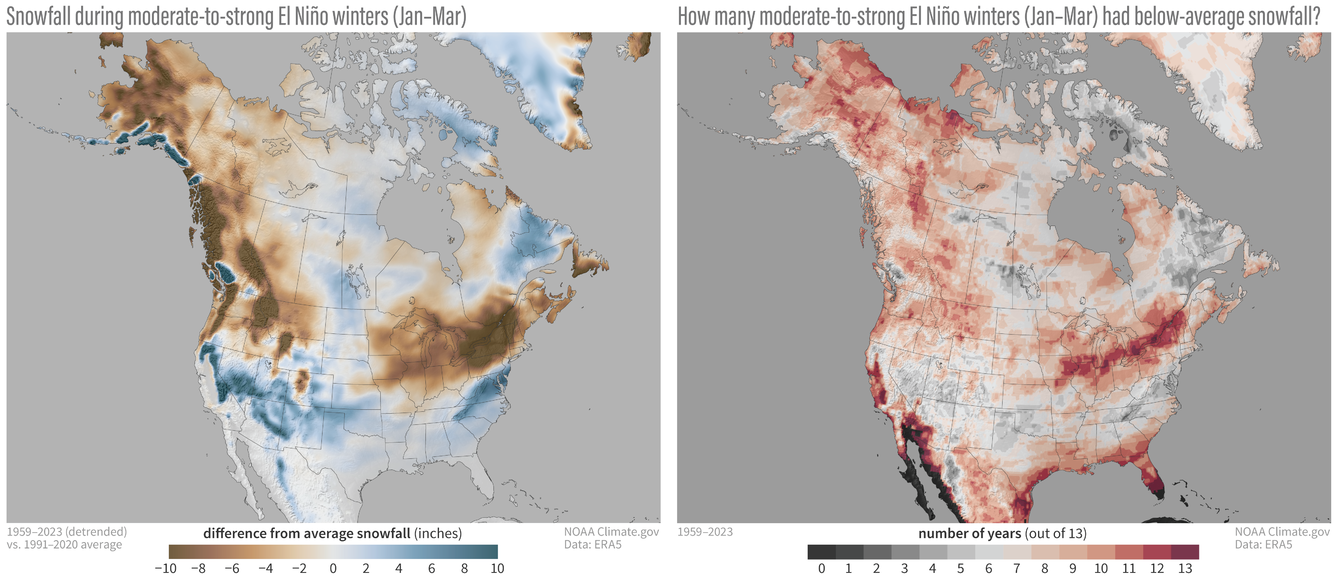
Another complication is related to how we normally look at the expected influence of El Niño on snow. It’s very common to see maps showing the average snowfall during El Niño winters relative to average snowfall in all winters. Snowfall during the average El Niño winter is not necessarily what you expect in every El Niño winter because a small number of very snowy winters can lead to a high average even if many winters are close to normal or even less snowy than normal. A final complication is related to questions about snowfall versus the snowpack that accumulates. When winters are warm, snow can melt during the winter, meaning that the buildup of snow, known as the snowpack, can be smaller than expected for the amount of snow.
How Might El Niño Influence Snow?
Break Out the Skis?
In places where winter temperatures are very cold, and most of the season’s precipitation falls as snow, more precipitation will generally lead to a snowier winter, even if storms are a bit warmer than normal. If this winter is wetter than normal, places like Alaska’s coastal mountains and high elevations of the Sierra Nevada and the southern Rocky Mountains, could be snowier than usual because temperatures are low enough that most storms will deliver snow, even if it is a little warmer than normal.
In many places colder than normal temperatures can lead to more of the precipitation falling as snow. If storms are cold enough, it might be possible to get more snow than usual, even if overall precipitation is a little below normal. This assumes that a colder than normal winter also means freezing temperatures during more storms, which is true sometimes but not always. Colder average temperatures can preserve snow on the ground, however. As a result, places like the Appalachian Mountains and parts of the south-central U.S. might be snowier than normal because El Niño winters are often wetter and cooler than normal.
Store the Shovel?
Less precipitation generally leads to less snow, particularly when storms are warmer than normal. If storms are cold enough and it is only a little drier than normal, it might be possible to get more snow than usual, but a significantly drier than normal winter usually means less snow, irrespective of the temperature. Lower precipitation could lead to a lower snow winter in the Cascades, northern Rocky Mountains and Montana where El Niño winters are often drier than normal. They tend to be warmer, too, which can exacerbate issues, by leading to earlier melting of the snowpack.
In all but the coldest places, warmer temperatures can lead to less of the precipitation falling as snow. This assumes that a warmer than normal winter also means above-freezing temperatures during more storms, which is true sometimes but not always. Warmer average temperatures can also lead to earlier than usual melting of the snowpack.