



Explore More RADish Profiles
Explore interviews with scientists and managers researching and implementing the resist-accept-direct (RAD) framework.
Dr. John Morton
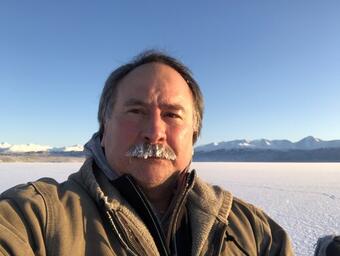
Supervisory Biologist, Kenai National Wildlife Refuge (retired, USFWS) and Vice President, Alaska Wildlife Alliance
The way John learned about climate impacts was very experiential. “It was not like I was picking up a book to read about climate change,” he says. While working in places throughout the world, including from Guam to the Chesapeake NWR to Alaska, he questioned what was behind the changes he saw in the landscape. “I’m always searching for the ultimate driver…questioning what is driving the process.”
While working on the Kenai Peninsula in Alaska, John’s studies soon led him to realize that issues like rising treelines, drying wetlands, receding glaciers, and warming waters were present even in the remote areas of Alaska. In fact, Alaska’s vast wilderness and minimal development made the effects of climate change much more obvious and impossible to ignore. That's when John realized that traditional wildlife management approaches were no longer sufficient, prompting John and his team to reassess their approach to these changes and marked a turning point at the Kenai Refuge.
Q: How long have you been a RADish?
I was already very involved in the climate change piece when we started to work on RAD. Dawn Magness (a senior author on many RAD publications) was a PhD student of mine at the University of Alaska Fairbanks, and we had a 2012 publication in which we coined the terms "prospective" and "retrospective." Essentially, it was the ‘R’ and the ‘D,’ but the crucial piece we lacked was the ‘A’. We also didn't have a really cool acronym like RAD, and I salute Steve Jackson for coming up with that. I, like Steve Jackson, was on both of the formative RAD groups, the FedNet group that met in Fort Collins, as well as the USGS group that met in Seattle.
Q: Has there ever been a moment working with RAD where you witnessed it help shape a project, a decision, or a collaboration in a meaningful way?
The big epiphany for me was that I had to apply ‘A’. I’d been so focused on the ‘D’ and the ‘R’ [for the Kenai Peninsula] that I hadn’t explicitly thought about ‘A’. I realized that with issues like rising treelines, stream warming, ice melting, and wetlands drying, I had already accepted it. We weren't doing anything, and that forced me to start going through the process. I have often said that the beauty of RAD is that it forces you to take an action verb, and the follow-up question to it is “accept until when?” or “direct until when?” In this instance, I thought, “Wow, I've been missing something.” I needed to sit down and think about whether I was willing to accept these changes in the landscape, or if there would come a point when things would get so bad that we would need to do something different.
Q: What are some of the biggest challenges you’ve seen managers face when choosing between resisting, accepting, or directing change?
Throughout my career, I’ve noticed that a lot of researchers have their own set of values. Many of them, including myself in the past, are attached to the idea that “natural” is inherently good. But climate change forces you to confront the fact that “natural” isn't a very meaningful term, so I've even tried to eliminate it from my lexicon. What we’re really talking about is what is historical. As soon as you say historical, people ask, “What time period?” and then you’re forced to define it, instead of relying on a vague idea of a primeval ecological state.
Within the RAD framework, in all the groups and papers I've been in, I've actively pushed that there is no excuse for doing nothing. We should be doing pilot studies for adaptation, and if you really do have uncertainty about the trajectory in question, then we shouldn't just do passive monitoring. What we should be doing is experimental manipulation to test the trajectory and figure out whether our models are true. Getting ahead of the curve. It applies to both the managerial and research communities, and both groups should be involved in action-oriented projects.
Q: In one sentence (or as close as you can get), how would you explain RAD to someone outside of science?
The beauty of RAD is that it forces an action. It's all action verbs that force you to respond to a trajectory. That's the key. If you aren't forced to deliberately look at direct in the context of accept and resist, both of which we do already, you probably won't get there on your own. It must be on the table, and that is the beauty of RAD: that all three action items in response to a trajectory are on the table together.
Explore interviews with scientists and managers researching and implementing the resist-accept-direct (RAD) framework.
Dr. John Morton
Supervisory Biologist, Kenai National Wildlife Refuge (retired, USFWS) and Vice President, Alaska Wildlife Alliance
The way John learned about climate impacts was very experiential. “It was not like I was picking up a book to read about climate change,” he says. While working in places throughout the world, including from Guam to the Chesapeake NWR to Alaska, he questioned what was behind the changes he saw in the landscape. “I’m always searching for the ultimate driver…questioning what is driving the process.”
While working on the Kenai Peninsula in Alaska, John’s studies soon led him to realize that issues like rising treelines, drying wetlands, receding glaciers, and warming waters were present even in the remote areas of Alaska. In fact, Alaska’s vast wilderness and minimal development made the effects of climate change much more obvious and impossible to ignore. That's when John realized that traditional wildlife management approaches were no longer sufficient, prompting John and his team to reassess their approach to these changes and marked a turning point at the Kenai Refuge.
Q: How long have you been a RADish?
I was already very involved in the climate change piece when we started to work on RAD. Dawn Magness (a senior author on many RAD publications) was a PhD student of mine at the University of Alaska Fairbanks, and we had a 2012 publication in which we coined the terms "prospective" and "retrospective." Essentially, it was the ‘R’ and the ‘D,’ but the crucial piece we lacked was the ‘A’. We also didn't have a really cool acronym like RAD, and I salute Steve Jackson for coming up with that. I, like Steve Jackson, was on both of the formative RAD groups, the FedNet group that met in Fort Collins, as well as the USGS group that met in Seattle.
Q: Has there ever been a moment working with RAD where you witnessed it help shape a project, a decision, or a collaboration in a meaningful way?
The big epiphany for me was that I had to apply ‘A’. I’d been so focused on the ‘D’ and the ‘R’ [for the Kenai Peninsula] that I hadn’t explicitly thought about ‘A’. I realized that with issues like rising treelines, stream warming, ice melting, and wetlands drying, I had already accepted it. We weren't doing anything, and that forced me to start going through the process. I have often said that the beauty of RAD is that it forces you to take an action verb, and the follow-up question to it is “accept until when?” or “direct until when?” In this instance, I thought, “Wow, I've been missing something.” I needed to sit down and think about whether I was willing to accept these changes in the landscape, or if there would come a point when things would get so bad that we would need to do something different.
Q: What are some of the biggest challenges you’ve seen managers face when choosing between resisting, accepting, or directing change?
Throughout my career, I’ve noticed that a lot of researchers have their own set of values. Many of them, including myself in the past, are attached to the idea that “natural” is inherently good. But climate change forces you to confront the fact that “natural” isn't a very meaningful term, so I've even tried to eliminate it from my lexicon. What we’re really talking about is what is historical. As soon as you say historical, people ask, “What time period?” and then you’re forced to define it, instead of relying on a vague idea of a primeval ecological state.
Within the RAD framework, in all the groups and papers I've been in, I've actively pushed that there is no excuse for doing nothing. We should be doing pilot studies for adaptation, and if you really do have uncertainty about the trajectory in question, then we shouldn't just do passive monitoring. What we should be doing is experimental manipulation to test the trajectory and figure out whether our models are true. Getting ahead of the curve. It applies to both the managerial and research communities, and both groups should be involved in action-oriented projects.
Q: In one sentence (or as close as you can get), how would you explain RAD to someone outside of science?
The beauty of RAD is that it forces an action. It's all action verbs that force you to respond to a trajectory. That's the key. If you aren't forced to deliberately look at direct in the context of accept and resist, both of which we do already, you probably won't get there on your own. It must be on the table, and that is the beauty of RAD: that all three action items in response to a trajectory are on the table together.