



Rising seas and coastal erosion threaten sea turtle nesting beaches around the world
A global study of nine important nesting sites finds that some beaches face greater risks than others, highlighting the importance of accounting for shoreline dynamics and limited space for beaches to move inland.
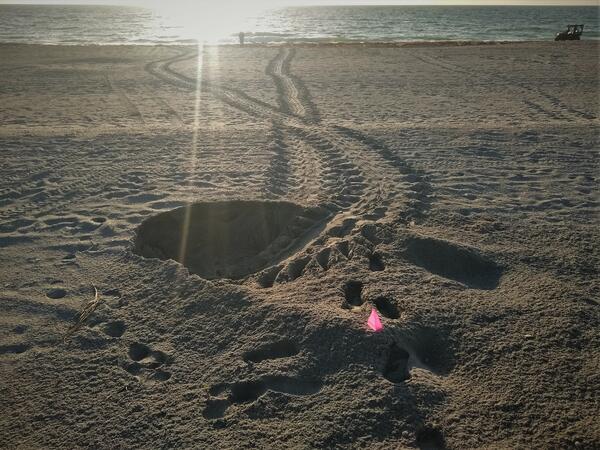
For sea turtles, a gently sloping, minimally disturbed sandy beach is essential habitat for laying eggs and giving the next generation a chance to survive. But rising sea levels, coastal erosion, and human development are putting pressure on nesting beaches around the world.
A new study focusing on nine of the world's most important sea turtle nesting sites finds that the vulnerability of these beaches varies considerably. By combining satellite imagery, computer models, and global wave and sea-level datasets, researchers at Delft University and USGS assessed how shorelines have changed since 1980 and projected how they could evolve through 2100 under various sea-level-rise scenarios.
The findings show that while some beaches are naturally gaining sand and expanding, others are eroding and have limited space to accommodate future changes. Three of the nine sites appear particularly vulnerable because they are experiencing erosion and have little room for nesting habitat to shift farther inland.
The research provides a framework for identifying beaches where conservation efforts may be most urgently needed as coastal conditions change.
Not all beaches respond to rising seas in the same way
Sea turtles depend on sandy beaches to dig nests and deposit their eggs. The availability and condition of suitable sandy nesting habitats are therefore closely tied to shoreline dynamics.
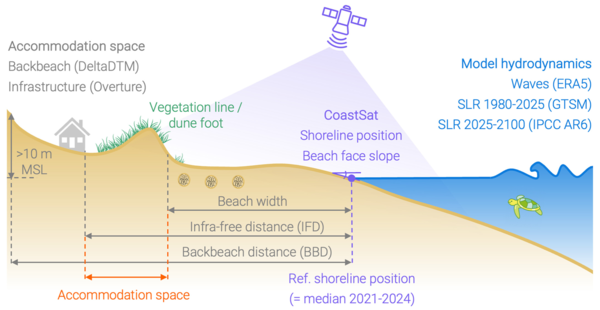
As sea levels rise, beaches may retreat inland, but the amount and direction of shoreline change depend on more than rising water levels alone. Waves, sediment movement, coastal topography, and human development all influence how beaches evolve.
To better understand these processes, researchers analyzed satellite-derived shoreline positions dating back to 1980 at nine major sea turtle nesting sites. They then used computer models and global data to project future shoreline changes through 2100 under different sea-level-rise scenarios.
The analysis revealed substantial differences among the study sites. Some beaches have experienced natural shoreline buildup, while others have steadily eroded. The differences demonstrate that rising sea levels do not affect all beaches uniformly; local shoreline trends and physical characteristics play an important role in determining how much suitable habitat may remain.
Limited space creates additional vulnerability
One of the study's most important findings is that a beach's vulnerability depends not only on how quickly its shoreline is retreating, but also on whether suitable habitat exists farther inland.
As beaches change, sea turtles may need available sandy areas farther inland to continue nesting. However, coastal development, steep terrain and other physical barriers can limit that movement.
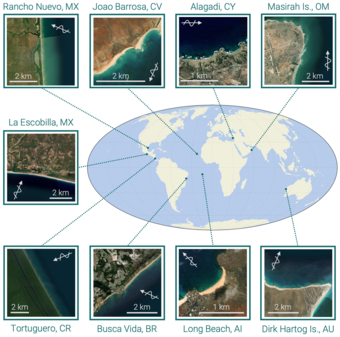
Researchers identified three particularly vulnerable nesting beaches (in Australia, Cyprus, and Ascension Island) where ongoing erosion coincides with limited room for nesting habitat to migrate inland. These locations could face increasing pressure as sea levels rise, potentially reducing the amount of suitable beach available for nesting.
The findings underscore the importance of considering both shoreline change and the availability of inland habitat when evaluating the long-term vulnerability of sea turtle nesting sites.
“Eroding beaches eventually threaten coastal infrastructure,” said Dr. Sean Vitousek, USGS Research Oceanographer and co-author of the study. “But anything living or nesting on the beach is in harm’s way much sooner than buildings. “[Lead author] Jakob Christiaanse’s study really shows this, with its focus on sea turtles which are obligate beach-nesters.”
Looking beyond simple sea-level projections
The study also highlights the limitations of using simple "bathtub" approaches to estimate the effects of sea-level rise. Bathtub methods typically identify areas that could be inundated by raising water levels across an unchanging landscape, but they do not fully account for the complex sediment-transport processes that shape beaches over time.
Beaches are dynamic systems. They can erode, accumulate sediment, and shift their position in response to changing environmental conditions. Understanding those processes is essential for accurately assessing how much nesting habitat may remain in the future.
By combining decades of satellite observations with computer modeling and information about local terrain and development, the researchers developed a more comprehensive approach to evaluating nesting-beach vulnerability.
Informing sea turtle conservation worldwide
The results provide valuable information for conservation organizations and coastal managers working to protect sea turtle nesting habitat. Identifying beaches that are both eroding and constrained by development or terrain can help direct limited conservation resources toward locations facing the greatest challenges.
Because of the wide availability of historical satellite imagery, the approach also offers a way to evaluate nesting beaches in other parts of the world, helping researchers and managers identify where habitat protection, coastal planning, and restoration efforts may be most beneficial.
Read the study, Vulnerability of Key Sea Turtle Nesting Beaches to Future Erosion and Sea Level Rise, in Earth’s Future.
Related

Remote Sensing Coastal Change
Related