



Environmental Toxicology
Environmental Toxicology
Filter Total Items: 77

Per-and Polyfluoroalkyl Substances (PFAS) Integrated Science Team
Increasing scientific and public awareness of the widespread distribution of per- and poly-fluoroalkyl substances (PFAS) in U.S. drinking-water supplies, aquatic and terrestrial ecosystems, wildlife, and humans has raised many public health and resource management questions that U.S. Geological Survey's (USGS) science can inform. The USGS Environmental Health Program's PFAS Integrated Science Team...

PFAS Transport, Exposure, and Effects
The team is determining the movement and behavior of per- and poly-fluoroalkyl substances (PFAS) from their sources in the environment, as they move through exposure pathways in ecosystems including watersheds and aquifers, their incorporation into food webs, and molecular to population scale effects on fish and wildlife. These studies are accomplished at a variety of spatial scales from regional...

Ecologically-Driven Exposure Pathways Science Team
The Ecologically-Driven Exposure Pathways Integrated Science Team identifies how ecological pathways and physiological processes within a single organism can alter exposure and toxicity of contaminants and pathogens and seek to understand outcomes at different scales from individuals to populations and ecosystems.
Do Trace Metal Concentrations in the Upper Columbia River Affect Early Life Stage White Sturgeon?
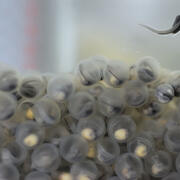
To understand if contaminants are associated with white sturgeon population declines, U.S. Geological Survey scientists reviewed the life history, physiology, and behavior of white sturgeon, along with recent toxicological studies and existing trace metal data for locations in the Columbia River. The analysis indicated that the highest concentrations of copper and other metals in the Columbia...

Ecotoxicology and Ecological Risks of Per‐ and Polyfluoroalkyl Substances
Ecotoxicology and ecological risks of per- and polyfluoroalkyl substances are summarized to highlight critical gaps and uncertainties, and to provide potential approaches to fill those gaps, including the development of targeted monitoring programs and cross-disciplinary approaches.

Scientists Provide an Understanding of Anticoagulant Rodenticide Exposure in Non-Target Bird Species
U.S. Geological Survey scientists and their partners utilize laboratory and field studies and existing information to improve understanding of anticoagulant rodenticide exposure and effects to wild birds.

Nationwide Occurrence
A National-scale approach is used to examine and analyze per- and polyfluoroalkyl substances (PFAS) prevalence and magnitude in watersheds and aquifers. As an initial step to fill known science gaps in the understanding of human and wildlife exposure, the team will provide a snapshot of PFAS in drinking water paired with bioaccumulation in fish and wildlife near known or suspected sources of...

Advanced PFAS Measurement Methods
Environmental Health Program scientists, in collaboration with other USGS scientists, are developing complementary field and laboratory methods and capabilities to detect and quantify a range of target and nontarget per- and polyfluoroalkyl substances (PFAS) and indicator compounds at low levels (parts per trillion) in a variety of environmental matrices. The PFAS Integrated Science Team is...
Clothianidin Exposure Associated with Changes in Tadpole Behavior
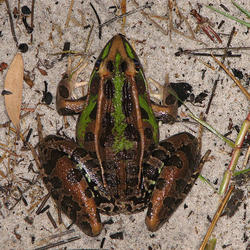
During a laboratory exposure study, tadpole movement decreased with increased concentrations of clothianidin, a neonicotinoid pesticide. Decreased movement could affect a tadpole’s ability to forage, escape predation, and metamorphose before ponds dry.

Wetland Management Technique Designed to Reduce Mercury in Water and Fish Tested During a Short-Term Field Study
Results from a 3-year study indicate there was support for the use of open- and deep-water treatment pools at the downstream end of seasonal wetlands to reduce methylmercury concentrations in water exported from the wetlands, but the treatment had no measurable effect on wetland fish. Questions remain about the long-term potential for mercury removal using this wetland management strategy.

U.S. Geological Survey Microbiologist Selected as an American Society for Microbiology Distinguished Lecturer
Dale Warren Griffin, a U.S. Geological Survey (USGS) environmental public-health microbiologist, was selected as a Waksman Foundation Distinguished Lecturer for the 2020–22 American Society for Microbiology (ASM) Lecture Series.

Framework for Examining Stream Ecosystem Health in Areas of Shale Gas Development—A Multi-Parameter Watershed-Based Case Study in Pennsylvania
In a case study of 25 headwater streams in Pennsylvania, no statistically significant associations were determined between shale gas development and geochemical tracers of produced waters or measures of microbial and macroinvertebrate community composition. Although the results are specific to the region studied, the integrated biological and geochemical framework provides a tool for examining...